REVIEW · 2019-10-22
Tangle Tower
Lire les avis Steam d'un polar dessiné à la main, adoré pour ses personnages et discuté pour sa fin
First Impressions
A painter's daughter, Freya Fellow, is found murdered in a strange tower — and the prime suspect is a painting. That's the opening of this first-person detective adventure, shipped in 2019 by the UK studio SFB Games as a follow-up to its own Detective Grimoire. I write this from the Steam review pool: English reviews are 'Overwhelmingly Positive,' 95% of 2,682; ~5,800 across all languages, and 87% of 47 in the last 30 days (snapshot 2026-07-21). Metacritic 82.
Line up the helpful reviews and the praise converges on one place: the hand-drawn art, the fluid animation, and the fully voiced cast. 'Phenomenal voice acting,' 'brings it to life,' recur; Rock Paper Shotgun went so far as to call it more appealing to eye and ear than Capcom's Ace Attorney. What the positives love first is the feel of interrogating a web of peculiar suspects.
The negative side and the qualified positives keep returning to two things. The ending — 'the culprit appears from nowhere,' 'an exposition dump,' 'impossible to deduce yourself.' And the puzzles — 'trivially easy' and 'moon logic' said of the same game. My job isn't to stage that as a fight but to translate where the split happens into design terms.
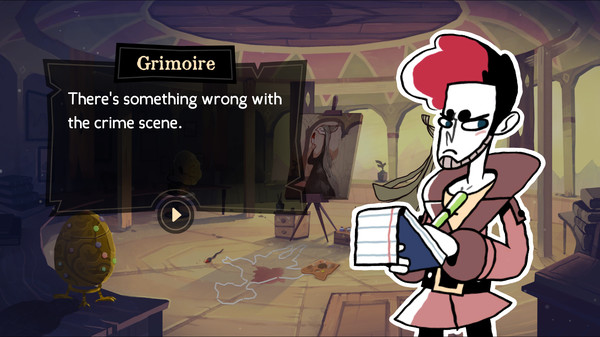 Tangle Tower — Steam store key art
The Feel of the Story
What reviewers praise first is the ensemble that carries the story: fully voiced suspects who live through expression and gesture, witty and often funny dialogue. One reviewer says they spent most of their playtime just admiring the art; another notes the characters are ordinary alone but come alive in their relationships. The developer's 'interrogate peculiar suspects' matches the pool here.
Yet many of the same reviewers stop at the ending. 'The culprit starts confessing out of nowhere,' 'a double twist, both abrupt,' 'great atmosphere, no narrative build-up.' Even a recommending review warns 'the ending nearly ruins it — buy it on sale.' One negative frames it against Ace Attorney: there the culprit is obvious but gives you a foothold to work back from; here you're rushed to a solution with no foothold.
In Puzzlebyrinth's terms, a whodunnit is a promise of fair play: the clues you gather form a grammar, and reading it should reach the culprit. Tangle Tower keeps that contract for most of its run — which is why the late reveal, arriving from outside the taught grammar, stings so much. Return of the Obra Dinn and The Case of the Golden Idol made that one thing — the answer living inside the grammar — their whole discipline.
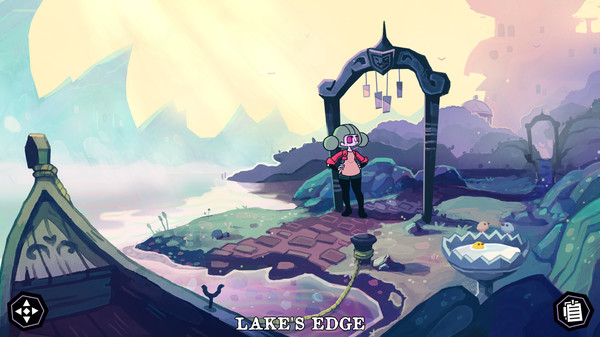 Tangle Tower — Steam hero capsule key art
Putting the Mechanics into Words
The loop reviewers describe: search the mansion for clues, pair two of them to produce a 'question' for a suspect, present evidence to expose contradictions, and solve standalone lock-and-cipher puzzles in between. True to the 'point & click' and 'dialogue heavy' tags, most of the time goes to talking and looking.
The central verb here is matching — pair two observations to yield one new fact. It's deduction-as-pairing, like Obra Dinn's 'match a face to a fate.' But Tangle Tower weaves its grammar over conversation, not space, so the tempo is less board-staring puzzle than a shuttle back and forth between characters.
Opinion splits where a second grammar — the standalone puzzles — is grafted onto the conversational one. One camp calls them clever and rewarding; another, padding that stops the story, or moon logic. The two grammars don't share rules, so whoever rides one gets thrown by the other. Much of the positive/negative split lives at that seam.
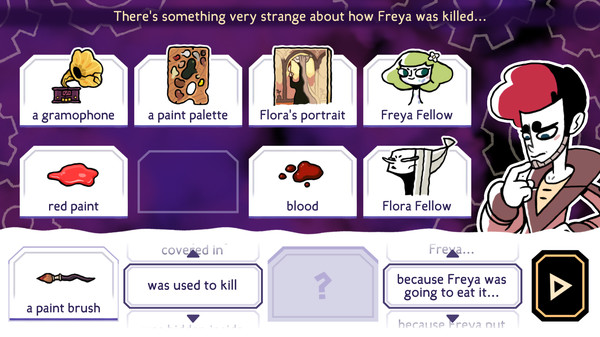 Tangle Tower — Steam store screenshot
Place in the Lineage
The external title that appears most in the reviews is Ace Attorney; next, Disco Elysium, cited as a mystery whose culprit you can't deduce. And Tangle Tower is itself the sequel to SFB Games' own Detective Grimoire. Reviewers are quietly drawing a family tree for where it belongs.
I'd sort detective games into two schools. One is theatrical: an authored reveal, culprit mostly visible, the pleasure in the performance of cornering them — Ace Attorney. The other is fair-play: you deduce from clues, the answer on your side — Golden Idol, Her Story. Tangle Tower wanted the charm of the first and the logic of the second at once. The ending complaint is the sound of those two goals colliding.
That placement explains the split. As theatre it's a high achievement — cast and performance are first-rate, which is why 95% recommend it. As fair-play it lets the answer escape out of reach at the climax. The same game reads as a gem or a letdown depending on which school's ruler you hold up. It's the fate hybrids like Murder by Numbers carry.
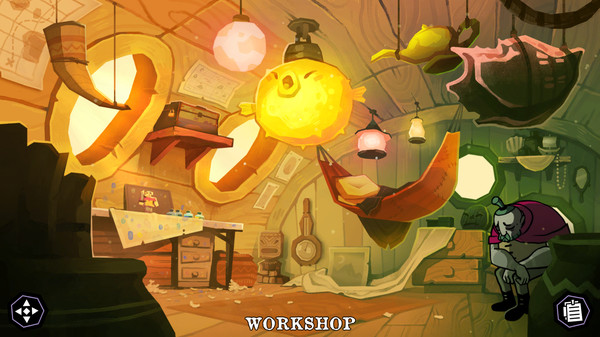 Tangle Tower — Steam library hero art
The Texture of Difficulty
Difficulty splits cleanly into two peaks. On one side, 'the puzzles are trivial,' 'no challenge'; on the other, 'moon logic,' 'I don't know what I did to reach that conclusion.' The very first forced puzzle being 'moon logic straight away' is a named gripe across several reviews — a signature sticking point.
Sorting the negatives and qualified positives, the friction is three kinds: padding puzzles that ask for no thought; a few opaque puzzles whose rule is never taught (moon logic); and the un-fair-play ending covered above — a matter of fairness, not depth. Most complaints say not 'too hard' but 'the wrong kind of hard.'
In Puzzlebyrinth's terms this is learning-curve design: mostly flat, with the occasional untaught spike, and at the summit — the reveal — the grammar you'd built no longer applies. The spikes aren't brutal; they're just untaught. Difficulty splitting readers happened with Her Story too — less a flaw than a question of design range: who is this for?
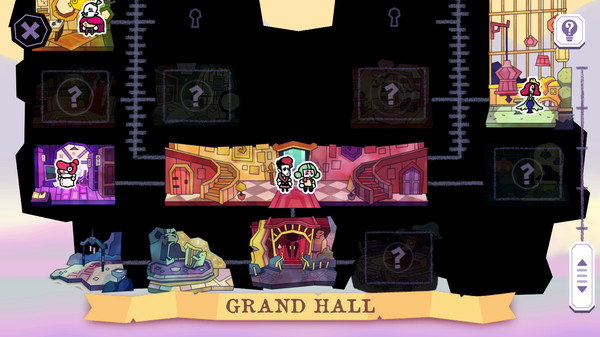 Tangle Tower — Steam library capsule
Sources
This piece was written by reading the user reviews on the Steam store page as of 2026-07-21. No review text is quoted directly; typical claims are reconstructed.
- Steam: Tangle Tower (Overwhelmingly Positive, 95% of 2,682 English reviews; ~5,800 all-language reviews, Very Positive)
- Read via WebFetch: the Steam Community reviews (including recent and not-recommended ones); aggregate figures cross-checked on SteamDB and Steambase (~92% positive across all languages, 87% of 47 in the last 30 days)
- Press: Rock Paper Shotgun, plus Adventure Gamers, Buried Treasure (John Walker), and Metacritic 82
Closing
Steam reads 95% in English, ~92% across all languages; my design-critique score is 7.5, deliberately below Steam's number. The gap is explainable. As production — hand-drawn art, full voice, music, witty writing — the game is nearly faultless, and the 95% is applause for that. As detective design, the puzzles that fall into the seam between two grammars, and an ending that breaks fair play, take marks off.
What lingers after the pool isn't the 95% but how sharply the experience sorts by what you came for. Come to bathe in the cast, the art, the voices, and you'll almost certainly be satisfied — that's what the high score really is. Come as a fair-play solver wanting to draw the line from taught clues to the culprit, and the ending pulls the floor out. Expecting Obra Dinn's strict logic, you'll find this leans theatrical. The split isn't proof of a flaw but the reverse side of how far this detective story reached.
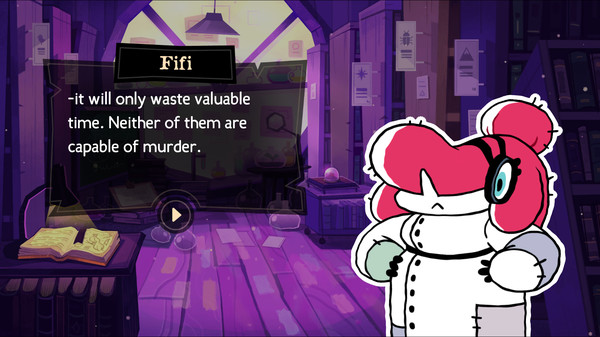 Tangle Tower — Steam store capsule key art
Where are you with this game?
Press one and the game goes on your shelf. You can see it on your account page.
Reactions (no login)
Anonymous • one of each per visitor per day
Read next

Related reviews
Phoenix Wright: Ace Attorney Trilogy
Une aventure judiciaire où l'on incarne l'avocat Phoenix Wright, confrontant une ligne de témoignage à une pièce à conviction pour faire tomber un mensonge. La compilation de Capcom réunit les quatorze épisodes des trois jeux parus entre 2001 et 2004, avec des graphismes redessinés image par image.
Trüberbrook
Une aventure pointer-et-cliquer dans laquelle Hans Tannhauser, physicien américain ayant gagné un voyage dans un village reculé d'Allemagne de l'Ouest en 1967, part à la recherche d'un article scientifique volé et se retrouve happé par une histoire d'une autre dimension. Réalisé par le studio allemand btf, avec des décors construits en véritables maquettes et photographiés.
The 7th Guest: 25th Anniversary Edition
Une aventure-puzzle à la première personne où six invités arrivent dans un manoir désert et doivent résoudre vingt-et-un dispositifs, un par pièce. C'est la réédition MojoTouch de 2019 du jeu fondateur de Trilobyte sorti en 1993, qui montrait à l'époque tout ce qu'un CD-ROM pouvait contenir, avec ses acteurs filmés et ses décors pré-rendus.


