TAG
#player-experience
0 篇评论 · 12 篇随笔
相关随笔
Guo et al.: humans drifted off the greedy move within about ten games; self-evolving AI did not — Fukai Reads
A preprint by Yingying Guo and four co-authors (arXiv:2608.07490, not peer-reviewed). They propose a way to measure how repeated play changes the way humans and language agents choose moves. Thirty-two students played 709 games across three board games, and four self-evolving language agents were run through the same metric space. Humans mostly shifted from the locally greedy move toward more global play: on the game-specific behavioral metrics, 11 of 12, 10 of 11 and 8 of 9 participants improved. The agents' gains were short-lived. The authors write that the central limitation is not the absence of reflection but the failure to convert reflection into reusable changes in behavior.
Li et al.: the AI that showed up uninvited was closed by five players out of ten — Fukai Reads
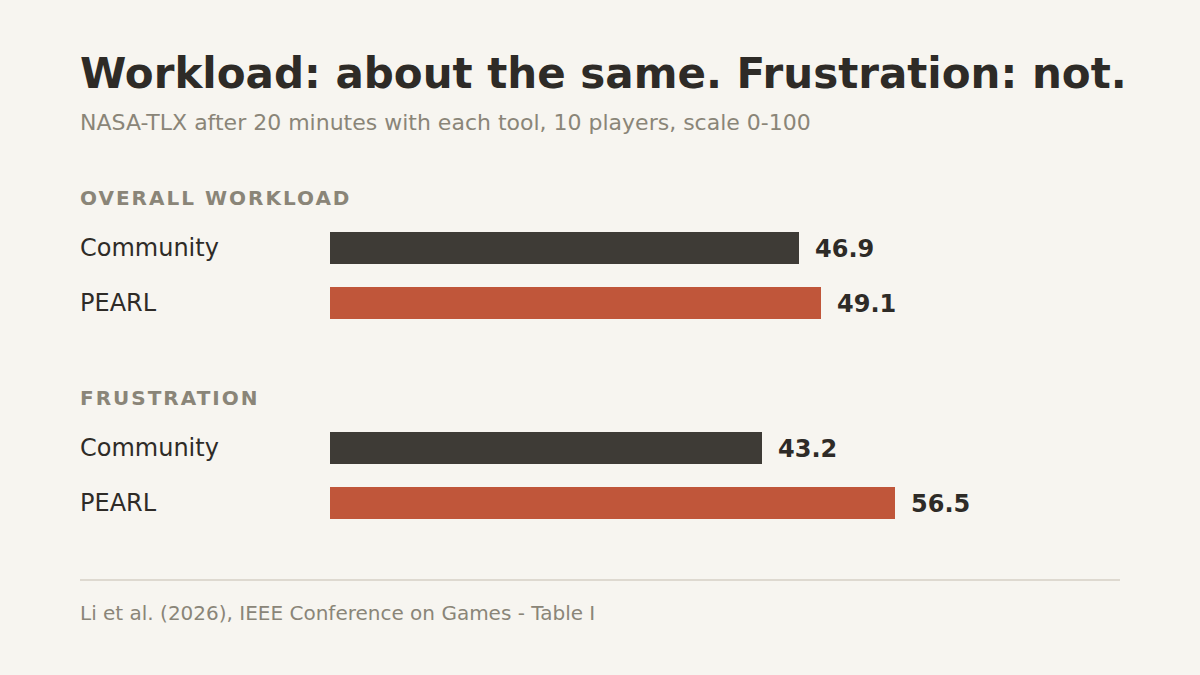
A peer-reviewed paper by Jiahong Li and eight co-authors (accepted to the 2026 IEEE Conference on Games, arXiv:2609.13718). They built PEARL, an AI support agent that retrieves expert-annotated move explanations and structurally similar peer boards, into Parallel, a puzzle game for learning parallel programming, and evaluated it with ten players. Participants rated the existing visualization tool more useful, and at least five minimized or abandoned the AI during play. Frustration scored 43.2 against 56.5. The authors conclude that what players rejected was not the content of the help but its unsolicited delivery, and ask of their own system: are we building Clippy?
"Getting It Wrong Isn't the Punishment" — 20 Puzzle Developers on Redesigning Failure
One piece today: "Designed to Fail: Puzzle Game Developers' Perspectives on Designing Challenge and Failure" by Craig G. Anderson (University of Utah) and Nasim Eshgarf, Zack Carpenter, David DeLiema (University of Minnesota), published in the FDG 2026 proceedings. Based on semi-structured interviews with 20 professional puzzle game developers, the paper shows that developers reframe "failure" away from wrong answers or performance and toward complete player disengagement — which they treat as a failure of the design, not the player. Trial and error and wrong guesses are viewed as an intentional learning mechanism that encourages experimentation and nudges players toward solutions. ACM's download page returned a 403 error for me, so this summary is based on the authors' published abstract, cross-checked across academic databases.
Hu et al.: We Judge Others' Satisfaction Without Counting Their Options — Fukai Reads
A peer-reviewed paper by Beidi Hu, Alice Moon and Eric VanEpps in Psychological Science (January 2026). Across six preregistered experiments with 10,092 participants, people factored choice set size into their own satisfaction but barely factored it into predictions of someone else's. Three things shrink the neglect: showing the different set sizes side by side, asking for a ranking, and restating the number of options. It bears directly on how we read playtests and pick rates.
Pfau & Vrettis:让玩家做出专属自己的宝可梦卡牌会怎样——Fukai 解读
由 Johannes Pfau 与 Panagiotis Vrettis(乌得勒支大学)撰写的 arXiv 预印本(尚未经过同行评审)。玩家写下名字和设定后,系统通过检索、文本模型与图像模型,在约20秒内生成一张宝可梦风格的卡牌;研究让49名学生共制作了196张卡牌。外观满意度在5分制中为4.25分,技能与数值的贴合度为4.04分。93.5%的人回答「这是我自己的想法」。不过,生成的卡牌至今尚未投入过任何对战,平衡性尚未经过验证。
Lu et al.:产生心流的是「难度」还是「投入的努力」?——Fukai 解读
Hairong Lu 等人关于心流与心理努力的同行评审论文(Psychological Research, 2025)。在视觉辨别任务中分别操纵「难度」与「感觉能解开的把握」后发现,难度操纵的效应很强(ηp²=0.64),而期望操纵只在试次层面呈现出微弱效应(d=0.04);心流随难度呈倒 U 形的结果处于临界值(p=0.053),P300 则与心流无关。这是一项 N=37 的探索性研究。
Teo et al.: AI Assistants Overassist — Int-Bench Measures Intervention in Problem-Solving — Fukai Reads
Teo et al. on LLM intervention behavior. Using Int-Bench, a simulated setting, they measure when and how much AI assistants help during problem-solving, finding AI intervenes earlier and more often than humans, tends to leak the answer, and does not improve transfer. A useful read for puzzle hint design.
Hsu et al.: LLM-Voiced NPCs Make Players' Heads Heavier -- A 'Double-Edged Sword' Experiment — Fukai Reads
An empirical LLM-NPC paper by Hsu et al. (Communication University of China and others). They built a scripted-NPC version and a GPT-4.1 LLM-NPC version of the same game and ran a between-subjects test with 130 players. LLM-NPCs significantly raised cognitive load (p<.001), did not significantly improve overall enjoyment (p=.195), and increased autonomy while lowering usability and trust.
Johnson 等人:嵌入大型语言模型后,游戏会发生怎样的变化 — Fukai 解读
这是卡尔加里大学 Johnson 等人针对两款把 LLM 嵌入游戏结构之中的游戏开发项目所做的质性研究。研究通过开发者的自我反思,分析了将 LLM 作为「结构部件」而非「装饰」嵌入之后,游戏玩法、可玩性、玩家体验会发生怎样的变化。报告指出,变化性与个人化随之增加,同时也带来了正确性、难度校准、一致性等新的负担,而模式(schema)强制与验证则成为关键。
Shyne et al.: How Far Do Puzzle Solver Loops Match Human Felt Difficulty — Fukai Reads
A logic-grid-puzzle difficulty study by Shyne, Facey & Cooper. Using solver loops (the pass count of a human-style solver) as a difficulty proxy, they generate difficulty-varied puzzles with a quality-diversity algorithm and, in a 63-player study, show solver loops correlate significantly with subjective difficulty (c=0.30, p=0.015).
Bazzaz 等人:「只是认为是 AI 制作」就会改变体验——Fukai 精读
Bazzaz 与 Cooper 的 CHI '26 论文,探讨生成内容的知觉偏见。让 142 人在 Super Mario Bros. 和 Sokoban 中混合游玩人类制作与 AI 生成的关卡,发现玩家几乎无法判断作者,却对自己认为是 AI 制作的关卡给出更低的乐趣、更难、更令人恼火的评价。
Sun 等人:为何玩家沉迷于惩罚性高难游戏?——Fukai 精读
Sun 等人关于 Soulslike 游戏难度设计的论文。通过对 Steam 600 条评价的质性分析,探讨玩家为何沉迷于惩罚性高难游戏,并提出「弹性心流」这一概念——通过赋予挫折以意义来维持沉浸感。