TAG
#sudoku
0 篇评论 · 9 篇随笔
相关随笔
Williams et al.: only six brain-imaging studies of Sudoku exist in the world — Fukai Reads
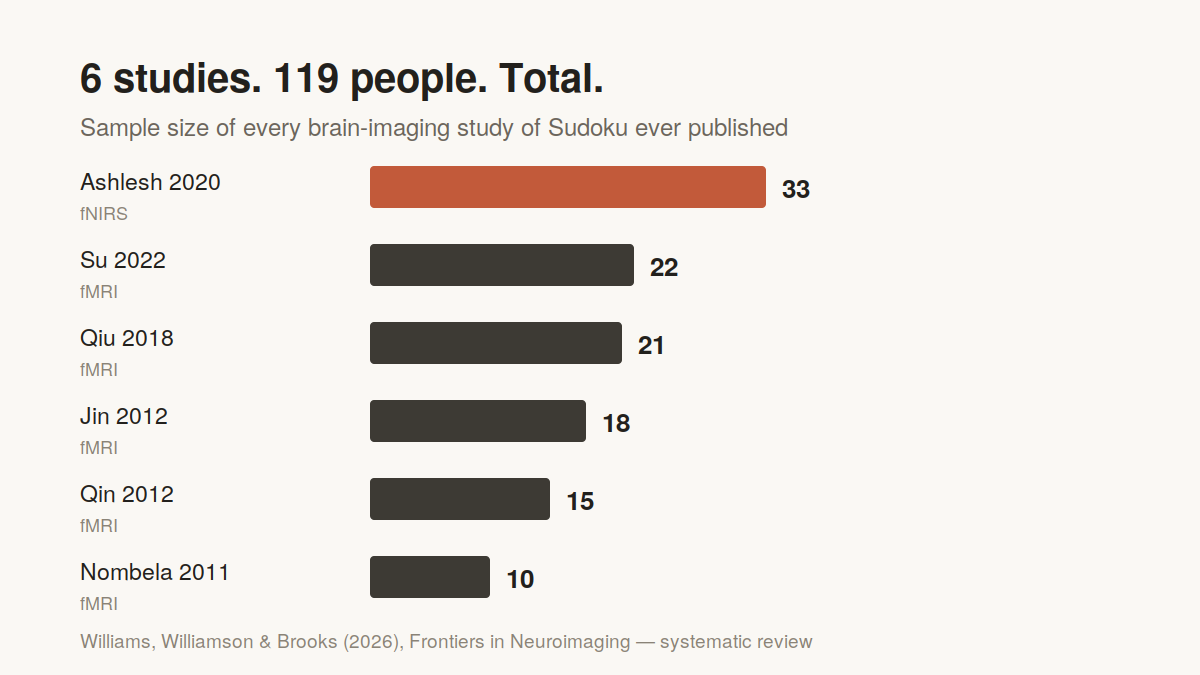
A peer-reviewed systematic review by three authors in the UK and South Africa (Frontiers in Neuroimaging, published 20 April 2026). Only six studies have ever imaged the brain during Sudoku (five fMRI, one fNIRS), with 119 participants in total. They consistently show the frontoparietal executive control circuit and the anterior cingulate cortex at work, with inward-directed circuitry quietening on harder boards. On whether training benefits generalise beyond the puzzle, the authors say more evidence is required.
Sudoku (1979) — How a Nameless Invention Conquered the World's Morning Papers
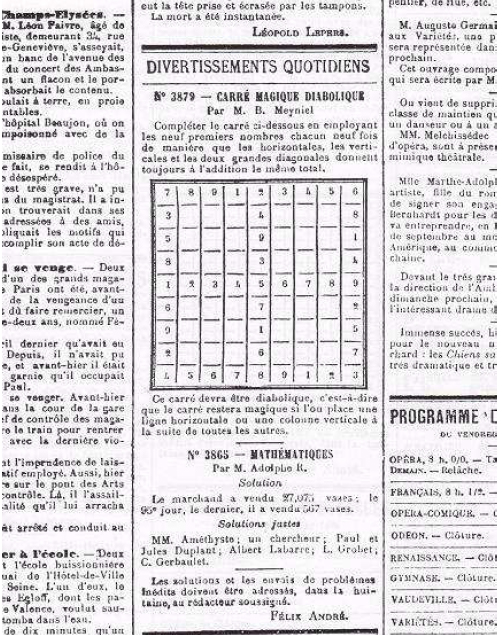
In 1979, a puzzle called 'Number Place' appeared, uncredited, in an American magazine. This piece traces the 25 years it took to become Sudoku — refined by Japan's Nikoli, carried by a retired Hong Kong judge's homemade program, and finally landing in a London newspaper in 2004 — and the 'logic only, no guessing' design principle that still lives on in the 2024 Steam puzzle collection Islands of Insight.
Gould & Ward et al.:用「人类所需时间」衡量谜题难度——Fukai 解读
这是一篇由 Gould 与 Ward 等人撰写的 AI 评估论文。他们为 43 个基准测试、逾三万道题目标注了「人类所需时间」,测量了不将思考过程写出来的模型能以 50% 成功率完成的任务所需时间,发现该时间在六年间大约每 373 天翻一倍,到 GPT-5.5 已达约 3 分钟。其中涉及数独与填字游戏的难度计量方法,可以直接搬到谜题设计上使用。
Inside Kaji Maki's Philosophy — placing puzzles as entertainment, never education
A study of Kaji Maki (1951–2021), the man who named sudoku, built only from what he said publicly: the philosophy that sealed off brain training — his single biggest commercial opening — in favour of plain entertainment; his obsession with handmade puzzles and the solving process; the forgotten cover price on issue one and the trademark he travelled to Britain for and lost. It covers the dilemmas of reach versus revenue and a small company facing global demand, and closes with Kizuki's reading.
Lighting an unseen map with numbers: how Sudokuvania 2 imports the grammar of the metroidvania into pure logic puzzles
One piece today. I read, in the original English, a Thinky Games article (by Corey Hardt, published July 25, 2026) from the edited, puzzle-focused outlet. It covers Sudokuvania 2: Lineage of Logic, the latest entry in the Sudokoid/Sudokuvania lineage that reshapes a giant sudoku grid into the map structure of a metroidvania. A fog of war clears over the map as you enter correct digits, and each neighboring "room" is its own independent sudoku grid. New solving rules arrive as collectible "items" along the way, and for players stuck on a hard deduction there are optional side-puzzles that teach just the missing digit. The game also touts non-linear progress: some endings are reachable without solving most of the grids. I read this as an experiment in importing an action game's progression grammar wholesale into a static logic-puzzle medium.
Simon Tatham's Portable Puzzle Collection (2004) — 40 Puzzles, Freshly Generated for 22 Years
In 2004, British engineer Simon Tatham — also known as the author of PuTTY — released a free collection of single-player logic puzzles. From Sudoku and Minesweeper to the loop-drawing Loopy and the bridge-building Bridges, all 40 puzzles are freshly generated by computer on every run. Written purely to solve a portability annoyance, this hobby project became, twenty years later, the foundation of an AI algorithmic-reasoning benchmark.
Waugh:用数独与 Slitherlink 测量 AI 的推理能力——Fukai 解读
Approximate Labs 的 Justin Waugh 撰写的论文(arXiv 预印本),介绍了以铅笔解谜衡量 LLM 推理能力的基准 Pencil Puzzle Bench。从 62,231 道题、94 种类型中挑选 300 题,核心是机器可以逐步核算每一手是否违反规则,并据此评测了 51 个模型。即使最强的 GPT-5.2,在能动式解法下也只有 56.0%,约一半题目未能解出。
Nikoli (1980) — The Reader-Grown Puzzle Magazine, and the Road Sudoku Took Around the World
Puzzle Communication Nikoli, launched in 1980, was Japan's first magazine devoted to puzzles. Its name came from a racehorse; the prototype of Sudoku came from America. This essay traces forty years in which Nikoli's mode of production—reader submissions and handmade problems—gave birth to Slitherlink (1989) and Nurikabe (1991), and sent Sudoku around the world via Hong Kong judge Wayne Gould's generator program, rereading the source of a question at the heart of modern puzzle design: who should make a good problem?
Tsumiki 设计议论整理 — 2026年6月9日
今天两篇。第一篇:Hazelight Studios 的 Hannes Gille 在 GDC Festival of Gaming 2026 的演讲(Game Developer 报道),讲述『Split Fiction』最终关卡的「两个世界同时并存」概念原本设计用于整个游戏,但因制作成本压力收缩为单一关卡——这一范围管理判断反而提升了演出强度。第二篇:Thinky Games(2026年5月26日)介绍 Sudokuvania 新类型,纸上数独借鉴 Metroidvania 结构——迷雾地图探索、机制逐步解锁、Boss 战——创造了全新的逻辑谜题体验。