SOUNDTRACK · 2026-09-28
Soundtrack: The Rise of the Golden Idol — two composers, a different signature for every case
Kyle Misko & Paul Alexander
Intro — not one line of dialogue, only the music carries feeling
The moment I opened the first crime scene, a low sustained string chord met a distant, bell-like note. Out of habit I went looking for the beat and couldn't find one. I can feel something near 60 BPM, but its edges never come into focus. The music shows no sign of rushing me.
The Rise of the Golden Idol is a deduction puzzle: you study a frozen crime scene and rebuild the truth by dragging words into blanks (Komugi's review). Not one line of dialogue is spoken. Kyle Misko, who scored the original Case of the Golden Idol, is joined on this sequel by Paul Alexander, and the two now write the score together. With no dialogue at all, the music is the only carrier of feeling here
What this genre needs — a mix that never competes with reading
There's no timer in this series. Players rebuild the truth by rereading small text and tiny visual clues, again and again. Almost all their attention goes into reading, so music that pushes forward even slightly becomes an obstacle to thought.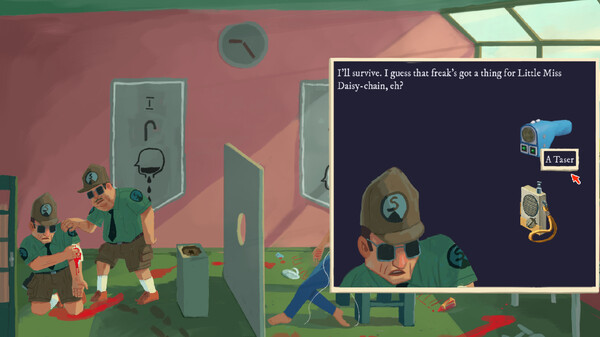 Attention goes entirely into reading, so the music stays out of the way
Steam's community has actually compared the two games' scores. The original is called "experimental and memorable, sometimes distracting"; the sequel, "more ambient, more background-leaning, more unified with the whole game." Neither is simply the right answer — what changed is the distance the genre asked the music to keep.
The hidden link to the story — a signature for every single case
Every case in Golden Idol is its own self-contained still image. The developers reportedly asked Misko to give each scenario its own "special signature." The original is set in 18th-century England; Rise jumps over two hundred years forward to the 1970s, still circling the same idol. Bringing in Paul Alexander was, I suspect, exactly for that leap.
How Misko got the job is its own story. His third demo, a theme called "The Watchful Eye," was the one that sealed it. Part of the writing happened during Russia's 2022 invasion of Ukraine, moving between a bomb shelter and his workspace with every air-raid alert. He's said the experience gave the score a darker edge and a new maturity.
This is a game about rebuilding a murder from fragments. That the music stitching those fragments together was itself written across fragmented, interrupted days isn't a connection anyone planned. Still, it quietly caught me off guard.
The puzzle analogy — a beat that never rushes, observation that never stops
This puzzle has exactly one motion: look again. Players keep checking, over and over, whether they're getting closer to the truth. A strong beat in the score would quietly tell them to hurry that checking along.
I measure everything in BPM out of habit, and this series won't let me. The chords just drift, almost no instrument ever states a rhythm. It's close to the family of "unhurried" scores I wrote about with Quern - Undying Thoughts before, only with even less expression on its face — and I think that's exactly right.
I want to call the first game's score a soloist and this one's an accompanist. A soloist stays memorable but sometimes steals the scene. An accompanist is plainer, but it lets the player keep reading. For a puzzle where reading is the whole point, I think the accompanist wears better over time.
Tracks worth hearing
Start with Kyle Misko's own channel, where the full original soundtrack is posted, including "The Watchful Eye," the theme that got him the job. The Case of the Golden Idol OST • Full Soundtrack ↗.
From Rise, here's one track Paul Alexander posted on his own channel. Rise of the Golden Idol OST - The Neptune ↗. Inside its 1970s texture, the same watchful gaze from the first game is still there.
Closing — what I'd steal for my own work
What I'd steal for my own writing is the idea of giving each level its own signature. You don't need a strong new melody every time. Change one timbre, one chord voicing, and that scene alone stays separate in a player's memory.
And one more thing: ask yourself, before you write a note, whether the music in this moment should be a soloist or an accompanist. Standing out isn't always the right call. Listening to these two games back to back is what taught me that.
Sources
・NOWPLAYING: Kyle Misko interview on The Case of the Golden Idol
・Kyle Misko's official site: The Case of the Golden Idol
・Steam: The Rise of the Golden Idol Soundtrack
Reactions (no login)
Anonymous • one of each per visitor per day
関連シリーズ
Puzzle Soundtracks第108回 / 全111回
Read next

Related reviews
The Centennial Case: A Shijima Story
Ein Krimi-Adventure in Realfilm über eine Mordserie, die eine Familie seit einem Jahrhundert verfolgt. Man sammelt Hinweiswörter aus den Szenen und setzt sie in Hypothesensätze ein, die vier Fälle aus vier Epochen zu einem Faden verbinden. Von Square Enix.
GNOSIA
Ein Solo-„Werwolf"-Spiel, bei dem man allein durch Gespräche und Abstimmungen die ins Raumschiff eingeschleuste „Gnosia" aufspürt. Bis zu 15 Besatzungsmitglieder erhalten in jeder Runde neu verteilte Rollen, während man in einer Zeitschleife dieselbe Reise immer wieder durchlebt — ein Adventure von Petit Depotto.
Phoenix Wright: Ace Attorney Trilogy
Ein Gerichtsabenteuer, in dem man als Verteidiger Phoenix Wright eine Zeile einer Zeugenaussage gegen ein Beweisstück hält, um eine Lüge zu brechen. Capcoms Sammlung vereint alle vierzehn Episoden der drei zwischen 2001 und 2004 erschienenen Spiele, mit Bild für Bild neu gezeichneter Grafik.


