ESSAY · 2026-10-04
Folding as a Verb: Turning a Sheet's Two Sides into Design Material (From Tengami to Paper Trail)
The same crease can hold spectacle, a point of contact between two people, or a circuit of keys and weights
Introduction
Fold a sheet of paper in half and the face you were just looking at disappears. The hidden side comes forward instead. What's visible and what's hidden swap places at the crease. A handful of puzzle games over the last decade have taken this simple physical fact and made it a verb, the way other games make a verb of walking, pushing, or rolling.
This site's mechanics glossary has no entry for "folding" yet; the population is still small. That's exactly what makes three games built around the same verb worth lining up side by side: the difference in where each one hides its answer becomes easy to see.
Three games today. Tengami (2014), a pop-up picture book where folding changes the stage. A Fold Apart (2020), where folding brings two distant people's worlds into contact. And Paper Trail (2024), where folding wires into keys and weights. Same verb, three very different places for the answer to live — part of the Single-Verb Design series.
Tengami — the fold as stagecraft, not as an answer
Tengami is a pop-up picture book set in old Japan. Trace a finger across the screen and paper buildings collapse, bridges unfold, trees spring upright. Nyamyam, its UK developer, clearly bet that this motion alone would be enough to carry the wonder.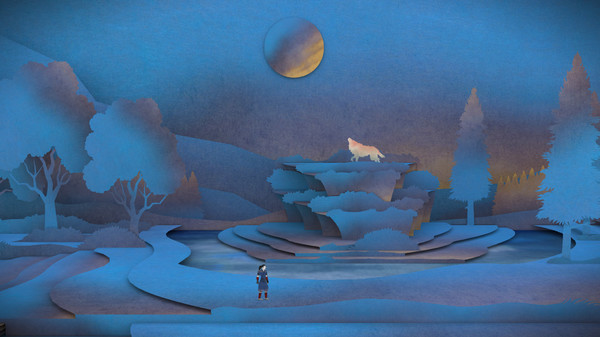 Tengami (via Steam store)
In practice, though, most folds just change the scenery; they rarely hide the puzzle's logic. Reviewers at the time called the puzzles that do use folding disappointingly simple, and the harder ones feel unrelated to the fold at all. The idea of a page with two sides never gets wired into what you actually have to figure out.
What I take from this is an old but easy-to-forget lesson: a beautiful verb is not a design by itself. However striking the fold looks, if there's no circuit underneath asking "what do you need to know to solve this," the verb stays scenery.
A Fold Apart — overlaying someone else's place on the back of the crease
A Fold Apart is a puzzle platformer about a long-distance relationship: him in the city, her in the countryside. Each world lives on one side of a single sheet, and you fold from the paper's edges and corners to reconnect their footing.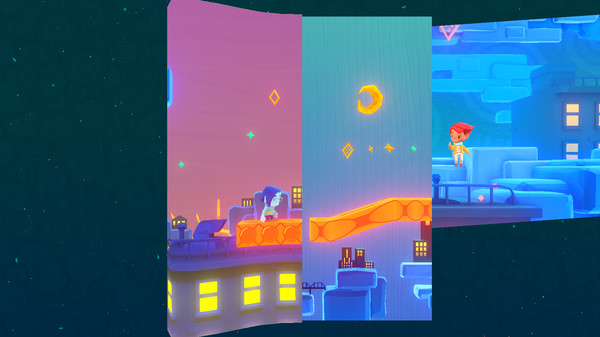 A Fold Apart (via Steam store)
Lightning Rod Games, its developer, staged the verb in steps. You start folding only the left and right edges; later the top and bottom, then the corners. Each fold rotates the screen and turns a path that was hidden on the back into solid ground.
Several reviews point at the same weakness, though: adding folding axes doesn't deepen what you're actually doing, which stays "bring the hidden path forward" again and again. Giving a verb more degrees of freedom is not the same as giving it more grammar.
Paper Trail — wiring the page's two sides into keys, weights, and circuits
Paper Trail (2024) treats each level as a genuine two-sided sheet. Fold it and elements from the back land on top of the front. An early puzzle type has you overlay dice from both sides to complete a bridge.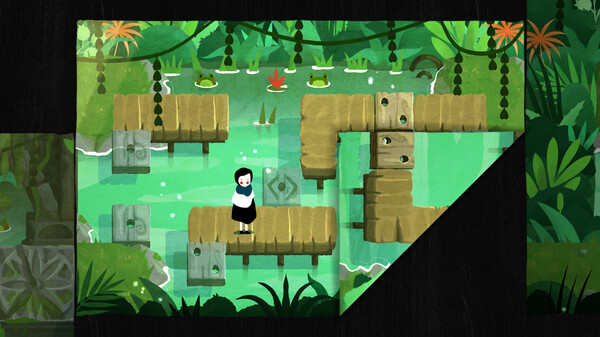 Paper Trail (via Steam store)
What sets it apart from the other two is that folding never stands alone. It gets wired into locked doors and keys, boulders that must land on switches, circles that complete a ritual. Overlapping the two sides is only step one; the result still has to satisfy another condition.
By the late levels, one sheet can carry several mini-pages, boulders, a key, and a door all at once. The payoff is real, but reviewers also describe later puzzles as overwhelming to track in your head — a reminder that combinatorial depth and combinatorial load arrive together.
Why does one word, "fold," hold its answer in such different places?
Pushing or rolling just moves an object from one spot to another. Folding is different: it lets one surface hold two states at once, front and back, before and after. Where a designer places the answer inside that doubling decides almost everything else.
Tengami spent the doubling entirely on the surprise of the scene-change itself. A Fold Apart spent it on the single instant where two separated worlds touch. I saw a related shape in the essay on overlaying images as a verb, though folding adds a further twist: the fold also rotates orientation, which makes it one notch more abstract.
Only Paper Trail turned that doubling into a component other systems could plug into — keys, weights, switches. As with flipping gravity, a verb only reaches real depth once it combines with other systems and the combinatorics start compounding. Folding, by itself, is not the answer. What it's wired to is.
Closing
Lining up all three, I land on a familiar conclusion from this verb-minimalism series: the same verb can mean the difference between night and day, depending on what it's combined with. Tengami's fold was probably the most beautiful of the three. But beauty and puzzle depth turn out to sit on different axes.
If I designed a folding puzzle next, I wouldn't make the crease itself the mystery. I'd design, before anything else, how the result of a fold connects to everything else on the page. No keys, no weights — just a single sheet: what would it take to get real combinatorial depth out of that alone? That's the question I want to carry into the next fold.
Reactions (no login)
Anonymous • one of each per visitor per day
Part of these series
Read next
Related reviews
Escape Goat
A 2D puzzle platformer in which a goat escapes a prison, collecting keys and opening doors with a mouse that fits small gaps and a magic hat that swaps their places. By MagicalTimeBean.
Mushroom 11
A 2D puzzle-platformer in which a green fungal mass is moved by erasing it: whatever you delete grows back somewhere else, so choosing what to cut is how you travel. Untame's descent through an emptied ruin, scored by The Future Sound of London.
BOKURA
A two-player-only co-op puzzle adventure about two runaway boys walking one road while seeing different worlds — a forest for one, a machine city for the other. Because neither player sees what the other sees, talking is the solution. By tokoronyori.


