HISTORY · 2026-10-07
Game of Life (1970) — A Grid with Two Rules Gained the Power to Compute
Conway's solitaire, Gardner's column, and the glider gun
Introduction — Two rules on a grid
This is a one-player pastime that reached the public in 1970. You fill squares on graph paper and advance the board in generations by a fixed rule. A filled square is a "living" cell.
Its creator was the British mathematician John Horton Conway. He called it "Life"; today it is known as the Game of Life.
The player's only job is to choose the starting pattern. After that, the rules move the board. There is no winning, and there are no points.
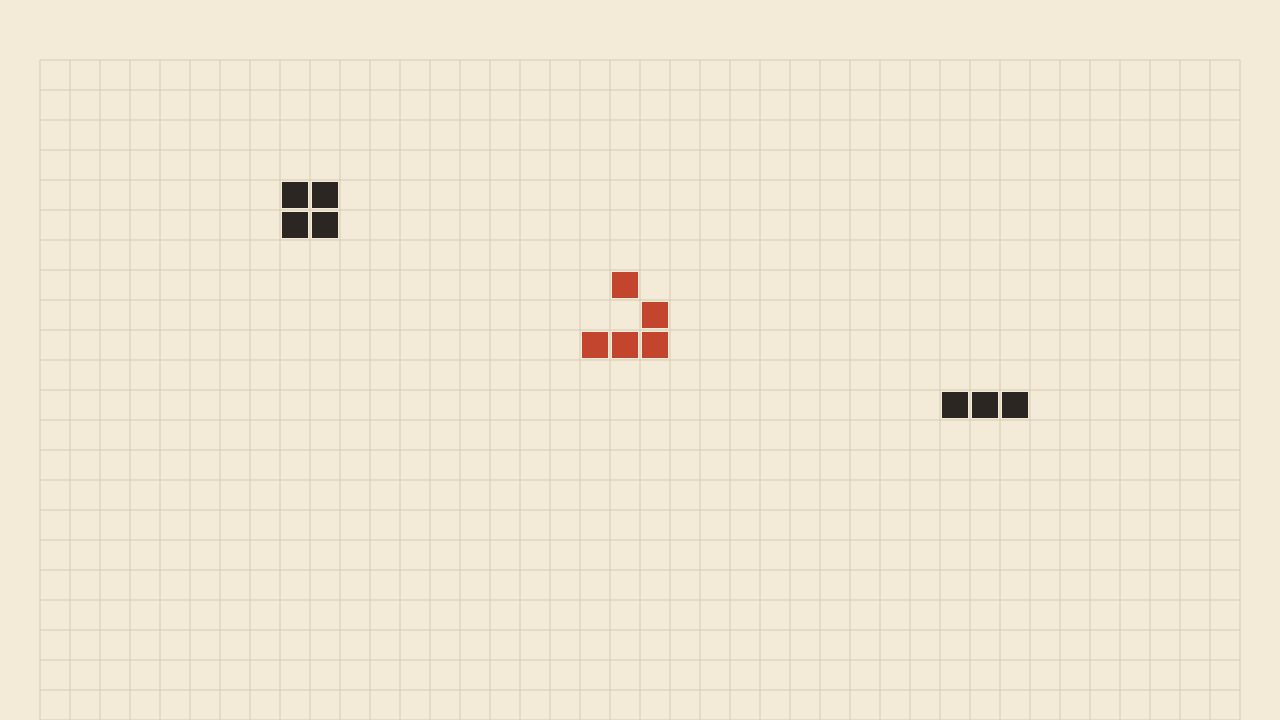 A five-cell shape moving across a grid (illustration, AI-generated)
Context — Gardner's column, October 1970
The game spread through the October 1970 issue of Scientific American. Martin Gardner's column "Mathematical Games" introduced Conway's new solitaire game, Life.
Gardner wrote the piece from conversations with Conway himself. The source is listed in the references.
Conway's aim is described as a simpler version of the idea of self-reproducing machines, which goes back to John von Neumann's work in the 1940s.
The timing helped. Affordable minicomputers were entering labs, and people ran Life in idle hours. It could be played with pencil and paper or on a machine, and that was its strength.
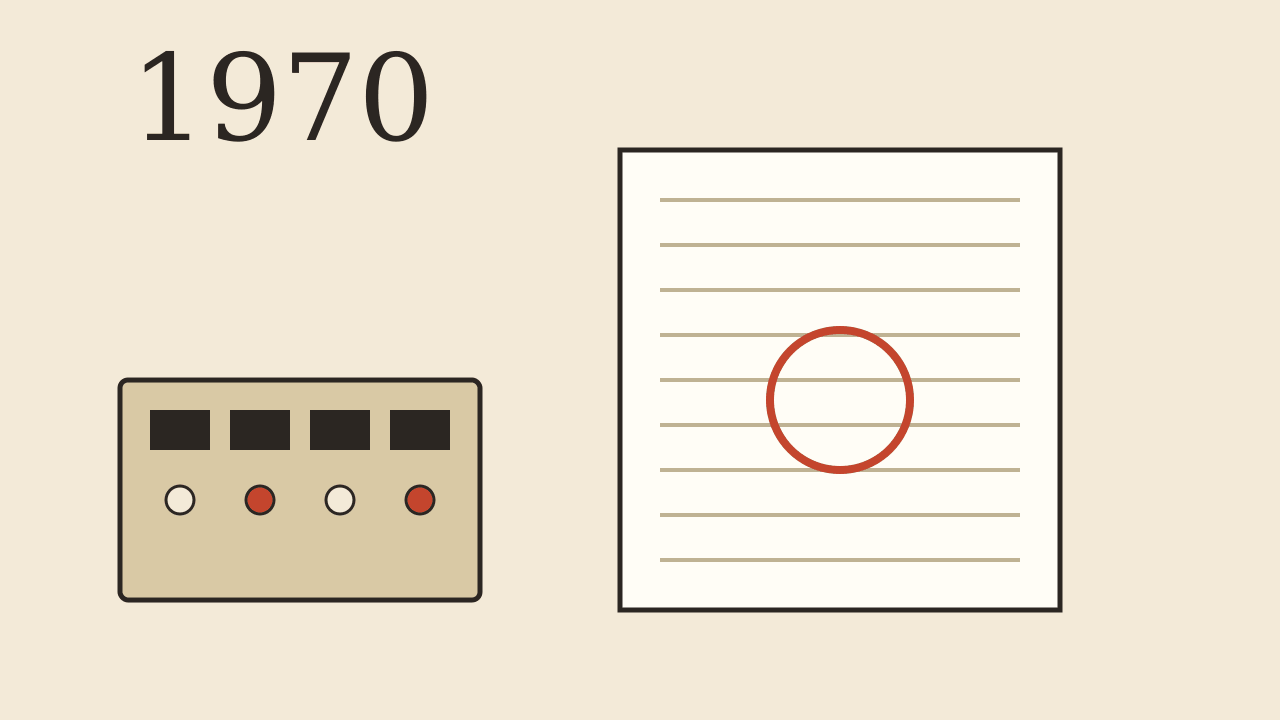 A small computer and graph paper, circa 1970 (illustration, AI-generated)
Mechanics — Three, two, and everything else
The rules are short. An empty cell is born in the next generation if exactly three of its eight neighbours are alive.
A living cell survives if two or three neighbours are alive. Otherwise it dies. The rule is written "B3/S23".
The board produces still shapes, blinking shapes and shapes that travel diagonally. The small travelling shape is called a glider, and it has only five cells.
Conway had at first conjectured that no finite starting pattern could grow without limit. A $50 prize was offered for disproving it.
In November 1970, a team at MIT led by Bill Gosper answered it: a pattern that fires a glider every 30 generations, the glider gun. The conjecture fell.
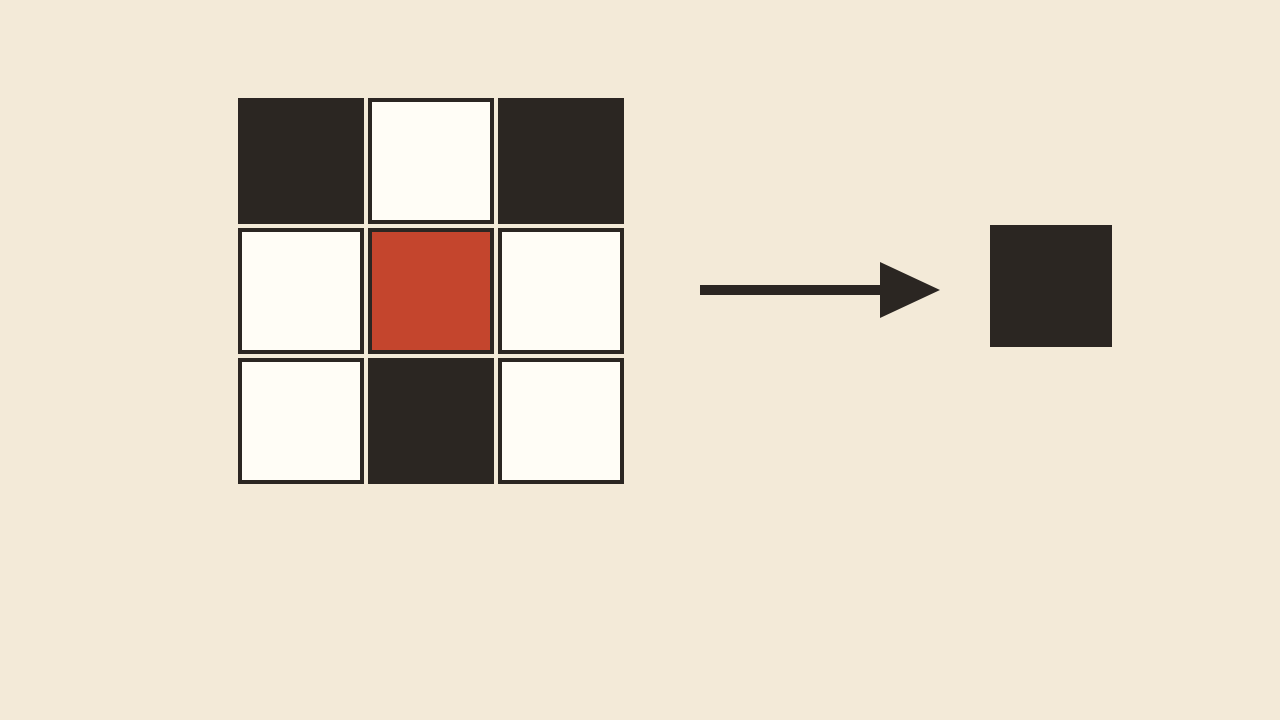 A centre cell and its eight neighbours (illustration, AI-generated)
Legacy — Simple rules with the power to compute
Life is said to have, in theory, the same power as a Turing machine. Anything an algorithm can compute can also be computed on this board.
In other words, you can build a computer inside a grid world with only two rules. Few examples show such complex behaviour from such simple rules.
The same thinking shows up in later puzzle design: a few rules, and the player discovers what can be built from them. Games like Baba Is You, where the rules themselves move, can be read in the same family.
That, however, is my own reading. I could not confirm any statement by Conway himself linking his game to those titles. It is more accurate to call them works standing on the same question than a lineage.
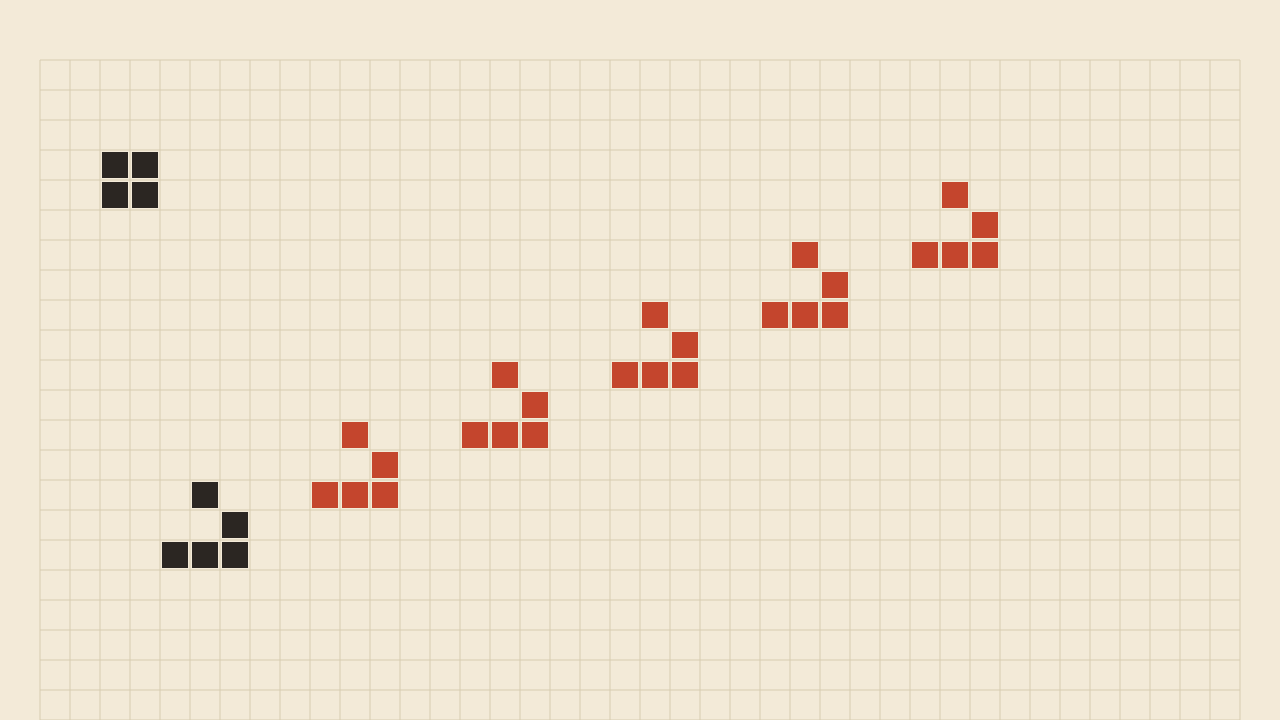 The same shape marching on, one after another (illustration, AI-generated)
References
Sources consulted for this article:
・LifeWiki: Conway's Game of Life
・Wikipedia: Conway's Game of Life
・Wikipedia: John Horton Conway
・Martin Gardner, "Mathematical Games: The fantastic combinations of John Conway's new solitaire game 'life'", Scientific American, October 1970 (confirmed via LifeWiki)
Closing — Why its author felt a little conflicted
What this work showed historically is that few rules and rich results can coexist.
Conway died on April 11, 2020, of complications from COVID-19. Published biographical accounts say he disliked being discussed mostly in terms of Life.
Even so, he is said to have remained proud of it. A world that starts from two rules still moves on someone's graph paper today.
 A small shape left in a quiet dusk (illustration, AI-generated)
Reactions (no login)
Anonymous • one of each per visitor per day
Part of these series
Puzzle Incident HistoryEpisode 54 of 54