PAPER-DIGEST · 2026-10-03
Engel et al.: When the right path through a maze flips, other people's footprints help people switch faster — Fukai Reads
Judgment and decision making — routinized rules and adapting to rule change
TL;DR
Have people solve 50 mazes while following the same shortcut rule. From maze 51 on, quietly swap the correct path to the other side. How long until they switch? A team at the Max Planck Institute for Research on Collective Goods in Bonn tested this with 288 people.
The answer is clear. Showing people the traces of another player made them switch faster. A paid "hint button" that revealed the rule did not produce a statistically significant difference, and only 55.21% of those who had the button ever pressed it. Also, people switched faster when the rule benefited themselves rather than a charity.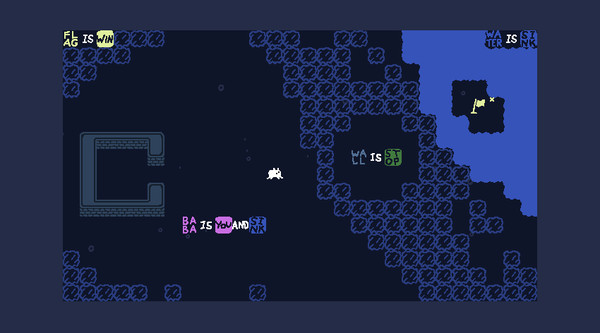 Baba Is You (Hempuli Oy, 2019). You push word blocks to rewrite the rules themselves, so the game constantly asks you to throw away what used to be the right answer. Image: Steam store page
Introduction — when the familiar answer stops being right
Today's paper is by Christoph Engel, Thomas Holzhausen and Dorothee Mischkowski: "Trapped in the past? Routinized rule compliance and the speed of adaptation after rule change."
All three are at the Max Planck Institute for Research on Collective Goods in Bonn; Holzhausen is also at the Karlsruhe Institute of Technology and Mischkowski at Leiden University. The paper appeared online on 21 September 2026 in Judgment and Decision Making, a peer-reviewed journal, under a CC-BY 4.0 open-access license.
The experiment was preregistered (the hypotheses and analysis plan were made public before data collection), and the data and materials are on OSF, an open research repository. Still, the paper is only about two weeks old and has not been replicated. I want to say that up front.
I chose it because the experimental tool is a maze, and the situation it studies — a rule that flips partway through — is something puzzle designers face all the time. Here it is measured under controlled conditions.
Background — routines are efficient but slow to change
From a rational-choice view (people compute costs and benefits each time they act), rule change is no problem: you simply recompute under the new rule.
But real people do not deliberate every time. As the authors put it, rules are picked up through experience and by watching others, then applied automatically whenever a situation looks similar enough. This "routinized rule following" helps coordination, because everyone behaves the same way.
The downside is that routines that were once adaptive can persist after the rule is updated. Which ways of learning help people escape faster? Does it matter who benefits from the rule? Few experiments had measured both at once. The Witness (Thekla, Inc., 2016). As you solve panels across the island, you internalize the rules for drawing lines almost by feel. Image: Steam store page
Approach — hidden traps and a shortcut that flips after 50 mazes
Participants move a ball square by square through a grid maze using the arrow keys, and earn more the fewer steps they take. Each maze has two paths, left and right, of roughly equal length.
What separates them are "trap" squares. They are invisible until stepped on and count as five steps instead of one. Each path has between one and eight traps, but one path always has fewer. The screen shows a rule such as "first take four steps up, then one step to the right." According to the authors, following the rule leads to the path with fewer traps — but the rule is not enforced. Following it is optional.
Participants solve 50 mazes under the same rule, which builds a routine. From maze 51 to 100, the better path switches to the other side. At the start, participants were told only that the rule could change during the experiment, not when.
The design crosses two factors into six cells of 48 people each. The first is the learning channel: (1) a baseline that shows only step and trap counts; (2) "observation," where after each maze you see the first seven steps of another player who solved the same maze; (3) "information search," where paying 25 ECU (experimental currency; €0.125) reveals the current rule. The observed player follows the current rule only 85% of the time, deliberately making the signal imperfect.
The second factor is who benefits. In the "individual" condition, steps are deducted from your own 100 ECU per maze. In the "social" condition, your pay is fixed at 30 ECU per maze, and steps instead reduce money sent to a charity you chose (climate, Red Cross, or pediatric cancer support). Participants spent about 1.5 hours in the lab and earned €18.85 on average.
Findings — footprints worked; the hint button went unpressed
First, the definition of "switching": choosing the new path four times in a row, without later reverting to the old path four times in a row. The fourth of those mazes counts as the switching point, so the earliest possible value is maze 54. The authors state that they tightened this definition relative to the preregistration. Of 288 participants, 222 switched by maze 100. The other 66 did not: 48 never managed four in a row, and 18 switched and then went back to the old path.
Among the 222, the mean switching maze was 67.91 (SD 11.91; Table 1). During the 50 routine-building mazes, participants followed the rule on average 42.11 times. In the 50 mazes after the change, they followed the new rule only 30.06 times on average.
The effect of learning channels was estimated with a Cox proportional hazards model (a method that compares how likely the switch is to happen at each point, by condition; Table 2). Compared with baseline, observation had a hazard ratio of 1.510 — a 51.0% higher rate of switching (95% CI 1.090–2.091, p = .013). Information search had a hazard ratio of 1.335 (33.5% higher), but its confidence interval of 0.962–1.852 includes 1, and p = .084 is not significant.
Part of the reason is usage. Of the 96 participants who had the search button, only 53 (55.21%) ever used it, for 160 searches in total. Who benefited also mattered: the individual condition switched faster than the charity condition, with a hazard ratio of 1.440 (95% CI 1.104–1.877), a significant difference. There was no interaction between learning channel and beneficiary; the two effects simply added up. DARK SOULS III (FromSoftware, 2016). In this series, messages and bloodstains left by other players (replays of their last moments) warn you about what lies ahead. Image: Steam store page
Use cases — for designers who flip their own rules
What follows are my own suggestions, translating the results into a designer's situation. The paper itself makes no claims about games.
First: if you are making a puzzle that flips its rules midway, like Baba Is You, do not rely on a hint button alone. In this experiment, nearly half of the people who had the button never pressed it. Instead, right after the flip, briefly show what someone else did — a ghost replay, another player's trail, a few steps of the designer's own solution. That may give players the nudge to switch. The example need not be perfect; the footprints in this study were right only 85% of the time.
Second: in daily puzzles or live operations, when you change scoring or which lines of play are rewarded, show more than an announcement. A distribution of "how others solved it yesterday" or a few representative solutions might shorten the time players cling to the old winning strategy. The clear observation effect here is a reason to try such designs.
Third: in co-op games where following a rule benefits teammates. Here, switching was slower when the beneficiary was not oneself. If you change a team-oriented rule, plan from the start to add a small personal payoff, or to show the change more often.
Fourth: if a tutorial repeats one solution dozens of times, a later level that breaks that solution becomes harder. The routine here lasted 50 mazes, and the study did not vary that length, so we do not know how much length matters. Still, keeping repetition moderate before a planned rule flip seems like a sensible rule of thumb.
Limitations — students, a lab, and invisible traps
First, what the authors acknowledge. Participants were students in a lab, and the authors say future research should test whether the findings generalize beyond that setting, noting that replications in non-WEIRD populations would strengthen confidence. They also point out that nearly half of the information-search group never used the search option. The non-significant search effect may reflect that the button was not used rather than that searching does not work; this experiment cannot fully separate the two.
I want to add three points. First, the "rule" here is just a route instruction — a different kind of thing from puzzles like Baba Is You, where you must re-understand the rule itself. Second, traps are invisible until stepped on, so cues that the answer has changed are scarcer than in most games, where changes are often visible on screen; switching in games may be faster. Third, participants were told at the start that the rule could change, unlike games that flip rules without warning.
Finally, this is one experiment with 48 people per cell. Preregistration and open data raise its credibility, but there is no replication yet. It is too early to generalize to "people switch faster when they watch others." More precisely: that is what was observed under this maze task and these incentives.
Fukai's reading — designing for unlearning
This part is my own opinion. I want to read this study as a measurement of what puzzle designers call unlearning — getting players to discard something they have learned. Good puzzles often surprise by betraying a method the player felt sure of. Whether that betrayal feels unfair or turns into a satisfying discovery depends on how you hand over the cues for letting go. In one controlled setting, this paper shows that a glimpse of someone else's footprints works better than asking people to go fetch an explanation. In design-critique terms, it is a small yardstick for deciding where to place relearning by example.
Closing — following the research on mental set
The way familiar methods get in the way of new problems has long been studied in psychology; the classic is Luchins (1942) and his water-jar problems, the textbook case of the Einstellung (mental set) effect. This paper can be seen as carrying that line of work into the toolkit of modern experimental economics, framed as rule change and differences in learning channels.
If you want to go further, start with the preregistration and data on OSF, where you can check for yourself which predictions held and which did not. Reading it alongside the study by McCaughey and colleagues on how much people pay for information, which I covered earlier on this site, should widen the map of when people go looking for information and when they do not.
References
Papers and materials referenced in this article:
・Preregistration (OSF) / Data and materials (OSF)
・Related article: McCaughey et al. on adapting to information search costs (Fukai Reads)
・Related work: Abraham S. Luchins (1942). Mechanization in problem solving: The effect of Einstellung. Psychological Monographs, 54(6).
Reactions (no login)
Anonymous • one of each per visitor per day
Part of these series
Paper DigestEpisode 100 of 101