RETRO-REVIEW · 2026-08-20
Tetris (1984) — Forty Years of Seven Pieces from a Moscow Computing Center
How a ruleset pared down from pentominoes crossed the Iron Curtain to become the world's fastest-spreading puzzle
Introduction — A Pastime at the Computing Centre
In June 1984, at the Dorodnitsyn Computing Centre of the USSR Academy of Sciences in Moscow, researcher Alexey Pajitnov finished a program in his spare time between assignments. Square pieces fell from above and stacked up; when a horizontal row filled without a gap, that row vanished. This was Tetris. Pajitnov could hardly have known that, forty-two years later, this same ruleset would still be in play.
I have traced other cases of a single simple rule surviving for decades—Sokoban (1982), the Rubik's Cube (1974). Tetris is an extreme case even among these. Its pieces are just seven shapes of four squares each; its rule can be stated in two verbs, 'fall' and 'clear.' And yet the story surrounding this work winds through a maze of licensing disputes far more tangled than anything on the board itself.
This essay traces how a pastime born in a Soviet research institute's off-hours spread across Moscow on floppy disks, became a commodity fought over by East and West, settled into a 1989 handheld called the Game Boy, and thirty-four years later was reborn as a musical experience.
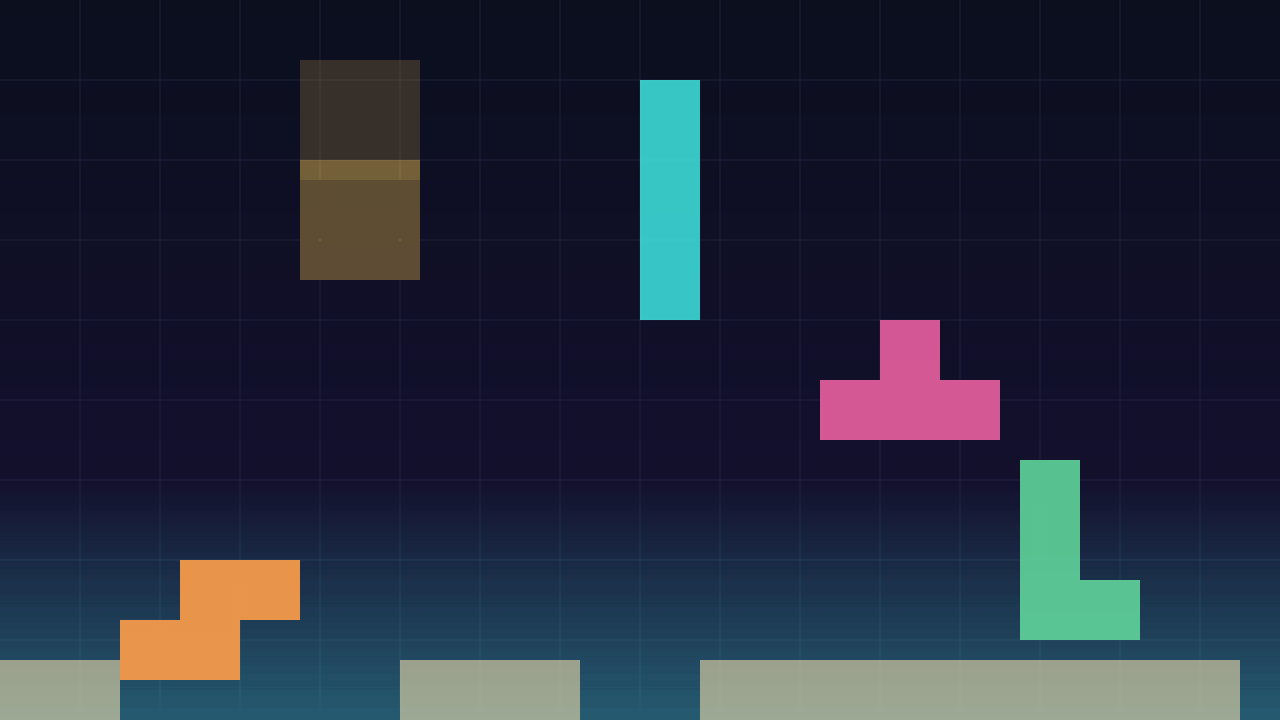 Seven falling pieces born in a Moscow computing center (illustration, AI-generated)
The Context — Paring Down the Pentomino
Pajitnov was 27 at the time, working on artificial-intelligence research—including speech recognition—at the Dorodnitsyn Computing Centre. His machine was a Soviet-made Elektronika 60, a clone of the American DEC PDP-11. Lacking any graphics capability, it could only represent the board using text characters and brackets.
His inspiration was the pentomino, a puzzle he was fond of, in which twelve distinct shapes made of five squares each are packed together. But displaying and rotating all twelve shapes was too heavy a task for the underpowered Elektronika 60, so Pajitnov pared them down to seven shapes of four squares. A compromise forced by constraint turned out, in the end, to be the simplest possible solution—a decision that shares its roots, I think, with how Sokoban (1982) narrowed itself to the single verb 'push.'
The first version had neither a scoring system nor levels. Even so, Pajitnov's colleagues are said to have become absorbed in it at the expense of their actual work.
 Before an underpowered machine, a five-square shape is pared down to four (illustration, AI-generated)
Mechanics — A Ship with No Port Crosses the Border
Pajitnov enlisted his colleague Dmitry Pavlovsky and 16-year-old Vadim Gerasimov to port the game to IBM PC compatibles. Rewriting it in Turbo Pascal reportedly took more than two months; Gerasimov added color, and Pavlovsky added a scoreboard.
This ported version spread through Moscow's computer-enthusiast circles via floppy disk, copied freely without anyone's permission. By 1986, it is said that nearly everyone who owned an IBM-compatible machine in Moscow and other major Soviet cities had played it. The work traveled freely through the city while its author held no notion of ownership over it at all.
Soviet copyright law at the time offered individuals almost no protection. Pajitnov arranged for the Dorodnitsyn Computing Centre to hold the rights for ten years, hoping to avoid future trouble—but this same arrangement, ironically, also blocked his own path to any reward for a long time to come.
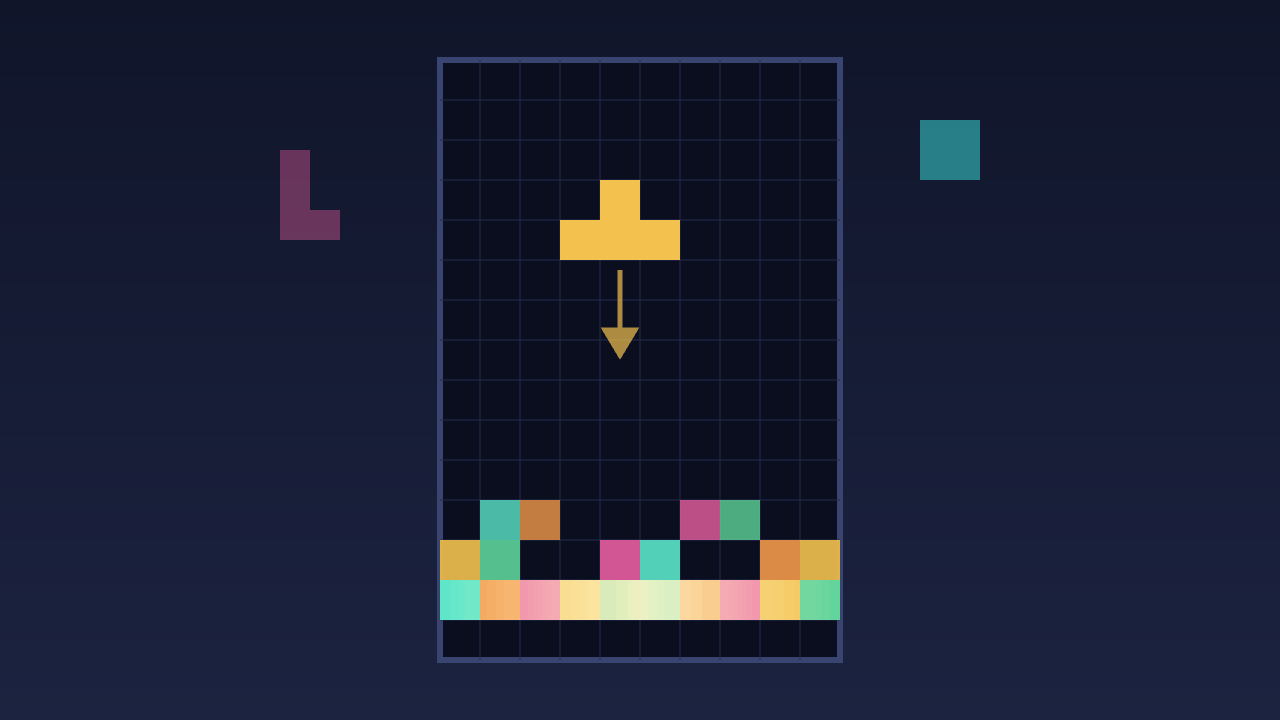 Fall, stack, clear — a board built from just two verbs (illustration, AI-generated)
Legacy — From a Rights War to the Game Boy, and Then to Music
In 1986, a copy that had reached a research institute in Budapest caught the eye of Robert Stein of the British trading company Andromeda Software. He contacted the Dorodnitsyn Computing Centre by telex to begin licensing talks, then sold the rights on to Mirrorsoft (UK) and Spectrum Holobyte (US). Both companies released their versions in January 1988—yet the formal agreement with Elorg (Elektronorgtechnica), the Soviet state trade monopoly, was not finalized until May 1988, after sales had already begun. The product, oddly, preceded the contract.
From Spectrum Holobyte the rights passed to Henk Rogers of Japan's Bullet-Proof Software, and the Famicom rights arrived via Tengen; the Famicom version, released in December 1988, sold two million copies in Japan alone. But when Rogers brought a Famicom cartridge to Elorg in Moscow in February 1989, Evgeni Belikov—who had just taken over as the new contact there—accused him of 'unauthorized publication.' Rogers settled by writing a check for over $40,000 and secured the handheld rights. Nintendo took up those rights and released the Game Boy version on June 14, 1989, bundling it with the console itself.
That single cartridge did more than sell well—it drove the Game Boy itself. By 2024, it had sold 35 million copies, and Tetris as a whole has sold over 520 million units, making it, by some counts, the second-best-selling video game series in history. In 1996, Pajitnov and Rogers formed The Tetris Company jointly with Elorg to centrally manage all future licensing.
As a modern connection point, there is Tetris Effect (2018), created by Tetsuya Mizuguchi (the Steam release, Tetris Effect: Connected, launched on August 18, 2021). Mizuguchi has said he wanted for years to make a Tetris synchronized with music, and he began planning the project around 2012 together with Henk Rogers of The Tetris Company—the very person who negotiated the 1989 Game Boy deal. He named the game directly after the 'Tetris effect,' the psychological phenomenon in which falling blocks keep appearing to a player's eyes long after they stop playing. Thirty-four years after 1984, the same square pieces were reborn as an experience of sound and light—a documented act of direct collaboration between the two men, not a speculative claim of influence.
 A chain of licensing paperwork crystallizes into a single handheld console (illustration, AI-generated)
Sources
Sources referenced for this article:
・Tetris Effect: Connected official: Steam launch announcement (July 15, 2021)
・Steam: Tetris® Effect: Connected
・SUPERJUMP: Tetris at 40: The Twisting Tale of Its Journey to Handhelds
・Morning Brew: How Tetris crossed the Iron Curtain and took over the world
Closing — One Gravity, Unchanged
Tetris's rules have not grown by a single character since the first version. 'Pieces fall,' 'a filled row clears'—with just these two verbs, it has remained, for forty-two years, the most-ported game in history, appearing according to Guinness World Records on at least seventy platforms.
Of all the puzzles I have traced, Tetris's history may be the most ironic. Copies crossed borders while its creator received nothing in return, and only the fight over its rights grew commercially bloated. But return to the board itself, and there is nothing there but seven pieces stacking under gravity, indifferent to any cold war or patent. That, I think, is what the strength of a rule looks like.
 A quiet board holding nothing but pieces stacked by gravity (illustration, AI-generated)
Reactions (no login)
Anonymous • one of each per visitor per day
Learn — Curriculum
LearnPart 2 Lineage — Where Puzzles Came FromChapter 5 Origins of the Digital Puzzle4 / 13
Part of these series
Retro RevisitedEpisode 33 of 45