REVIEW · 2014-02-19
Hexcells Plus
A quiet, stricter turn of the hexagon logic puzzle
First Impressions
On Steam, Hexcells Plus stands at 2,681 positive out of 2,835 reviews as of 2026-09-30 — roughly 95%, labelled Very Positive. The helpful positive reviews open with almost the same three phrases: harder than the first game, no guessing, and mistakes hurt.
One reviewer calls it Minesweeper on steroids; another says it makes you work for it. Players coming from the first game seem to want resistance, not comfort, and most of the praise is aimed at the added difficulty.
What stands out to me is that this difficulty is not about luck. The subtraction of guessing that I described in Hexcells Infinite is intact; only the resolution of observation goes up. Readers treat the sequel as the same grammar with a deeper question.
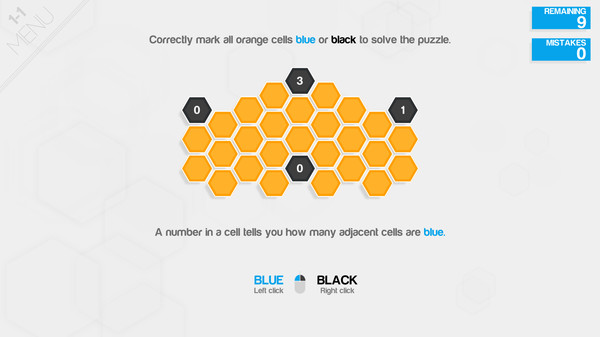 Hexcells Plus in play — image 1 as listed on the Steam store page (Steam store screenshot)
Putting the Mechanics into Words
The new element reviewers describe most concretely is the blue tile. Positive voices treat it as an aid: one says it adds strategic depth beyond the basic hints, another says clicking the blue cells to sort out the view makes the game easier to play.
In Puzzlebyrinth's vocabulary, this is less a new verb than a tool for moving board memory outside the head. As observational resolution rises, working memory hits its limit first, and the tile reads as the remedy.
Not everyone got that far. One negative review says the game never explained the helper feature and they got stuck. The more tools a design adds, the more teaching debt it takes on — a matter of instruction rather than of the mechanism itself.
 Hexcells Plus in play — image 2 as listed on the Steam store page (Steam store screenshot)
The Texture of Difficulty
The quality of difficulty splits cleanly here. Positive reviewers praise that it can be solved by logic alone, with no guessing. Some negative reviewers describe the same scenes as forced guessing. One board looks fair to one side and unfriendly to the other.
Reading closely, the sticking points sort into three kinds: not enough logic actually available; stacking what-if hypotheses because the constraints do not fit in the head; and slipping with the hand so that a mistake gets counted. The second negative review I read is about that last kind of fatigue.
So the difficulty mixes thinking and handling. The first is the design's claim; the second is its side effect. Even some positive reviews say mistakes add up heavily or that full completion is tedious, so the dividing line looks like tolerance for that side effect rather than a different taste in puzzles.
 Hexcells Plus in play — image 3 as listed on the Steam store page (Steam store screenshot)
Design Craft
What reviewers name most often as craft is the pairing of mistake handling with ambient sound. Phrases pile up: meditative music, a balance of relaxation and challenge, auto-save suited to casual sessions. A hard question is wrapped in a quiet shell.
The contrast shows up when you set it beside similar works like Squarecells or Tametsi. A game that hands you nothing but logic needs a separate way to lower the player's tension, and the sound and color here take that role.
Calm does not remove the sting, though. A design that counts mistakes is discipline to one player and attrition to another. The author's quiet strictness flips between virtue and flaw depending on how tired the player is — which I read as the limit of the design's reach.
 Hexcells Plus in play — image 4 as listed on the Steam store page (Steam store screenshot)
Reviews Consulted
This piece was written from the Steam user reviews as of 2026-09-30.
・Steam: Hexcells Plus (overall about 95% positive, 2,835 reviews, Very Positive)
・Read via Steam's appreviews API: about 20 helpful positive reviews, 4 negative reviews (English-language negatives are few), and 15 recent ones. Descriptions of the helper mechanism are limited to what several reviews mention in common.
・Captions only give the order on the store page; no description of image content is attached.
Closing
Steam's overall is about 95%; my score is 8.0. The gap comes from a design that leans hard on quiet strictness, leaving two side effects: fatigue from handling and thin teaching. Reviews mention clear times of roughly 8 to 16 hours.
I can recommend it almost without hesitation to anyone who enjoyed the first game. For players who come looking for comfort, the feel of fairness may look different. The same logic lets some players through and stops others cold.
If you design guessing-free puzzles, read it alongside Designing Luck Out of the Game. When difficulty goes up, how many aids and how much teaching should be added? This sequel offers one answer.
 Hexcells Plus in play — image 5 as listed on the Steam store page (Steam store screenshot)
Where are you with this game?
Press one and the game goes on your shelf. You can see it on your account page.
Reactions (no login)
Anonymous • one of each per visitor per day
Read next
Related reviews
Hexcells Infinite
A Minesweeper-lineage logic puzzle: find the hidden blue cells on a hex grid using only adjacency counts, line hints and consecutive/non-consecutive markers — pure deduction, no guessing. Matthew Brown's third entry layers an endless puzzle generator over 36 hand-made boards.
Hexcells
An ambient logic puzzle where you deduce which hexagonal cells are blue using only neighbouring number clues — a distant cousin of Minesweeper and the first entry in Matthew Brown's series.
Cypher
A first-person puzzle game about cryptography. You walk white exhibition rooms and decode the ciphertexts hung on their walls, from simple substitution through polyalphabetic ciphers to machine ciphers. A solo work by Matthew Brown of the Hexcells trilogy, and it assumes you have paper and a pencil.


