REVIEW · 2022-01-25
Not For Broadcast
A mixing desk between the bleep and the ratings
First Impressions
On paper this game is not divided at all. Counting every language and purchase type, Steam records 11,795 positive out of 12,566 reviews — about 94%, labelled Very Positive (snapshot 2026-09-28). The English pool sits at the same 94% of 6,466, and the last thirty days read 92%.
Read the review bodies, though, and the picture changes. The positive side reaches for immersed, unique concept, hectic, wonderful acting. The negative side reaches for whack-a-mole, wasting the player's time, outstays its welcome, a chore. Praise and complaint appear to be pointing at the same moments.
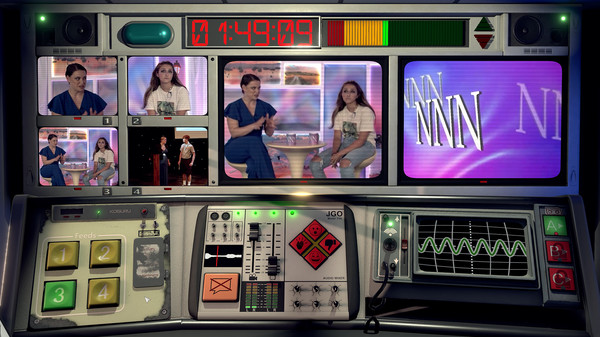
Per the store description, a new party has just won the general election by a landslide, the editor of the news programme has walked out, and you — the janitor — inherit the desk. A live broadcast, shot in live action, cut together by the player from behind.
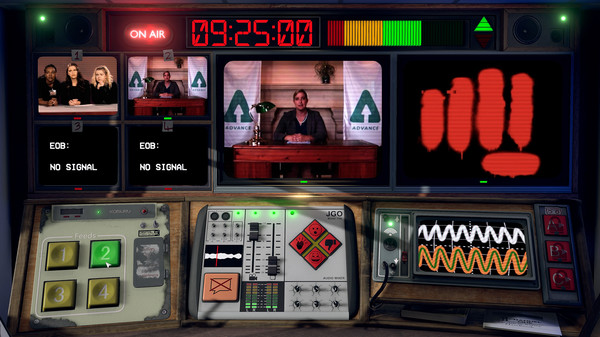 Not For Broadcast in play — image 1 as listed on the Steam store page (Steam store screenshot)
Putting the Mechanics into Words
At the start, the review pool yields only three verbs: cut between camera feeds, bleep what cannot go out, choose which story runs. All of them resolve in a single action. All of them are light.
What happens next is the interesting part. Both sides report that each episode hands you more to do. The negative phrasing is they throw more and more mechanics at you, and you play whack-a-mole. In Puzzlebyrinth's vocabulary this is adding verbs, not subtracting them.
Most good thinking puzzles go the other way. Baba Is You and Sokobond hold the verb count down and dig into what one verb can combine into. Depth bought by subtraction.
This game buys simultaneity instead. Hectic and whack-a-mole are the same lever described with opposite signs. Set beside Papers, Please, which kept a single verb — compare — and thickened only the rulebook, the direction is exactly reversed.
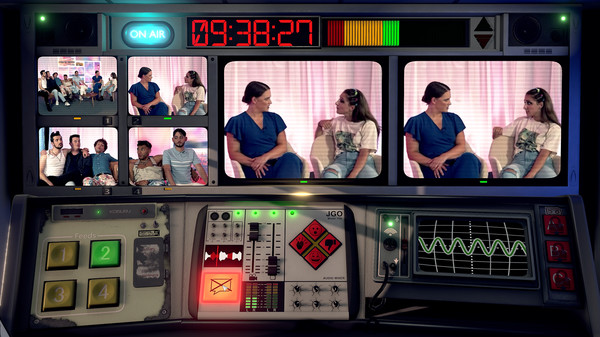 Not For Broadcast in play — image 3 as listed on the Steam store page (Steam store screenshot)
The Texture of Difficulty
Laid side by side, the reviews describe three separate difficulties: the speed of doing several things at once, the judgement call of what actually needs bleeping, and the rerun after a failure.
The negative pool reacts hardest to the third. Failing broadcasts for silly reasons and having to replay a ten-minute segment come back again and again. The complaint is about checkpoints, not about thinking.
It is the same lever The Occupation pulled. Enlarge the smallest unit of retry and every action gains weight — and every mistake gains a price. Immersed by the tension and soul-crushing are the two ends of that one lever.
The difficulty here is not a shortage of understanding but a shortage of hands. You are never given the time to read a board. Improvement therefore arrives as routine settling into the fingers, not as observation resolution going up.
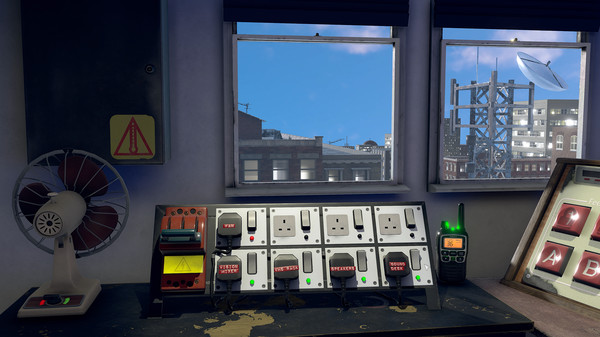 Not For Broadcast in play — image 5 as listed on the Steam store page (Steam store screenshot)
Design Craft
The best idea here is handing the player the verb edit: what the public sees, and what gets cut. As material for a thinking game that is a strong premise, standing just in front of the ground Orwell: Keeping an Eye On You and Do Not Feed the Monkeys have worked.
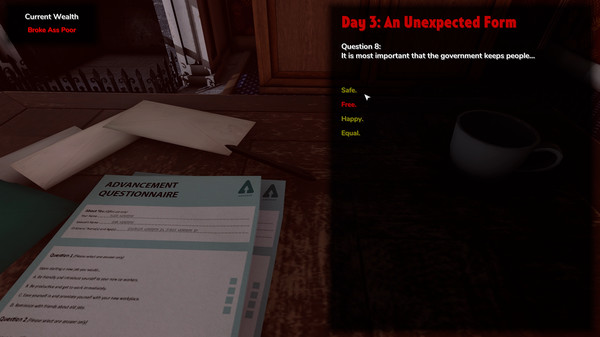
The grading, however, is a single number: how many viewers stayed. One negative review notes that the game's built-in assessor overrides any plot nuance, and that lands. Whatever editorial line you take, the answer comes back flattened to one dimension.
It also explains why the political readings arrive from both directions at once. Some reviewers call it too hard on the left; others call it too committed to the centre. Two opposite complaints sharing a review page suggests less that the game hides a position than that its scoring axis cannot carry one.
So this is a question of design scope. Score discretion with one scalar and discretion turns into optimisation. What was meant to be thought about becomes a procedure for raising ratings. The weak point is not the argument but the ruler used to measure it.
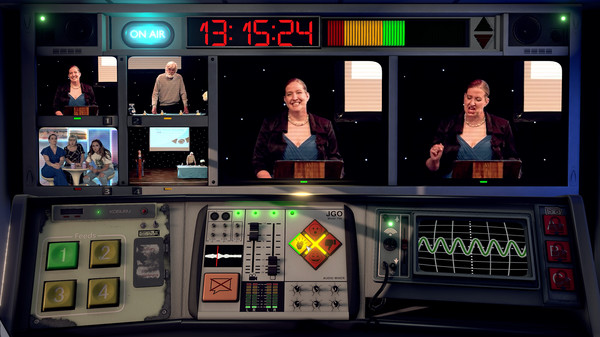 Not For Broadcast in play — image 7 as listed on the Steam store page (Steam store screenshot)
Pacing
The playtimes attached to the reviews cluster around ten hours. One run through appears to take about that. But there are several endings, and seeing them means running the broadcasts again from the top.
Almost every outstays its welcome and half a chore in the negative pool points at that rerun: watch the same long performance, change one decision. The more branches there are, the more viewing the player is charged for, linearly.
What is telling is that reviewers with twenty hours and more say the same thing. It is not that they soured on the game. They like it and still find the repetition heavy. This is where the pacing loses to the length of the footage.
 Not For Broadcast in play — image 10 as listed on the Steam store page (Steam store screenshot)
Sources
This piece was written by reading the user reviews on the Steam store page as of 2026-09-28. No review text is quoted directly; typical claims are reconstructed.
・Steam: Not For Broadcast (11,795 of 12,566 reviews positive across all languages = about 94%, labelled Very Positive; the English pool is 6,095 of 6,466 = 94%, and the last thirty days 92% of 67)
・Read in full: the 10 most helpful positive reviews, the 10 most helpful negative reviews, and 6 recent ones (26 in total). Aggregate figures come from the query_summary returned by Steam's review API.
・Developer, publisher, release date and genre labels are taken from Steam's appdetails API (NotGames / tinyBuild / 2022-01-25).
・The images are the store screenshot URLs returned by that same appdetails API, used verbatim. This environment could not reach Steam's image hosts, so their contents could not be inspected; the captions therefore do not identify what is depicted.
Closing
Against Steam's 94% I give this a 7.5. A little lower, and not because of rough edges. I take points off for steering towards adding verbs, and for measuring the result of that steering with a single ratings number.
The idea itself is real. Very few games have built a board out of cutting a live broadcast from behind it, and using live action as the raw material — making the cut point itself the move — is a decision that works.
The honest framing is who it suits. If having your hands full is the pleasure, there are ten hours here with no substitute. If you want to read a board calmly and check one move at a time, the busyness stands in the way rather than being the point. The difficulty is in keeping up, not in working out.
 Not For Broadcast in play — image 12 as listed on the Steam store page (Steam store screenshot)
Where are you with this game?
Press one and the game goes on your shelf. You can see it on your account page.
Reactions (no login)
Anonymous • one of each per visitor per day
Read next

Related reviews
Chinatown Detective Agency
A cybernoir point-and-click set in near-future Singapore, where you run a detective agency and crack international cases by researching real facts in a browser outside the game. General Interactive Co.'s experiment hands the last step of every clue to the live web.
GNOSIA
A single-player take on Werewolf: find the Gnosia hiding among the crew using nothing but discussion and votes. Up to fifteen crew members are redealt into different roles each loop, and a time loop sends you through the same voyage again and again. From Petit Depotto.
The Case of the Golden Idol
A deduction game: examine frozen crime-scene tableaus, gather words from the evidence, and fill in the blanks to reconstruct each murder across an 18th-century mystery.


