REVIEW · 2014-09-30
Sherlock Holmes: Crimes and Punishments
Reading the split verdict on a detective game that never checks your answer
First Impressions
You walk Holmes through Victorian London, lift clues off a scene, and wire them together as lines on a mental board the game calls the Deduction Space until a conclusion assembles itself. Released in 2014 by Kyiv-based Frogwares — met on this site once before as the studio behind Magrunner: Dark Pulse — as one entry in their long-running Holmes series, built on Unreal Engine 3. Focus Home Interactive handled distribution at launch; Frogwares is reported to have held the rights since 2019.
I write this from the Steam review pool. The label is 'Very Positive': 89% of 2,368 English reviews, and 92% of the 51 posted in the last thirty days, so it has not decayed (snapshot 2026-08-18). Yet the Metacritic user score sits at 7.2 across 336 ratings, filed under 'Mixed or Average,' and the critic side reads 73 from 36 reviews with 16 of them scored as mixed. The same game moves that much depending on where you tally it.
The recurring words on the positive side are atmospheric, faithful, polished, underrated, and 'buy it on sale.' The recurring words on the negative side are arbitrary, guesswork, contrived, hand-holding, and 'cut and dry.'
Lined up, the argument collapses into a single question: what this game does with the idea of a correct answer. Admirers and detractors are looking at the same point from opposite sides, so that is the point I will translate into design terms.
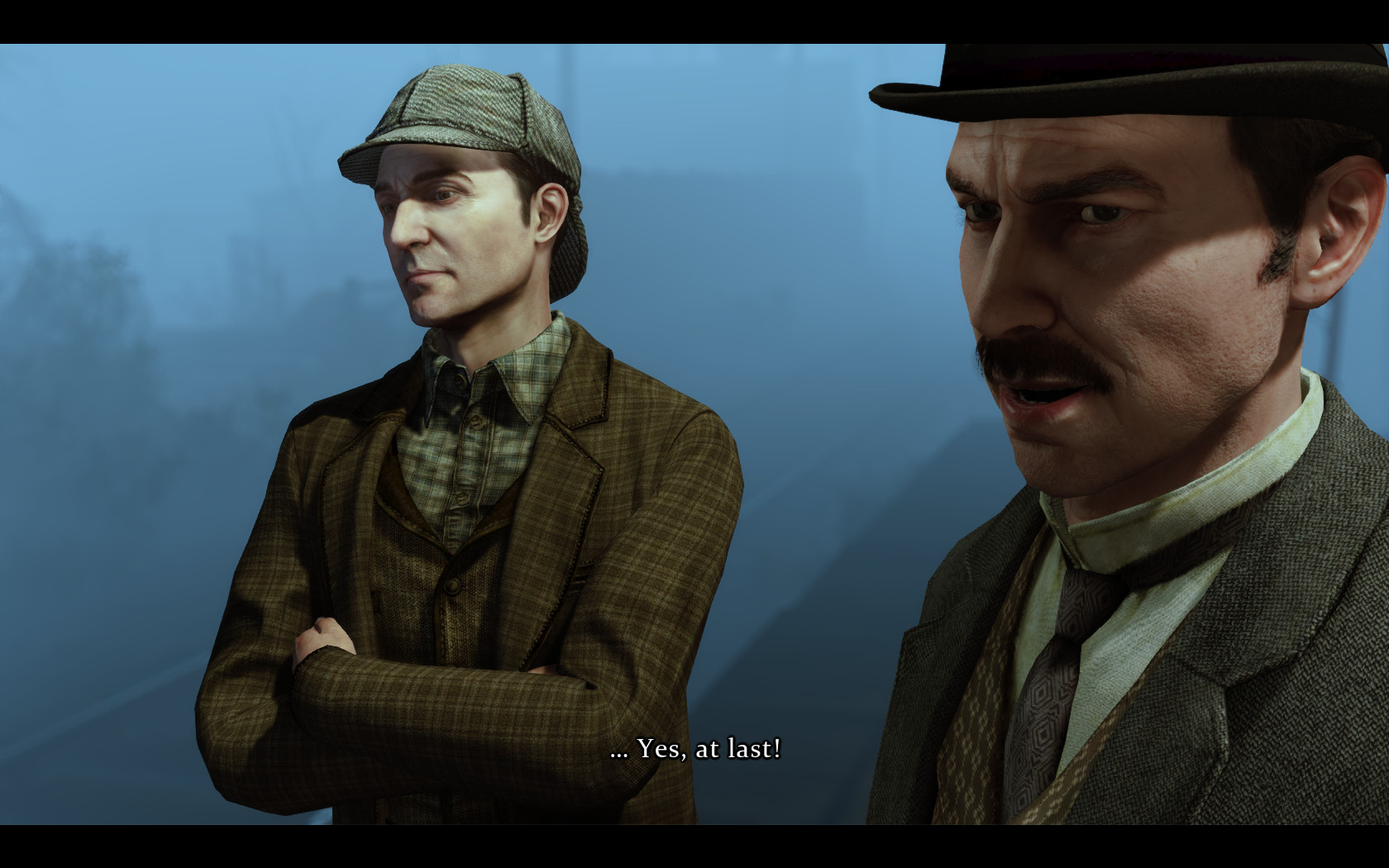 Sherlock Holmes: Crimes and Punishments — Steam screenshot
Putting the Mechanics into Words
There are only three verbs: collect, connect, commit. You walk a scene and zoom in on objects (a 'Sherlock Vision' assist exists to catch what you missed), lay the resulting clues out in the Deduction Space, link two or more into a node, and finally commit to which chain of nodes you believe. That is the grammar, the way push, pull and undo are the grammar of a sokoban.
What the most-helpful positive reviews single out is that the second verb was left in the player's hands. One recommendation puts it as: the game hides none of the process from you, it is a slow accumulation of clues associated by deduction into conclusions. In Puzzlebyrinth terms, an internal act has been externalised into UI. Most detective adventures compress that step into 'pick the right dialogue option'; this one spreads it across a board.
The third verb is the awkward one. Each case is stated to support three to five conclusions, and once condemning or absolving is folded in, six to ten endings. The space is genuinely wide — but wide also means every choice lets the story continue. When the negative side calls the freedom cosmetic, they are not complaining about the board. They are pointing at the fact that nothing is attached to the commit.
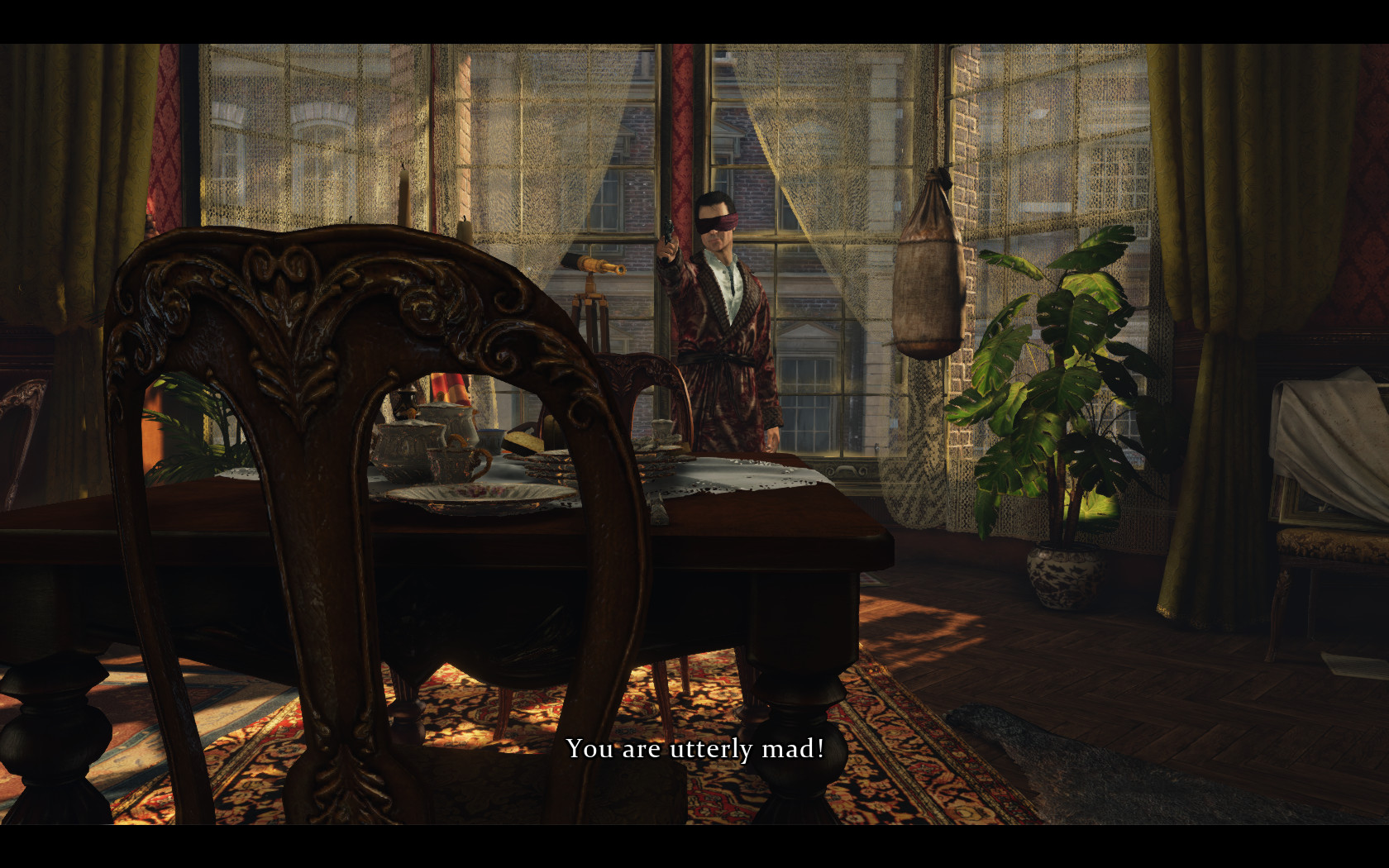 Sherlock Holmes: Crimes and Punishments — Steam screenshot
Design Craft
The structure is an anthology: six standalone cases. That cut is what the positive side agrees on, and the phrasing recurs — a case closes in two or three hours, and you can go back and replay just the one you liked. There is no through-line story; instead each case swaps out the whole population of clues. Nothing accumulates, but nothing has to: you start from the same height every time.
The second piece of craft is the moral layer bolted on after the truth. Having named someone, you choose to hand them to the law or let them go. Reviews that rate this highly describe it as a game about good versus law. EGM, scoring it 80, called the same system underdeveloped. Both are right: the choice exists, but the game supplies no instrument for weighing it.
And when a case closes, the game shows you what actually happened. That single move is the watershed. The pool splits cleanly between players relieved to learn an intended answer existed and players left wondering what their own reasoning was for. In terms of subtraction, I read it this way: the game did not subtract adjudication, it evicted adjudication from the deduction and parked it afterwards.
 Sherlock Holmes: Crimes and Punishments — Steam store image
The Texture of Difficulty
The single most common complaint is that it is too easy. On Metacritic users write that genre veterans will be underwhelmed, that an always-present skip button dissolves any tension in the minigames, and that instructions amount to 'go here, click that.' Among critics, IGN Italia noted the puzzles lack bite for experienced players.
And yet other reviewers call the same board unfair. Those are not in conflict once you separate the layers. This game's difficulty splits three ways: the difficulty of noticing (what did you miss at the scene), the difficulty of connecting (which clue joins which), and the difficulty of conviction (once linked, can you verify it yourself).
The pool's verdict is consistent: the first two layers are easy and the third is disproportionately hard. You cannot get to guilt beyond a reasonable doubt; the information given sometimes contradicts the answer the game presents as correct; evidence that looked decisive turns out not to be. Nearly every negative claim lands in that third layer. The puzzle difficulty was lowered and only the judgement difficulty was left standing — and no amount of observational resolution reaches it, so getting better never changes the feel. That is what 'easy but irritating' actually is.
 Sherlock Holmes: Crimes and Punishments — Steam screenshot
Place in the Lineage
It helps to remember what 2014 looked like. Almost nothing put deduction on a board as a piece of UI. Foregrounding a linking board was genuinely new then, and the long-time series players in the pool say as much: this was the entry that finally let them deduce.
Looking forward makes the placement clear. Return of the Obra Dinn confirms only when three identifications are right at once, handing the player external corroboration for their conviction. The Case of the Golden Idol runs the reasoning itself through a machine check in the form of fill-in-the-blank phrasing. Both pull back inside the deduction what this game parked after it.
So this is not a ranking. A detective game with adjudication lets you verify that you were right, at the cost of a world with exactly one reading. A detective game without it keeps several readings standing, at the cost of making you supply your own conviction. People who bought it wanting the first write the negative reviews; people happy with the second write the positive ones. Different reach, not different quality.
 Sherlock Holmes: Crimes and Punishments — Steam store image
The Reviews I Read
This piece was written by reading the user reviews on the Steam store page as of 2026-08-18. No review text is quoted directly; typical claims are reconstructed.
- Steam: Sherlock Holmes: Crimes and Punishments (Very Positive; 89% of 2,368 English reviews, 92% of the 51 from the last thirty days; roughly 7,900 across all languages, which SteamDB tallies at about 86.8% positive)
- Read via WebFetch: the ten most helpful positive, the ten most helpful negative, the ten most helpful German-language entries, and the most recent
- Metacritic user score 7.2 from 336 ratings (192 positive / 101 mixed / 43 negative), metascore 73 from 36 reviews (20 positive / 16 mixed / 0 negative; Polygon 80, EGM 80, Game Informer 80)
- Wikipedia: Sherlock Holmes: Crimes & Punishments (engine, publishing history, case and branch counts, and the source for the IGN remark)
Closing
Against 89% on the English Steam pool I give it 7.3. The gap is not about quality but about what is being measured. Steam is measuring whether walking six cases was enjoyable, and for that question 89% is fair. I am measuring the design of the act of deduction, and there a hole remains: the game built the board and never built the board an exit.
The median completion time mentioned in reviews is around sixteen hours, with two to three hours per case the most common report. That is a comfortable length to settle into, and it is not the kind of game you sit and grind against. Buy it for difficulty and you will likely miss.
Who it suits is clear enough: players who want their own reading adopted and the world to move accordingly. It does not suit players who want a machine to certify that they were right. If certification is what you want, something like Scene Investigators, which makes you type the answer in, answers that need more honestly. What this game offers is not a correct answer but the responsibility of claiming one. If that reads as reward enough, it is still worth picking up on sale.
 Sherlock Holmes: Crimes and Punishments — Steam store image
Where are you with this game?
Press one and the game goes on your shelf. You can see it on your account page.
Reactions (no login)
Anonymous • one of each per visitor per day
Read next

Related reviews
Magrunner: Dark Pulse
A first-person puzzler in which a Magtech glove charges cubes and platforms so that like colours attract and opposites repel, carrying you through 40-plus test rooms. Frogwares' 2013 game pours Lovecraft's Cthulhu Mythos into a Portal-shaped mould.
The Vanishing of Ethan Carter
A first-person mystery in which you play an occult detective, walking a deserted valley to examine bodies and belongings and reassemble each death by putting the scattered fragments back in order — a photogrammetry-built forest explored with no map and no HUD, from The Astronauts.
Hexcells
An ambient logic puzzle where you deduce which hexagonal cells are blue using only neighbouring number clues — a distant cousin of Minesweeper and the first entry in Matthew Brown's series.


