SOUNDTRACK · 2026-09-29
Soundtrack: Her Story — music that was never written for the game becomes the air of the archive
Chris Zabriskie
Introduction — music you can't quite place at first
Her Story is a puzzle game Sam Barlow self-released in 2015 (see Komugi's review; difficulty rated "Standard," with an estimated 3-hour clear time). The whole stage is a single search window on an old computer. Footage of a 1994 police interview sits in a database, cut into over 200 clips, and you type words to pull up only the testimony that contains them.
The moment it boots up, a modest ambient hum starts playing low. The credited composer is Chris Zabriskie. But the official sound credits page (herstorygame.com, linked in the sources below) shows this wasn't written for the game at all — these are tracks he'd already released, dropped in as they were. Try to count a BPM and the beat won't hold still. I heard it as a single piano's decay, slowly lowering the temperature of the room.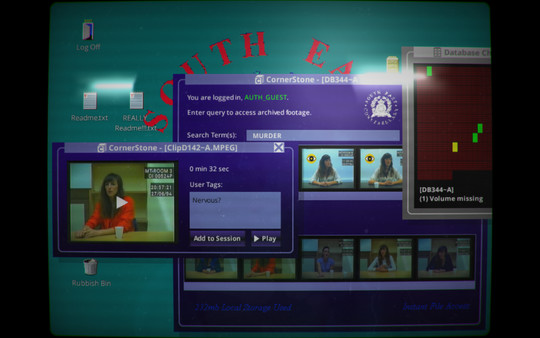 Her Story in play — image 1 as listed on the Steam store page (Steam store screenshot)
A puzzle-specific trait — matching a search with no cue to end to music that never ends either
Her Story has no timer and no failure state. A search session can run for ten minutes or two hours, for exactly as long as it takes the player to feel "that's enough." Ordinary game scores can be sized to the scene — three minutes for a boss fight, a couple of minutes per stage. The "scene" here, a search, has no fixed length to score at all.
The six tracks named in the official credits ("That Kid in Fourth Grade Who Really Liked the Denver Broncos," "CGI Snake," "Undercover Vampire Policeman," "The 49th Street Galleria," "There's Probably No Time," "NirvanaVEVO") are all ambient pieces that loop without ever falling apart, with starts and ends too soft to pin down. Rather than a bespoke theme, these are songs built from the start to be replayed hundreds of times on their own. A scene with no fixed length gets a song with no fixed length. It sounds obvious, but I think it's a stance.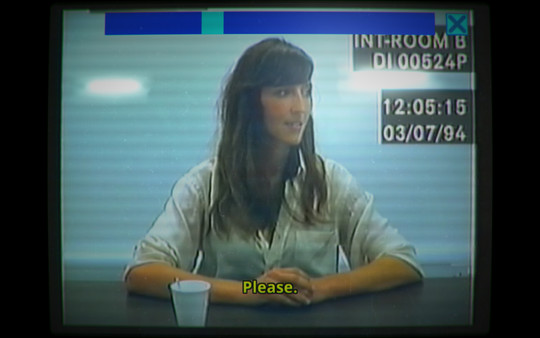 Her Story in play — image 3 as listed on the Steam store page (Steam store screenshot)
A hidden link with the experience — music that had already been free to take for years
Zabriskie is an American composer who's worked alone since 2001. He released vocal albums from 2006 to 2009, then turned to instrumental ambient work in 2009. In 2011 he joined the Free Music Archive and has released his work under increasingly open Creative Commons licenses ever since (sources: Wikipedia, his own site). On the official page for his 2012 album Undercover Vampire Policeman, he writes it plainly: "The songs on this album are free to use in creative projects under a Creative Commons Attribution license."
No music plays at all during the actual interview footage in Her Story — only a voice, talking. Music only plays on the search-window side, where you're the one digging through someone else's record. Music that had already been free for anyone to take, chosen to score a game about combing through someone else's past without asking — there's something in that pairing I find less ironic than oddly fitting. Both the songs and the testimony are things set loose, out of their maker's hands.
The puzzle analogy — a search with no correct order, and chords that never resolve
There's no fixed procedure to solving Her Story. A clip found through one word points you to the next word, and sends you back to re-listen to a clip you'd already seen. I think of it less as a puzzle solved in a straight line than as work done by circling the same ground again and again, sharpening the picture a little each pass.
Zabriskie's music doesn't move the classical way either — tension building toward resolution. It rises softly and drifts into the next texture without ever clearly landing. The search doesn't head straight for an ending, and neither does the score. Both move the way a loop does, tracing the same ring.
Tracks worth hearing
Of the six tracks named in the official credits, here are the ones I could confirm on the composer's own official YouTube channel (channel name "Chris Zabriskie").
Start with "CGI Snake" — for all its lighthearted title, what's actually playing is a low, sunken drone. Then "The 49th Street Galleria," built from nothing more than single piano notes set down one at a time. I think these two capture the search window's temperature best.
The remaining track, "That Kid in Fourth Grade Who Really Liked the Denver Broncos," along with the songs from the album Undercover Vampire Policeman, are also on the same official channel (links in the sources below).
Closing — what I'd steal
What I'd steal is the choice not to write anything new at all. A bespoke score isn't always the right answer. Sometimes it works better to go looking through music that already exists for the one track that matches a scene's temperature, and just place it there.
One more thing: a scene with no fixed length deserves a song with no fixed length. The next time I score a puzzle built around searching or reviewing records, I want to start by choosing one track on a single condition — that it won't wear thin after a few hundred plays — before I write a single note of my own.
References
・Her Story official site: Sound Credits (official composer and track credits)
・Chris Zabriskie's official site
・Wikipedia: Chris Zabriskie (biography, joining the Free Music Archive)
・Chris Zabriskie's official YouTube — "CGI Snake"
・Chris Zabriskie's official YouTube — "The 49th Street Galleria"
・Direct access to the Steam image CDN was blocked in this session's runtime (a known environment constraint), so the images below could not be visually inspected. The in-article images use the real URLs returned by Steam's official appdetails API (confirmed to exist via WebFetch), and their captions are kept generic rather than describing specific scene content.
Reactions (no login)
Anonymous • one of each per visitor per day
Part of these series
Puzzle SoundtracksEpisode 109 of 110
Read next
Related reviews
Else Heart.Break()
A Swedish adventure set in the electric town of Dorisburg, where you carry a device that opens up the insides of almost anything. Coffee makers, doors and buses all run on source code written in the game's own language, and you edit it directly. Led by Erik Svedäng and released in 2015.
Not For Broadcast
On the night a new party wins the general election, the editor of a national news programme walks out — and you, the janitor, take his chair. A live-action editing simulator where you cut between camera feeds, bleep what cannot go out, and choose which stories run, all while the broadcast is live. Made by NotGames, published by tinyBuild.
Sethian
A first-person language puzzle in which you play a far-future archaeologist typing questions into an ancient terminal on a depopulated planet, in a constructed tongue with its own grammar. You build sentences from a handwritten journal and dictionary, and how well you write decides which ending you reach. From Duang! Games.


