REVIEW · 2020-03-05
THE LONGING
When a review turns into a progress report — reading 3,869 reviews of a game that asks for 400 real days
First Impressions
I read the Steam review pool for THE LONGING as it stood on 26 August 2026. The store page shows 92% of 3,869 reviews positive, labelled Very Positive, and 90% of 41 over the last thirty days. SteamDB counts roughly 7,000 reviews across all languages, 89.4% of them positive.
The provenance first. Deep underground, you wait 400 days for a sleeping king to wake. You control one small creature, called the Shade. Studio Seufz developed it, Application Systems Heidelberg published it, and it arrived on 5 March 2020. Anselm Pyta is credited as the main author, over a production reported to have taken six years.
Open the review column and the first thing you notice is a broken number. Near the top of the helpful positive reviews sits one logging 9,600 hours. That is exactly 400 days. A few rows down sits one logging 15.2 hours. Both are praising the game. Both are telling the truth.
The timer in this game keeps running while the game is closed. So Steam's playtime figure is not measuring how much was played; it is measuring how long a window was left open. On that single point the review form itself starts to wobble. This piece reads the wobble.
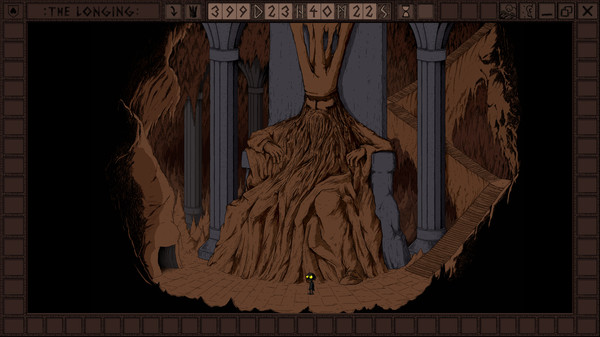 Screenshot published on the Steam store page (image 1)
Putting the Mechanics into Words
The verb list is short. Walk, pick up, put down, read. That is close to all of it, and every one of them is slow. The Washington Post's critic describes a door on old hinges that takes a couple of minutes to open.
But the load-bearing verb sits outside the screen: wait. The 400-day timer advances in real time, whether you are doing something or nothing at all. We looked at cutting verbs down in the lineage of subtractive design; this game cuts them down and then puts what remains outside the game.
There is one exception. Time runs faster while the Shade is at home. Reading, drawing, sleeping, playing an instrument. According to the forum, eating three mushrooms makes the Shade pass out and skips an hour. Out in the caves, time runs at its ordinary speed.
So the author built an escape hatch out of his own central constraint. That is where the pool divides. One positive review calls the game a clicker in reverse: instead of watching a number climb, you wait for one to fall.
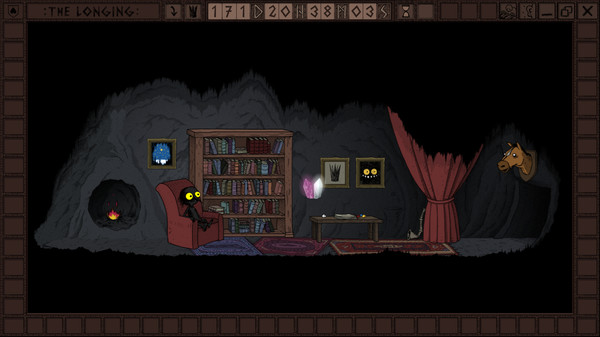 Screenshot published on the Steam store page (image 4)
Design Craft
Make real time your only currency and one problem follows immediately. Move the computer's clock and the currency can be forged.
The author's answer was thorough. At launch this single-player game required an internet connection to start, so that the clock could be checked against a server. On the forum he explained that this was the only safe way he had to detect cheating.
Trip the check and the Shade is thrown into a time dungeon. To get out you press a repentance button four hundred times. The number is a copy of the 400 days, of course. Even the punishment is cut to the shape of the theme, and I read that as consistency rather than cruelty.
The mechanism misfired, though. Several of the most helpful negative reviews come from players thrown into the dungeon without touching a clock. The author wrote that he could not reproduce it, and guessed at the time server or at the game being minimised during standby. The online requirement was dropped in a June 2024 update.
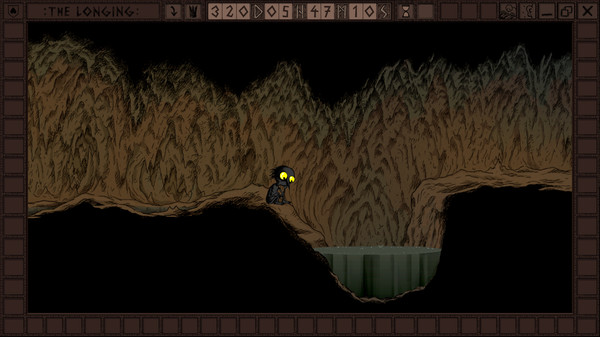 Screenshot published on the Steam store page (image 7)
Pacing
The sharpest split in the pool is not about difficulty. It is about length. And the estimates of that length differ by more than tenfold from one writer to the next.
The Japanese column holds one review saying it actually finishes in about four months, and another saying thirty days is enough. A forum post claims a determined player could reach the final ending in twenty. All of them are describing the same game, and none of them is lying: there are several endings, and routes that do not require the full 400 days.
Almost every negative complaint gathers here. Things to do run out in the first fifty days and the rest is idling. Thin content padded out with slowness. Exploration and puzzles resolve too quickly. One short review simply cannot get past the walking speed.
The positive side describes exactly the same slowness in another vocabulary. Something to play alongside other work. A quiet coworker. A Tamagotchi for introverts. Moss creeping outward, a spider spinning a web, and that alone is reason enough to check in. Lower the rate of change and small changes become legible. I call that observational resolution. We wrote about how games handle boredom in the board that fills the empty hour. Whether you call it a burden or a resolution is decided on the side of your life, not the side of the game.
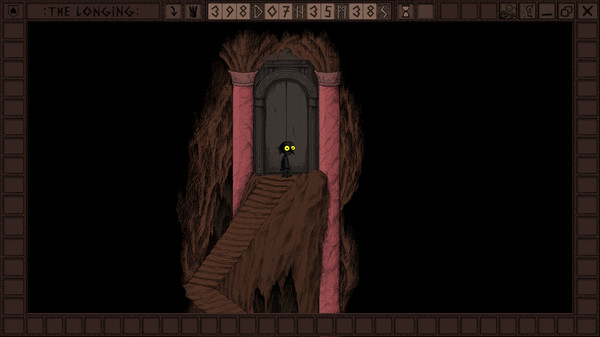 Screenshot published on the Steam store page (image 10)
Sources
This piece was written by reading the Steam user reviews on the store page as of 26 August 2026, together with official information, aggregate sites, one press review and the official forum. No review text is quoted directly; recurring claims are reconstructed.
- Steam: :THE LONGING: (92% of 3,869 reviews positive, Very Positive; 90% of 41 over the last thirty days; $14.99 list)
- Read the top ten by helpfulness on the positive side, the top nine on the negative side, ten most-recent reviews, and the top ten Japanese-language reviews
- All-language counts from SteamDB (about 7,000 reviews, 89.4% positive); the critic and user split from Metacritic (79 from eight critics; user score 7.8 from 52 ratings)
- For the press view I read Christopher Byrd's review in the Washington Post. Time acceleration, clock detection and the online requirement were checked against threads on the official Steam forum and the update history. Credits, release history and awards come from Wikipedia
- On images. All five in the body are official screenshots published on the Steam store page, and their URLs were confirmed through the appdetails API. The image CDN was unreachable from this environment, so their contents could not be checked by eye; the captions therefore stay generic, naming only the game, the asset type and the store ordering. No hand-made diagrams were used
Closing
The same thing happens on the critics' side. Christopher Byrd filed his Washington Post review from 387 days out, seven real days in. The deadline is shorter than the game. Metacritic shows 79 from eight critics, with no negatives but three mixed, and a user score of 7.8 from 52 ratings.
A review is normally a report on a book you have finished. Here that is not available. So the column filled up with diary entries instead of recommendations. Among the most recent reviews is one written in the present tense: growing a mushroom right now, to reach somewhere deeper. Playtimes run from 1.9 hours to 9,600, clustering around twenty to thirty, and in this game it is not even settled what that number is counting.
Against Steam's 92% I put 7.8. The credit is for never letting go of a single idea. The walking speed, the count of the penalty, the online check: all of it descends from one decision, that real time is the only currency. Two deductions. The events laid across those 400 days lean too heavily into the first stretch. And the machinery guarding the currency put innocent players in a cell.
Who is it for? Someone who can keep caring, on a scale of months, about something that continues after the game is closed. It is not for someone who wants progress in proportion to time spent sitting down. Minit also treats time as a price, but what it charges is sixty seconds inside the game; what this one charges is 400 days out of your own life. Same word, different wallet.
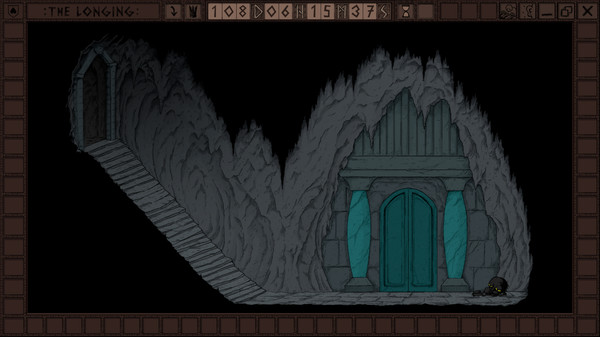 Screenshot published on the Steam store page (image 13)
Where are you with this game?
Press one and the game goes on your shelf. You can see it on your account page.
Reactions (no login)
Anonymous • one of each per visitor per day
Read next
Related reviews
Röki
A point-and-click adventure through a snowbound forest drawn from Nordic folklore, following Tove as she gathers and combines objects to search for her sister. Polygon Treehouse's game has no combat and no fail state, carried instead by hand-drawn landscapes and a story about loss.
Metamorphosis
A first-person adventure that walks through the morning of Kafka's Metamorphosis. At Gregor's new insect height, desktops and gaps between floorboards become terrain, and climbing across them is how you travel. From Ovid Works.
Lost in Play
A hand-drawn point-and-click adventure told entirely without words. The siblings Toto and Gal make their way home through fifteen scenes built out of a child's imagination, picking things up, combining them, and solving a different little minigame in almost every room. From Happy Juice Games.


