ESSAY · 2026-08-07
The Board That Fills the Boredom — Pascal's "Divertissement" and the Puzzle on Your Commute
"The Nature of Play" series, matching edition. Why do we open a tiny board just to fill the boredom?
Intro — On the train, the person next to me opens a board
Morning commute. The person standing beside me was tracing a tiny board on their phone. A four-by-four grid. Slide the number tiles together, merge them, slide again. For three stations straight. When they got off, they just flicked the screen dark. Not to show anyone a score, not with the face of someone dying to see what came next — they were simply filling something. And what they were filling wasn't the board. It was, most likely, three stations' worth of boredom.
That night I poured a glass of whisky and jotted the scene into my drafting notebook. "Why do people open a board to fill their boredom?" For someone who makes puzzles, that question is terrifying enough to pull the floor out from under you. Am I designing fun — or a device for looking away from boredom? One man gave the most merciless answer to that question. Blaise Pascal. A man from more than three hundred years ago.
Pascal's "divertissement" — unable to sit still in a room
In the Pensees, a collection of fragments, Pascal (1623-1662) set down one merciless observation about human beings: that all our unhappiness comes from a single thing — our inability to stay quietly in a room. Why do people go hunting, gamble, even go to war? Not because they truly want the quarry, the winnings, or the territory, Pascal says. The real aim is to avoid sitting alone in a room and being left to think about themselves.
And the content of "thinking about themselves" is heavy. Left alone, a person notices that they will one day die, that the present does not satisfy them — in short, their own wretchedness (misere). So they are forever searching outside for something to take their mind off it. Pascal called this divertissement — diversion. That is the only piece of jargon this article needs. The root of the word carries a sense of "turning aside": something that turns your gaze away, from your own interior to the outside.
Pascal gives a famous example. A king should be the most fortunate person alive, yet take away his diversions and leave him alone to think about himself, and he becomes miserable in no time. That is why a king is forever surrounded by jesters, courtiers, and entertainments. At the center of a lavish machine of diversion sits one human being who cannot stay still. Seen this way, the hunt, the court — and the four-by-four board on the train — all start to look like members of the same family.
Read this far, Pascal looks like an enemy of play. Diversion, he seems to say, is the cowardice of looking away from what we ought to face. There is indeed that harsh side to him. But Pascal is one step slyer than that. I'll save that turn for the next section. First I want to name, as a maker, the exact board I saw on the train.
Threes! — a four-by-four board that turns your gaze aside
I can't verify exactly what my neighbor was playing. But say "a small four-by-four board where you slide numbers together and merge them," and the first thing a maker thinks of is Threes! Developed by Sirvo, the three-person team led by Asher Vollmer, it first came out on iOS in February 2014. You swipe to push tiles together — a 1 and a 2 make 3, 3 and 3 make 6, 6 and 6 make 12 — growing them by doubling. The board is a mere sixteen squares, four by four. You can learn the rules in thirty seconds.
That smallness is what does the work. Because the board isn't large, you can open and close it in one stop of the train, in a single breath at a red light. There's no beginning and no end; you can pause anytime and resume anytime. It is exactly the right vessel for "three stations' worth of boredom." Threes! is a well-made puzzle, with real depth that makes you think — one swipe direction changes the board's whole future. But when people open it on the commute, most of them, most likely, are not opening it to savor that depth. They open it to turn their gaze aside.
Here I noticed something as a maker. A good time-killer puzzle pours all its effort into being "turn-aside-able anytime, returnable anytime." No setup to start. No punishment for pausing. A small tactile reward with every move. This is the design of fun and, at the same time, a perfect miniature of Pascal's machine of diversion, built to fit in the palm of your hand. I thought I was making fun — but perhaps what I was really polishing was ease of looking away.
Pausing — is turning your gaze aside a bad thing?
So is opening a board on the train just the cowardice of fleeing something we ought to face? Read Pascal harshly, and yes. But Pascal doesn't stop at condemning diversion. This is where he is both sly and honest. Read on in the Pensees and he also writes this: without diversion, a human being could not bear their own wretchedness and would sink into an even deeper boredom and dread. Diversion, with the very same hand that makes us miserable, also rescues us from misery.
From Pascal's position, you could put it this way: the problem is not diversion itself, but believing that diversion has "filled up life." Three stations of Threes! is probably nothing wrong, as long as you open it knowing it's three stations of diversion. It turns bad when turning-aside itself becomes the goal and you forget what you were turning aside from — when the board stops being a lid over boredom and becomes a device that erases the very existence of boredom.
Let me state my position in one line. I want to make a board that turns your gaze aside — but a board you can always look up from and step off at your stop. When you close it, I want the design to leave you thinking "I caught my breath" rather than "my time got dissolved." Pascal doubted diversion; I believe an honest diversion is possible — a board you can play while quietly aware of what, right now, you are turning your gaze away from.
This is probably nothing but a maker's wish. How a player opens it and closes it is not something I can decide. And precisely because I can't, I want at least to design so I never block the way back. Earlier in this series I wrote about Camus and the walk back down the mountain; this is continuous with that. Turning aside, and coming back. Play, perhaps, is that round trip.
Takeaway — design "ease of closing" as part of the fun
Let me put today's takeaway in one line. If you're making a time-killer puzzle, design "ease of closing" with the same intensity as "ease of opening." Pausable anytime, no punishment for pausing, and, once closed, your head lifts a little. That, I think, is the condition for a diversion that doesn't end at merely turning your gaze aside.
I added three lines to my drafting notebook: "(1) opens with zero setup, (2) closes anytime with no penalty, (3) you've caught your breath once it's closed." The third is the hard one. Chaining a player to the board with scores and streaks is easy, but that takes one step toward Pascal's "machine that keeps you turning aside." Better to leave them unchained, yet wanting to come back. I drained the whisky. That's it for tonight.
One last thing I want to ask you. The puzzle you open on your commute or in a waiting room — how does it leave you feeling once you close it? Head up, refreshed? Or do you look up to find you've ridden one stop too far? That "how it feels after you close it" may be the very answer to whether the game is, for you, an honest diversion. Tell me in the comments.
The next longer piece goes back to the reading edition. Stepping away from Huizinga for now, I'll turn to Roger Caillois's Man, Play and Games — the book that carves play into four kinds: competition (agon), chance (alea), simulation (mimicry), and vertigo (ilinx). I'll open it as a maker's toolbox.
References: Blaise Pascal, Pensees (Japanese ed., trans. Yoichi Maeda and Yasushi Yuki, Chuko Bunko), from the fragments on "diversion" (divertissement). The sense of the quotation follows that translation (Pascal died in 1662, so this refers to the primary text). Threes! was developed by Sirvo (Asher Vollmer and others) and released on iOS in February 2014.
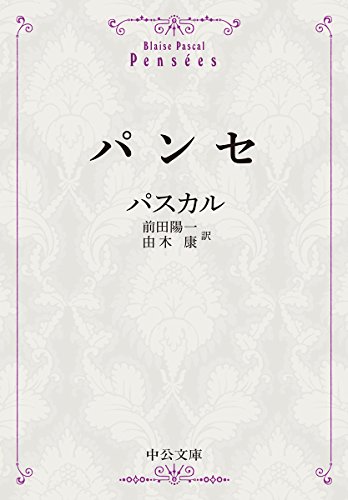 Blaise Pascal, Pensees (Japanese ed., Chuko Bunko)The cover image is an Amazon Associate link. As an Amazon Associate, Puzzlebyrinth earns from qualifying purchases.
Reactions (no login)
Anonymous • one of each per visitor per day
Learn — Curriculum
LearnPart 1 Introduction — Play and PuzzlesChapter 1 What Is Play?8 / 8
Part of these series
The Nature of PlayEpisode 10 of 20