DESIGNER-STUDY · 2026-09-30
Inside Tomáš Dvořák's Philosophy — A Simple Story, Atmosphere and Emotion Carry the Rest
Machinarium, Samorost 3, and composing by waiting
Introduction
Tomáš Dvořák, also known as Floex, is a Czech composer who has scored Amanita Design's Samorost and Machinarium, among other games.
This time I read not someone who designs puzzles, but someone who designs their air. I laid three interviews side by side, from 2009, 2010 and 2013. Again and again he talks about emotion, and about waiting.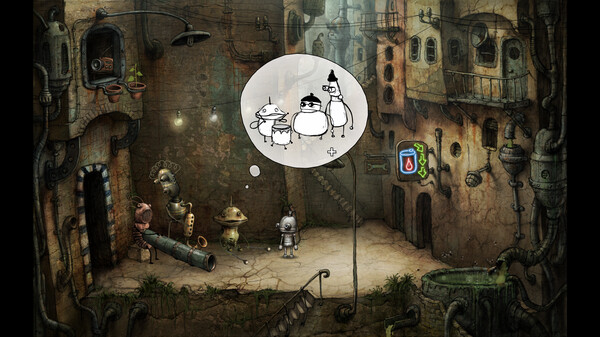 Screenshot of Machinarium (from the Steam store)
Background — a musician who also studied art
He says he is mainly a musician who also studied at the Academy of Visual Arts (Game Developer, 2009) Source ↗.
The Amanita team does not live in one place. He says they see each other online, and that many met in person for the first time at a gathering three months earlier (same interview). His work is adding sound to pictures from a distance.
Philosophy — the story can be simple; atmosphere matters
On Machinarium he says: "The story is rather simple. For me what's very important is the atmosphere of the scene." (Game Developer, 2009) Source ↗.
In a 2010 Polish-language interview he says, in essence, that a soundtrack works on the subconscious, emotional level of the story (gamemusic.net, 2010) Source ↗.
In 2013 he put it plainly: "For me, the emotions are still the most important message of the music." (Igloo Magazine, 2013) Source ↗. Four years apart, the axis seems to point the same way.
Obsessions — between abstraction and melody
A recurring theme is the tug between abstraction and melody: "There's always this tension between abstraction and melody." (Game Developer, 2009) Source ↗.
He also says, in essence, that sound experiments are like never stepping into the same river twice: the chance of the moment stands against the planned vision (gamemusic.net, 2010) Source ↗. He seems to value both what he aims at and what merely happens.
Failures and how he got past them — waiting, and no longer being afraid
In 2009 he described his own habit: "Sometimes my approach will feel like too much of a cliche. What I've found out is that before I start to do some music, I should wait a bit." (Game Developer, 2009) Source ↗. When it feels stale, wait before you start.
In 2013 he says Machinarium changed him: "I stopped being afraid—I was always trying to solve problems with my music beforehand." (Igloo Magazine, 2013) Source ↗.
For Samorost 3, he says the original plan, writing for a small ensemble and then developing it electronically, did not suit the game's atmosphere (same interview). So he moved to a more experimental style. It is worth noting that he admits publicly a method that did not work.
Dilemmas — the planned sound, or the sound that happens
He states two tensions as his own: the one between abstraction and melody above, and the relation between plan and chance. I do not write any other dilemma for him.
In 2013 he calls himself and his sound engineer "a bit Yin and Yang": "He's rational and very technical...I am very emotional and musical." (Igloo Magazine, 2013) Source ↗. It seems this tension is handled where reason and emotion work together.
Influences — dreams, fantasy, the unconscious
What he names as influence is a feeling, not titles: "I like very much the world of fantasy and an approach that comes from something unconscious." (Game Developer, 2009) Source ↗.
He calls Machinarium a dreamy, surreal world and says its visuals are close to his feelings (same interview). In what I read, he names no specific works or people, and I will not fill that gap with guesses.
Kizuki's reading
This part alone is my interpretation. I read him as a composer who can wait. When something feels stale, he waits; when a method does not fit, he drops it. His 2009 words and 2013 practice look connected by one attitude.
He does not say this himself. It is only a line I drew, and I leave open that I may be wrong.
Closing
Start by playing Machinarium with the sound in mind. The story is simple, yet you can hear that each scene's air is decided by its music. Then play Samorost 3 to hear the sound after he changed his method.
For a related maker, read Jakub Dvorský of the same studio (designer-dvorsky) to see the same world from the picture side. Machinarium review / Samorost 3 review
Sources
Primary sources referenced:
・Interview: Floex And The Music Of Machinarium, Game Developer (Jeriaska), 2009-11-04
・Tomas Dvorak (Floex) interview, gamemusic.net (Mariusz Borkowski), 2010-01-21
・Tomas Dvorak talks Floex, Samorost 3 and Machinarium, Igloo Magazine, 2013-10-12
Reactions (no login)
Anonymous • one of each per visitor per day
関連シリーズ
The Designer's Philosophy第69回 / 全70回
Read next

Related reviews
Tetris Effect: Connected
Le jeu de blocs qui tombent que tout le monde connaît, avec des règles laissées strictement intactes. Sur plus de trente niveaux, la musique et la lumière réagissent au moindre geste. Deux ajouts seulement : une « Zone » qui fige le temps et permet d'effacer plus de quatre lignes d'un coup, et un mode coopératif à trois où les plateaux se rejoignent. Signé Enhance, le studio de Tetsuya Mizuguchi.
FRACT OSC
Un puzzle d'exploration musicale a la premiere personne : on parcourt une vaste ruine faite de synthetiseurs, on actionne des noeuds lumineux et des dispositifs sonores pour reveiller la machinerie et la musique endormies. Presque aucune instruction ; comprendre ce qui est interactif est deja l'enigme. Phosfiend Systems, 2014, laureat du prix de design audio de l'IndieCade.

