DESIGNER-STUDY · 2026-10-01
Inside Jenova Chen's Philosophy — Decide the Feeling First, Then Subtract
Reading the maker of flOw, Flower, Journey and Sky in his own words
Introduction
Today's subject is Jenova Chen, co-founder of thatgamecompany, the studio behind flOw, Flower and Journey, and later the creative director of Sky: Children of the Light. He is less a master of puzzles than a designer who starts from the question, "What will the player feel?"
What draws me to him is that he settles on a feeling first and then strips the mechanics down to serve it, rather than starting from win conditions. For anyone thinking about difficulty and kindness in design, it is a way of thinking worth reading once. Here I follow only what he has said himself.
Background — He started a studio to build a feeling
Chen is a co-founder of thatgamecompany, which released flOw, Flower and Journey. He is best known as the creator of Journey, but his own words are rarely introduced. So let me pin down one point of his background in his own voice.
In a 2008 Game Developer interview he looks back on working on Spore at Maxis and says the environment was a good one. Even so, he felt "I'm not getting closer to the goal that I'm looking at," and that is why he left to found his own studio (Game Developer 2008). He measures his path by the distance to his own goal, not by how good the work around him is.
Philosophy — Story is a tool; the goal is feeling
In the 2008 interview, Chen says, "story is a tool, but not the goal of video games." Taking music and experimental film as models, he wants experiences that move people without needing a story (Game Developer 2008).
In Fast Company in 2012 the same idea appears in different words. Games can create a broad spectrum of feeling, he says, yet only a sliver of it is on the market, and modern society is missing "the feeling of not knowing, a sense of wonder, a sense of awe" (Fast Company 2012).
Put side by side, the position looks consistent to me: choose the feeling, then choose the mechanics for it, never the other way round.
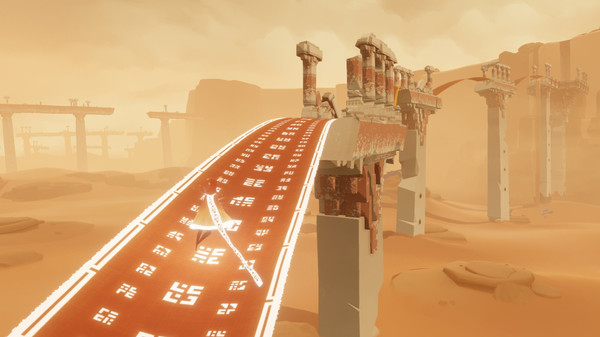 A scene from Journey (Steam store screenshot)
Obsessions — Feelings that cross cultures
What Chen keeps returning to is choosing subjects that anyone can relate to. In 2008 he said, "I'm going to pick the most global feeling," aiming for things that cross culture, gender and age (Game Developer 2008).
His examples are childhood dreams (Cloud), ocean microorganisms (flOw) and flowers (Flower). He also says that English not being his first language is part of the reason (ibid.).
In Journey the idea extends to how players relate to each other. According to coverage of his 2013 GDC talk, he said, "I wanted to see a world where everyone is the same," and left out systems that create hierarchy through visible armor or items (Destructoid 2013).
Failures — "We 400% under-delivered"
The failures he speaks about publicly are concrete. On flOw, work he expected to take four months took eight and delivered only half the original design. "We 400% under-delivered. So you can imagine how much crunch the people had," he says (Game Developer 2008).
He describes making Flower as "like walking in the mist": a game with no precedent has a schedule that cannot be read the way an established genre's can (ibid.).
On Journey he says in 2012, "We convinced ourselves this is not going to be a two-year game; it's going to be a three-year game." He also admits there was confusion and struggle because the team could not agree (Fast Company 2012).
The remedies he names himself are revising the schedule and keeping the team small with one direction. For the latter, he explains that with one artist and one composer, the art cannot drift into different styles (Game Developer 2008).
Dilemmas — Novelty, schedules and how people behave
I can read two tensions in what he says. One is that the more you aim at a new feeling, the less predictable the schedule becomes, which is the "mist" remark above.
The other is the design of distance between people in Sky. In PC Gamer in 2024 he says, "Nobody is born toxic. It's really just the environment we formed" (PC Gamer 2024).
His answer is that in Sky, social features unlock only with mutual consent. He puts it as "you have to earn your rights to apply your social power" (ibid.). I read it as a design that leans toward feeling safe to talk over being free to say anything.
Influences — Mythology and a lonely online game
He acknowledges two influences. One is the mythologist Joseph Campbell. In Fast Company in 2012 he says he read The Power of Myth and The Hero With a Thousand Faces and realized that spirituality had been missing from his early life (Fast Company 2012).
The other is his experience in World of Warcraft. According to coverage of his GDC talk, he said, "The more I played this game, the more people I encountered, the more I realized I had no connection with any of these people" (Destructoid 2013). That sense of loneliness reads to me as the motive for Journey's nameless, wordless companions.
Kizuki's reading
What follows is my interpretation. Chen's design looks to me like working backward from a feeling and subtracting what gets in the way: story is a tool, hierarchy and chat are removed, and social features stay shut without consent. Rather than adding, he first decides the sensation he wants to protect and takes away whatever interferes.
In puzzle design, difficulty and explanation are usually discussed by addition. Reading him, I think that being able to name in one word what you want the player to feel becomes the criterion for cutting. He never presents this as a theory of puzzle design, though; it is purely my reading.
Closing — Where to start
To meet his thinking, I would start by playing Journey through once. Then read the 2008 Game Developer interview, and the point of deciding the feeling first becomes much clearer.
Among my earlier pieces on this site, the one on Kyle Gabler is a useful companion, another designer who talks about design starting from feeling and experience. See Inside Kyle Gabler's Philosophy as well.
Sources
Primary sources consulted for this article:
・Game Developer, "Finding A New Way: Jenova Chen And Thatgamecompany," 2008-05-05
・Fast Company, "Game Designer Jenova Chen On The Art Behind His Journey," 2012-03-12
・PC Gamer, "'Nobody is born toxic' says Journey's creative director…," 2024-03-28
Reactions (no login)
Anonymous • one of each per visitor per day
関連シリーズ
The Designer's Philosophy第70回 / 全70回