SOUNDTRACK · 2026-09-07
Soundtrack: Phoenix Wright: Ace Attorney Trilogy — even the silence was a measure the composer wrote
Composed by Masakazu Sugimori (game 1) / Akemi Kimura (game 2) / Noriyuki Iwadare (game 3)
Why does “Objection!” land just as hard the tenth time as the first?
The answer is simple: the composer built that one line to land as the coolest moment of your day, on purpose. He's said as much himself.
Phoenix Wright: Ace Attorney Trilogy is a deduction game about catching contradictions in testimony, released for Steam by CAPCOM Co., Ltd. on April 9, 2019. The three games it bundles were originally released in Japan in 2001, 2002, and 2004. As Komugi's review notes, your job is cross-examination and presenting evidence. What I'm listening to today is the music of that interrogation room.
The composers were Masakazu Sugimori (game one), Akemi Kimura (game two), and Noriyuki Iwadare (game three), per the credits listed on Steam's “Turnabout Tunes” DLC (as of 2026-08). Sugimori wrote the “Objection!” theme. By ear, it sits around 140 BPM, brass out front over jazz-leaning changes — the kind of thing that straightens your spine the moment it hits. My habit of clocking every track's BPM finished fastest today.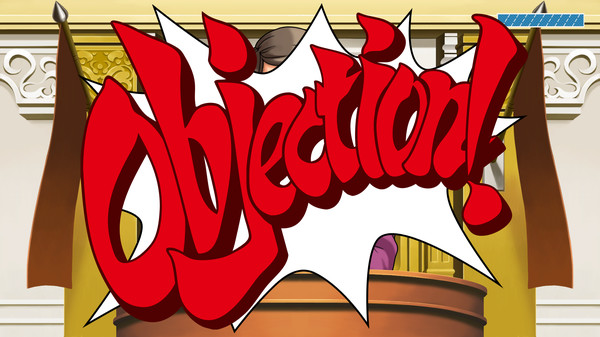 Phoenix Wright: Ace Attorney Trilogy (screenshot from its Steam store page)
Why do the dialogue's letter-by-letter scroll and the music's breathing line up?
In an interview with Time Extension, Sugimori said he synced the music directly to the game's letter-by-letter text display. He'd stop the song mid-line and only let sound back in at the punchline. The silence wasn't a shortcut — it was a measure he wrote on purpose.
Early in development, he felt the GBA's PSG channels alone made the sound too thin. A senior sound designer, Atsushi Mori, suggested switching to PCM channels instead — and once he did, Sugimori recalls, “everything changed: the sound, the headroom, all of it” (per the Time Extension interview, as of 2026-08). Those funky, textured drums only exist because of that switch.
Late in development, Sugimori pushed himself hard enough that his health gave out, and a doctor ordered him to rest. The game got finished partly at the composer's own expense. That one detail reminded me there's always a person behind the score. Phoenix Wright: Ace Attorney Trilogy (screenshot from its Steam store page)
As you close in on a witness, what does the music's tempo change?
The cross-examination music comes in two versions, "Moderato" and "Allegro." It's a relaxed moderato most of the time — but the moment you're closing in on a contradiction, the same theme switches to a faster allegro. The trick is right there in the tempo marking.
The pursuit sections use the same idea. "Pursuit ~ Cornered" has a higher-tension alternate version, and the distance between hunter and hunted becomes, quite literally, a difference in tempo.
So this game's score tells you how far your own deduction has gotten, purely through tempo. Before a single hint is spoken aloud, the music has already given away half of it. Phoenix Wright: Ace Attorney Trilogy (screenshot from its Steam store page)
The testimony's tempo and the music's tempo are tightened by the same screw
Cross-examination has a lot more waiting built into its solving tempo than most puzzles. You listen to testimony one line at a time, and present evidence on the line that feels off. Get it right, and the story moves; get it wrong, and you hear the same line again.
The moderato-to-allegro switch fits that waiting tempo exactly. The music stays relaxed while you're just listening. The instant you spot the contradiction and your finger starts to move, the music has already sped up — whispering in your ear that your instinct is right.
I wrote before about Return to Monkey Island, another score built around dialogue. That one adds sound to the comic timing between lines; this one measures tension, silence included. Same dialogue-driven design, aimed at a completely different feeling.
Footage worth watching
I couldn't find an official upload of any single track on its own. Instead, here are two videos from official channels where you can hear this courtroom's sound for yourself.
First, Capcom USA's official channel: “Phoenix Wright: Ace Attorney Trilogy - Launch Trailer.” It packs the courtroom tension and the “Objection!” payoff into a few dozen seconds, with the game's actual audio intact.
Second, the official Ace Attorney channel's “Ace Attorney Trilogy - Turnabout Tunes Bundle Trailer,” introducing the official soundtrack collection's orchestral, piano, and jazz arrangements — a good look at the bones of the original themes.
Closing — what I'd steal for my own work
What I'd steal is the idea of tying silence to a separate system — the speed of the dialogue's scroll. Instead of measuring silence in bars, measure it in reading speed. Let the music adjust itself to the reader's own pace.
If you're replaying anything, make it the seam where moderato breaks into allegro. One sip of black coffee. It's worth checking again, that moment where the music seems to already know the answer before your own finger has moved.
Sources
・Time Extension: interview with original composer Masakazu Sugimori
・Wikipedia: Music of the Ace Attorney series
・Wikipedia: Phoenix Wright: Ace Attorney – Trials and Tribulations (composer credit)
・YouTube: Phoenix Wright: Ace Attorney Trilogy - Launch Trailer (Capcom USA, official)
・YouTube: Ace Attorney Trilogy - Turnabout Tunes Bundle Trailer (Ace Attorney, official)
・Komugi's review: Phoenix Wright: Ace Attorney Trilogy
・On images: the three screenshots in this article come from the game's Steam store page (URLs taken as-is from the appdetails screenshots endpoint). This run's execution environment could not reach the Steam image CDN directly, so captions were kept general rather than asserting specific content.
Reactions (no login)
Anonymous • one of each per visitor per day
Part of these series
Puzzle SoundtracksEpisode 91 of 100
Read next
Related reviews
Zero Escape: The Nonary Games
Two Spike Chunsoft mystery adventures in one package: nine people are locked inside a facility and must pass through numbered doors to get out. It bundles the DS-born Nine Hours, Nine Persons, Nine Doors with its sequel Virtue's Last Reward, alternating first-person escape-room sections with branching novel sections.
Eliza
A visual novel about a woman who returns to work as the human voice of an AI counseling app, reading its scripted lines aloud to clients. Written by Matthew Seiji Burns and made by Zachtronics, the studio behind Opus Magnum, it ships with a kabufuda solitaire game on the side.
Phoenix Wright: Ace Attorney Trilogy
A courtroom adventure in which you play defense attorney Phoenix Wright, matching one line of testimony against one piece of evidence to break a lie. Capcom's collection gathers all fourteen episodes of the three games first released between 2001 and 2004, with the art redrawn frame by frame.


