ESSAY · 2026-08-14
'Game' Cannot Be Defined — Wittgenstein × Baba Is You
"The Nature of Play," long-form slot. On a night I fail to define 'puzzle,' Wittgenstein lends me the idea of family resemblance
I Can't Write "What Is a Puzzle?"
Late at night, a glass of whiskey. I sat down to add one paragraph to the site's intro page and my hands stopped. "Puzzlebyrinth is a site about puzzles. A puzzle is—". I couldn't finish the sentence. Write "a problem with a single correct answer" and you lose the experimental pieces with no answer at all, and the levels with many. Write "something you solve with logic" and you lose the riddles cracked by one flash of insight. Stretch it to "something you figure out by trial and error" and suddenly action games and even cooking wander in. I wrote a definition in my sketch notebook, erased it, wrote another, erased it — and an hour had melted away.
Last time Caillois taught me to split play into four drives, and it felt great. Tonight I do the opposite. Can words like "puzzle" and "game" be captured by a single definition at all? It turns out philosophy has a famous regular on this exact question: Ludwig Wittgenstein, Philosophical Investigations (1953). As promised last time, tonight I go ask him.
"Don't Think, but Look!" — The Philosopher Who Made Us Give Up on Definitions
Philosophical Investigations came out after Wittgenstein's death, and it has an odd shape: a long parade of short, numbered remarks. In §66, of all examples, he picks "games." Board games, card games, ball games, fighting games — surely, we want to think, there is something common to everything we call a game. And he pushes back: don't think, but look! (§66). Look one by one and you find no single thread running through them all. There are games with no winning or losing (a child throwing a ball at a wall). There are games of skill and games of pure luck. What you find is only a web of similarities, overlapping here and there.
In the next remark, §67, he gives the web a name: family resemblance. Line up a family photo and there is no single feature everyone shares, yet this one's eyes, that one's build, another's way of walking — the likenesses nest into each other, and the family unmistakably has "a face." The word "game," he suggests, is built the same way. I'll limit tonight's technical terms to two: this "family resemblance" and, coming up later, "language game."
What hooks me as a maker is what follows. There is no definition, and yet the word works fine. None of us can state the definition of "puzzle," yet we glance at a new release and call it: "ah, that's a puzzle." In §43 of the same book Wittgenstein puts it in a famous way: the meaning of a word is (in most cases) its use in the language. Meaning lives not in the dictionary but in how the word gets used. And he called this whole weave of words and actions a "language game." With words we cannot define, we all manage to play perfectly well, every day.
The Rules Are Lying on the Board — Baba Is You
There is a game that feels like this argument made playable: Baba Is You (Hempuli / Arvi Teikari, 2019). It looks like a sokoban-style puzzle, but it carries one decisive invention: the rules lie on the board as word blocks. BABA IS YOU. WALL IS STOP. FLAG IS WIN. And you can push these word blocks around like crates. Break the line WALL IS STOP and walls stop no one. Rearrange FLAG IS WIN into ROCK IS WIN and the victory condition itself is rewritten.
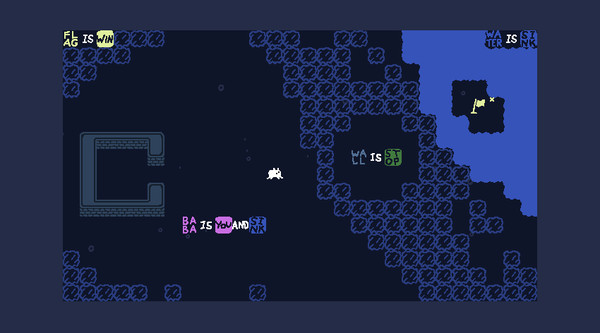 Baba Is You (from the official Steam screenshots)
What gives me goosebumps while playing is that in this game the meaning of a word literally is nothing but its use on the board. The word WALL carries no built-in wall-ness at all. The instant you line up WALL IS YOU, the walls become the player. I know no other example that implements §43's "meaning is use" this bluntly. Moving words just is acting — the weave Wittgenstein called a language game has become level design itself.
And the game teaches family resemblance through your hands too. Across its 200-plus levels, what you do changes completely from one to the next. A level about pushing, a level about melting yourself, a level about rebuilding what "winning" even means. Try to state the one core common to all of them and you can't quite say it. Yet every level wears the same family face called Baba Is You. Players never get handed a definition; they learn the game's "likeness" purely by meeting the relatives.
Blurred Edges Are Not a Defect
In §71 Wittgenstein asks himself: is a concept with blurred edges defective as a concept? Is an out-of-focus photograph even a photograph? And then he turns it around — aren't there moments when the blurred picture is exactly what we need? That one remark felt like it redeemed my lost hour. I couldn't write "what is a puzzle" not because I'm bad at putting things into words, but because "puzzle" was a family name with blurred edges from the start.
It also tidies up this series' shelf. Huizinga showed play as a single picture — the magic circle — and Caillois split it into four drives. Wittgenstein stops one step earlier and says: don't assume one word can wrap it all. That sounds like a contradiction, but it isn't. The circle and the four categories are tools for looking well at a family with blurred edges — not the family's civil registry. It made me a little happy to see the tools this series has borrowed join hands one level deeper down.
Seen that way, several of my site-running worries get lighter. Our labs shelf holds experiments with no right answer and games with luck mixed in. The definition-minded me worried the "puzzle site" sign would become false advertising. But thinking in family resemblances, what's needed is not a border but an account of kinship. "A cousin of the crossword." "A grandchild of sokoban." If you can introduce the newcomer as a relative, it may join the family.
Takeaway — Don't Guard the Genre With a Definition; Grow the Family
Tonight's discovery is this: the "definition of puzzle" doesn't need to be written. Failing to write it is the normal condition, and the word keeps working anyway because we use words through webs of similarity, not definitions. The takeaway in one line — when planning a new game, stop asking "does this satisfy the definition of a puzzle?" and instead write in the sketch notebook "which existing games does it share a face with, and in which features?" Eyes like a crossword, gait like Tetris — a rough family tree is plenty. If two resemblances turn up, it's already the family's newest member.
Let me show the core just once — I think a genre starts to starve the moment you guard it with a definition. Every time we turn something away with "that's not a puzzle," one face disappears from the family photo. Baba Is You itself would never have been born if someone had ruled "moving the rules around isn't a puzzle." Finishing the whiskey, I redrew the eraser-scarred definition in the corner of my notebook as a family tree. That's it for tonight.
Last, I want to ask you. Is there a game you hesitated to call a puzzle (or a game at all)? What stands at the far edge of your family photo? Tell me in the comments. Next time the long-form slot returns to the reading series: part two of Caillois's Man, Play and Games — into the second half, where the four drives work not solo but in combination.
References: Ludwig Wittgenstein, Philosophical Investigations (Japanese edition: trans. Akio Kikai, Kodansha).
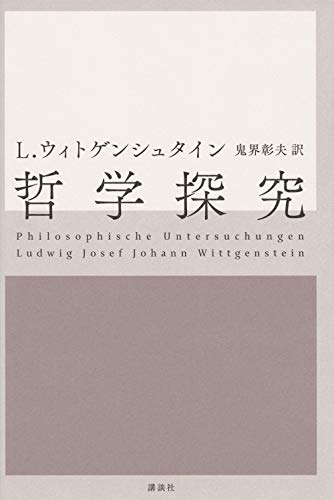 Wittgenstein, Philosophical Investigations (Japanese ed., trans. Akio Kikai, Kodansha)The cover images are Amazon Associate links. As an Amazon Associate, Puzzlebyrinth earns from qualifying purchases.
Reactions (no login)
Anonymous • one of each per visitor per day
Learn — Curriculum
LearnPart 1 Introduction — Play and PuzzlesChapter 1 What Is Play?5 / 8
Part of these series
The Nature of PlayEpisode 12 of 21