ESSAY · 2026-09-22
What Does It Mean to Be Good at a Game? Skill, Knowledge, or Where You Look
Seating Descartes and Polanyi across from each other, on the board of Into the Breach
Two people, the same board: three minutes and twenty
Night. A glass of whisky. This is about the day I asked two people to playtest my own puzzle.
Same board, same explanation, same hour of the evening. One solved it in three minutes. The other took twenty.
Here is the interesting part: the one who took twenty knew every standard line. When it was over, they explained why each move was correct better than I could.
No deficit in knowledge. Still slow. So what is "being good"? Skill? Knowledge? Attitude? I wrote the three of them down the margin of my drafting notebook.
The game I brought to the table is Into the Breach (Subset Games, 2018): three mechs defending a town from bugs, on a small tactical grid.
This game hides almost nothing. Where each enemy will strike next turn is drawn on the board with arrows and numbers. There is no hit chance to miss with.
Which means the strong player and the weak player receive literally the same information. And the gap is still obvious. If being good were a matter of knowing things, that gap could not exist.
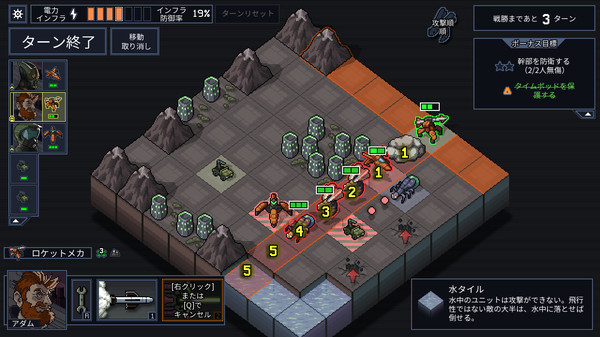 A rocket mech selected, its red attack range and numbered markers drawn over the board — Steam store screenshot
In the margin of the notebook, two men take "being good" apart
So I sat them down. On one side, the man of method: Descartes. On the other, the man of what cannot be said: Michael Polanyi. The lines below are my own reconstruction, inferred from their writings. They are not records of anything either man actually said.
Descartes. "I see no need for the word 'good'. What is needed is a method. In the Rules for the Direction of the Mind I wrote that it is better not to search for truth at all than to search without a method. Break the board down until it cannot be broken further. Reorder it from the simplest parts. Do that, and differences of natural talent disappear."
Polanyi. "And how do you do that breaking down?"
Descartes. "By following the order."
Polanyi. "Before you can follow an order, you must see where the thing breaks. I opened The Tacit Dimension with a single line: we can know more than we can tell. You can pick a friend's face out of a thousand. Can you say how you did it? You cannot. And you still do it."
Descartes. "You cannot say it because you have not yet taken it apart. In the ninth rule I wrote: turn the mind's gaze upon the smallest and easiest things. And that method and practice count for far more than natural gifts. Practice is required. But it is practice in applying a method, not in some nameless thing."
Polanyi. "You just said it yourself: turn the gaze. You are talking about where attention goes. Think of a stick. When a blind man probes the road with it, what touches his palm is the handle. But what he feels is the stone at the far tip. The moment he brings his attention back to his palm, the stone disappears. The same sensation, passed from one place to another. That is where being good lives."
Descartes. "The feeling in the palm is raw material for the method. Not attending to your material is not the same as having no method."
Polanyi. "I would not say it is the same. But a rule you can write down can only be handed to someone who can already use it. The road from receiving the rule to being able to use it lies outside the rule."
At this point I remembered the recording of the playtest. The one who finished in three minutes barely looked at the enemies. What she watched were the buildings, and the empty tile she was pushing things into. In Into the Breach too, most missions are not won by wiping out the enemy. They are won by surviving a set number of turns with the town still standing. Killing bugs is one means among several.
Descartes. "…That is simply a warning not to mistake the end for the means. It is my own rule."
Polanyi. "Quite. And when the hand moves to that end without having to recall it each time, that is what people call being good."
At this point the two are saying nearly the same thing: being good is not a quantity of skill or of knowledge, but a matter of where attention has landed. One disagreement survived. Descartes says the landing place can be taught. Polanyi says what can be taught is the pointing finger, and the rest is done by the person's own body.
I stand half a step toward Polanyi. But what I can design, as a maker, is not the attention itself. It is the shape that shows a player, afterwards, where their attention had landed.
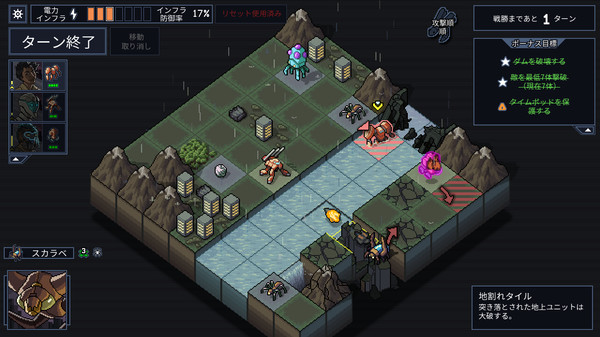 A green island with a river and a dam; the right panel shows one turn to victory and three bonus objectives — Steam store screenshot
Takeaway — return the miss, not the clock
If I write the takeaway in one line: when you display skill, do not display a time or an accuracy rate. Return the player's miss to them.
Into the Breach has Reset Turn. Once per battle, you can rewind to the start of the current turn.
One use is obviously too few. Nowhere near enough to brute-force your way to the answer. But it is exactly enough to go back after the "oh — that building". This rewind is not there for searching. It is there for noticing.
I made the edit in my notebook. I removed the timer from my own puzzle's clear screen. In its place, a single board: the one where the player's hand stopped for longest. No solution shown. All that remains is where they were not looking.
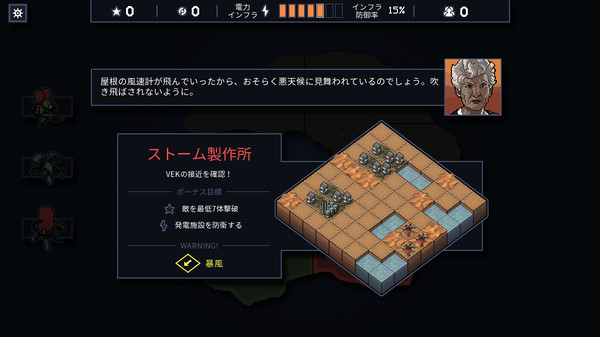 The pre-mission briefing; a storm warning sits under the bonus objectives — Steam store screenshot
Earlier in this series I tried to draw a line between knowledge and skill in Is It Still "Solving" If You Looked Up the Answer?. In Is Difficulty Unkind? two philosophers ended up side by side, both refusing the death you cannot learn from. Today's question about being good sits after those two. On Into the Breach itself, I wrote the review.
I want to ask you something. The last time you watched someone and thought "they are good at this" — where on the screen were they looking? And when you feel bad at a game yourself, what is missing: information, or the place to look?
Next in the short slot: "Is Stacking Up Unplayed Games Part of Playing? — ownership and experience". I will put the shelf of things bought and never launched in front of those two again.
References: Michael Polanyi, The Tacit Dimension (Japanese edition, trans. Isao Takahashi, Chikuma Gakugei Bunko) / René Descartes, Rules for the Direction of the Mind (Japanese edition, trans. Matao Noda, Iwanami Bunko).
 Michael Polanyi, The Tacit Dimension (Japanese edition, trans. Isao Takahashi, Chikuma Gakugei Bunko)
 René Descartes, Rules for the Direction of the Mind (Japanese edition, trans. Matao Noda, Iwanami Bunko)Note: the book covers are Amazon Associate links. As an Amazon Associate, Puzzlebyrinth earns from qualifying purchases.
Reactions (no login)
Anonymous • one of each per visitor per day
Part of these series
The Nature of PlayEpisode 21 of 21