COUNTER-REVIEW · 2026-09-21
Counterpoint on SUPERHOT — Reading Through the Negative Reviews
What Komugi's review didn't say
Introduction
Komugi's review gave SUPERHOT an 8.2 — a first-person puzzle game that SUPERHOT Team built and published itself, released February 25, 2016. "Time moves when you move" is basically the whole pitch in one line. An 8.2 out of 10 sits on the high side even by her own scale. SUPERHOT — official Steam store asset
As of 2026-09-21, Steam counts 40,761 reviews, 37,315 of them positive — 91.5%, "Very Positive." Only 3,446, or 8.5%, are negative. But a small share doesn't mean a weak argument. Komugi herself noted that the positive and negative crowds describe the same thing — only the sign differs.
Komugi's conclusion was that fusing verbs and time into one mechanic works as a system, not just a mood, which is why it scores high. She also wrote that nearly all of the negative side's complaints trace back to the "control layer." My interest doesn't stop there. Which complaints did Komugi's review simply not reach? I'll sort out where I agree and where I don't.
What the negative reviews claim
The first complaint the negative side raises is a length-versus-price mismatch. The campaign runs roughly two to three hours, at around $25 outside of sales. A decade later, the same complaint persists — some reviewers even joke that being short is the game's only virtue.
The next most common complaint is burnout somewhere past the first hour. You can move, shoot, throw, and grab — not much more — and the back half increasingly reads as the same steps repeated.
Plenty of reviewers name rough controls specifically. Movement and aiming feel unnatural, and moments demanding precise real-time shooting or melee build up stress. Calls for a better ammo readout, cleaner melee detection, and complaints about an unfriendly UI stand out.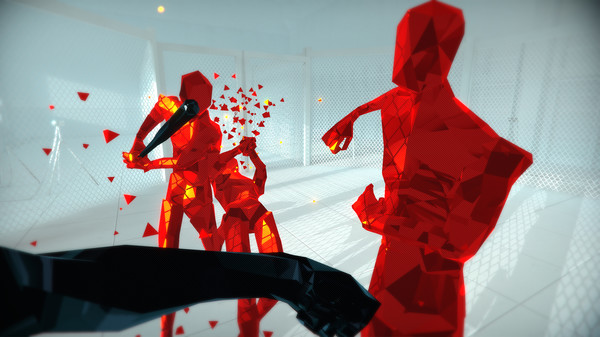 Reading frozen enemies mid-combat — Steam store screenshot
There's also resistance to the tone and story. Some call the hacker-style meta-narrative, the screen-filling red text, and the grating voice acting "too much" or "a tech demo dressed up big." A few also point to a thin tutorial and a steep early difficulty spike — unfriendly, they say, for the price.
Examining 1 — Is the length and repetition complaint fair?
Rereading Komugi's review turns up an irony. The length/price complaint mostly sits in the positive column, not the negative one. Two recommended reviews with 268 and 109 votes both say "good, but $25 is steep." The single top-voted recommended review, at 631 votes, goes further: the campaign is only the preamble — the real game is the post-clear challenge modes and Endless.
So when the negative side calls it short, they're not wrong about the fact. The problem is that this structure is almost invisible on the store page. Anyone who quits at hour three hasn't, in Komugi's own words, touched the puzzle's real body yet. That's a failure of information before purchase, not just a lack of grit.
The burnout complaint comes from the same root. The verb list really is short, but complexity is meant to grow later — in the challenge modes and NG+ — through combination. Players who stop at the base campaign never see that growth. So "bored after an hour" reads to me as evidence of a guidance failure, not evidence that the game is shallow.
Examining 2 — How to read the controls and tone complaints
On rough controls, Komugi's own conclusion already lands on the core of it. This is a time-manipulation puzzle meant to be solved by reading, yet the very last input is decided by real skill. Where Timelie and Portal mostly banish execution failure from the board, SUPERHOT keeps a margin of execution noise all the way through. The reported "friction" in thrown weapons traces back to its physics doing exactly that.
Looking at how control schemes and puzzle design usually interact, most successful examples cut execution variance as the board gets harder. SUPERHOT goes the other way — the deeper you go into Endless, the more reflexes matter. That's not "you're bad at shooters"; it's a coherent design critique.
The tone reads differently, though. The red text and hacker-voiced narration are a deliberate choice tied to the white room's symbolic identity. The sequel, SUPERHOT: MIND CONTROL DELETE, didn't tone this down — it turned it up. The fact that the studio didn't back off tells me this was policy, not an accident.
Where I agree
What I agree with most strongly is the lack of pre-purchase information and the rough controls. That the real game lives in the challenge modes and Endless is exactly the kind of thing a store page should state plainly, and Komugi's 8.2 doesn't dock enough for that omission. Keeping execution skill in a puzzle meant to be solved by reading also leaves the friction the negative side keeps naming.
I also agree on the difficulty ramp. The early tutorial barely teaches the basic habit of reading a frozen room before you move. The early deaths that feel unfair come less from the short verb list itself than from how thinly that habit gets taught — something Komugi's review barely touches.
Where I disagree
Where I don't agree is the resistance to tone and story. The red text and the grating voice work are a consistent choice meant to preserve the white room's symbolism, and the sequel doubling down on it rather than dialing it back backs that up. Calling a matter of taste a design failure is a weak critique.
Nor do I agree with the simplification "short means bad." A two-to-three-hour campaign is only the doorway into a much longer work once you count the challenge modes and Endless. The real complaint should be "nobody told me about that structure before I bought it," not "short" — and negative reviews that blend the two don't convince me.
Reviews referenced
This piece was written from the Steam store page's user reviews as of 2026-09-21.
・Steam: SUPERHOT (Overall 91.5% positive, 37,315 of 40,761 reviews positive, 3,446 negative)
・Read the top negative reviews sorted by helpful and by recent (both in English)
・Komugi's review (2026-08-22) referenced as a point of comparison
・Images are the screenshot URLs returned by Steam's appdetails and the store page's header image, used as-is
Closing
So how much of this negative side do I side with? On the lack of pre-purchase information, the rough controls, and the thin difficulty teaching — I agree with the negative side. On the resistance to tone and story, and on the "short means bad" simplification, I don't. Of five claims, I back three and set two aside.
That splits the purchase call. I wouldn't recommend it to anyone buying purely for shooting-game satisfaction, or anyone who breaks at the first difficulty wall — those are exactly the weaknesses the negative side names.
But if you like puzzles solved by reading, and you can treat the two-to-three-hour campaign as a prologue you'll follow into the challenge modes and Endless, it's worth full price. If you can't commit to that, waiting for a sale and trying just the campaign is the practical move. Know, before you buy, that the real game sits past the campaign — that's the one practical line I'll take from the negative reviews.
Reactions (no login)
Anonymous • one of each per visitor per day
関連シリーズ
The Counter-Review第24回 / 全24回
Read next
Related reviews
SUPERHOT: MIND CONTROL DELETE
La suite de SUPERHOT, le puzzle d'action à la première personne où le temps n'avance que lorsque vous bougez. Il abandonne les niveaux construits à la main, un par un, pour un format de combats enchaînés dans des salles distribuées au hasard, et y ajoute un système de capacités à choisir pour se renforcer. Le troisième jeu de SUPERHOT Team.
SUPERHOT
Un jeu de tir à la première personne fait uniquement de pièces blanches et de silhouettes rouges. Mais le temps du monde n'avance qu'à la mesure de vos propres mouvements. Les armes se prennent aux ennemis, et un seul impact suffit à mettre fin à la partie. Une œuvre de SUPERHOT Team, née d'un prototype de game jam.
The Gardens Between
Avec seulement deux flèches pour faire avancer ou reculer le temps et un bouton de validation, la jeune Arina et le jeune Frendt gravissent des îles de souvenirs. Ce que l'on déplace, ce n'est pas les personnages mais le temps lui-même, qui dénoue sans un mot des scènes d'enfance. Une œuvre de The Voxel Agents.


