SOUNDTRACK · 2026-09-06
Soundtrack: La-Mulana — sounding out a past that never existed, in 8-bit memory
Takumi Naramura / Houryū Samejima
Introduction — sounding out a past that never existed, in 8-bit memory
La-Mulana is an exploration-driven puzzle-action game released by NIGORO in 2013 (see Komugi's review; difficulty rated "Oni," the site's top tier, with an estimated 45-hour clear time). Its music was written by Takumi Naramura and Houryū Samejima (per the English Wikipedia, as of 2026-09). Going back to the original 2006 freeware release, these tracks are deliberately built as a tribute to 1980s MSX home computer games.
Here's what I find fascinating. The story is set in the ruins of an impossibly advanced ancient civilization that supposedly existed long ago. A past that never existed, holding technology that never existed either. The music running under it isn't the sound of a real MSX at all — it's a memory built after the fact, an answer to "what would an MSX have sounded like." A nonexistent past, voiced in the manner of a memory that never existed either.  La-Mulana (Steam store page)
How did a track manage to stay un-boring through the site's hardest-rated puzzles?
La-Mulana carries this site's top difficulty rating, "Oni" (see the review). Its hints are deliberately unhelpful, so getting stuck means walking back into the same room again and again — a design built around dying repeatedly and retracing the same corridor.
In August 2009, developer NIGORO ran a reader questionnaire about the music on its own blog (la-mulana.com, 2009-08-22). A reader named "io" wrote this about the exploration theme "Mr. Explorer": "Even you die or lost a life in the game, the music makes you like and try again and it's not boring."
It's also worth noting how track titles double as room labels. In that same thread, composer Naramura himself confirms that the early area "Guidance Gate" is scored by "Fearless Challenger." However many dozens of times you walk back into that room, the track's own name keeps telling you not to be afraid. 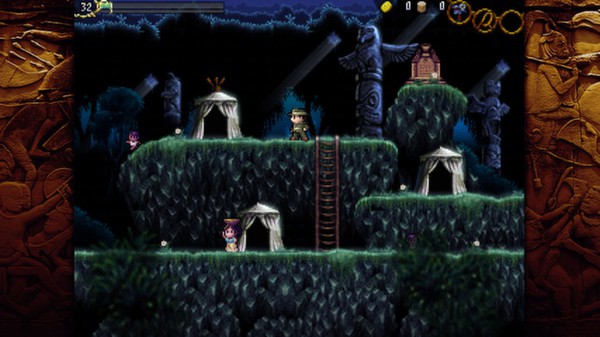 La-Mulana (Steam store page)
How does a long dwell time balance against a short musical loop?
In La-Mulana, the time you spend in any one room can run long — tens of minutes, sometimes hours, rereading the same handful of wall carvings. But the music loop itself is short. That gap ought to be exactly the kind of thing that breeds irritation.
It doesn't, and I think that's because the loops are written to push forward like a march rather than sink into a minor key. I have a habit of measuring every piece of music in BPM, and this series' theme tracks all run fast and bouncy. That's not a tempo built for long thinking — and yet it works the other way, nudging you toward "come on, get moving." It's the exact opposite answer from games that make you wait in silence, like The Witness or Taiji.
Tracks worth hearing
The official release is NIGORO's own "La-Mulana Original Sound Track" series on Bandcamp (composed by Takumi Naramura / Houryū Samejima).
・LA-MULANA ↗ — the track carrying the album's own title. Its confident theme is the face of the ruins-exploring main story.
・Fearless Challenger ↗ — the theme for the early area "Guidance Gate," confirmed by the composer's own blog comment.
・Mr. Explorer ↗ — the exploration theme a reader praised in 2009 as "the track that makes you want to try again even after you die."
Closing — what I'd steal
Here's what I'd steal. For a game that keeps you in one place for a long time, reach for a forward-marching tempo rather than a melody that sinks — don't let the music's own darkness stand in for boredom.
One more thing worth keeping. Building "nostalgia" always carries some risk of borrowing a little too much from a real memory. In 2009, Naramura admitted it himself and promised to fix it. A game built around a fabricated past owes its audio, of all things, some honesty about where the sound actually came from.
References
・Steam: La-Mulana (official store page, NIGORO)
・NIGORO — La-Mulana Original Soundtrack [Remaster] (official Bandcamp)
・Wikipedia: La-Mulana (MSX-tribute design, composer credits)
Reactions (no login)
Anonymous • one of each per visitor per day
関連シリーズ
Puzzle Soundtracks第90回 / 全100回
Read next

Related reviews
Tetris Effect: Connected
Le jeu de blocs qui tombent que tout le monde connaît, avec des règles laissées strictement intactes. Sur plus de trente niveaux, la musique et la lumière réagissent au moindre geste. Deux ajouts seulement : une « Zone » qui fige le temps et permet d'effacer plus de quatre lignes d'un coup, et un mode coopératif à trois où les plateaux se rejoignent. Signé Enhance, le studio de Tetsuya Mizuguchi.
FRACT OSC
Un puzzle d'exploration musicale a la premiere personne : on parcourt une vaste ruine faite de synthetiseurs, on actionne des noeuds lumineux et des dispositifs sonores pour reveiller la machinerie et la musique endormies. Presque aucune instruction ; comprendre ce qui est interactif est deja l'enigme. Phosfiend Systems, 2014, laureat du prix de design audio de l'IndieCade.

