SOUNDTRACK · 2026-09-23
Soundtrack: Somerville — music the game only allows itself at reunion
Dominique Charpentier / Matteo Cerquone
Introduction — a fleeting melody follows one car from above
Somerville opens with a family fleeing by car. The camera tracks that single vehicle from high above, and only there does a sentimental melody appear. Out of habit I tried to clock its BPM, and quickly realized this score has no intention of letting anyone count a beat. Released by Jumpship in 2022, this first-person puzzle adventure carries not a single line of dialogue (Komugi's review).
The music was written by Dominique Charpentier and Matteo Cerquone, with Jay Steen as audio programmer. But after that opening melody, the score doesn't come back for a long while. As the father searches the rubble for his family, all you hear is wind, your own footsteps, and something creaking far away.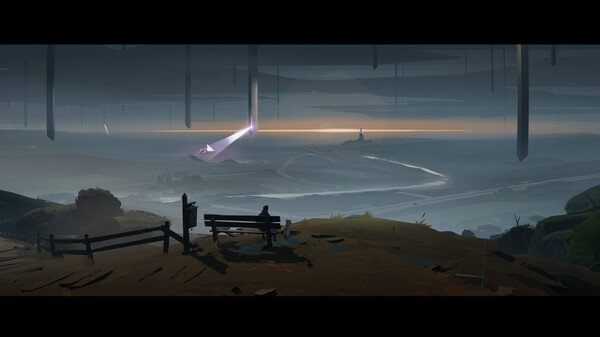 From a screenshot on Somerville's Steam page. A wordless world, walked in search of family.
A hidden link — the man behind LIMBO's silence also shaped this one
Jumpship was founded by Dino Patti, co-founder of Playdead, the studio behind LIMBO and INSIDE. Martin Stig Andersen, who scored both of those games, is known for erasing the line between music and ambience (see the LIMBO piece). That same bloodline runs through Somerville's quiet.
The difference is that Somerville has a concrete person to reunite with: family. Music is reserved almost entirely for the moments they come into view. The Steam soundtrack's own tracklist makes this plain — after "Intro," "Chased," and "Trapped" come "Reunited" and "Family," before "Abduction" pulls the score away again. The music itself is counting whether the family is present or gone.
A puzzle-specific trait — the hand that melts things and the hand that withholds music move the same way
The puzzles run on three powers the father picks up along the way. Blue light liquefies hard matter; red light solidifies soft matter into stone; purple light attracts or repels objects. You walk the world looking for light sources and work out where each power applies — nothing on a timer ever rushes you.
 Also from Steam's screenshots. Blue light liquefies, red light solidifies — this pair of states is the key to every puzzle.
The music is handled with the same two-value logic as the puzzles: dissolve a cue away, or solidify it back in, scene by scene. GameSpot's review called the opening car scene's music "emotive, like the first few minutes of The Shining," then noted that for most of what follows, music is "wisely nowhere to be found." Withholding sound becomes the direction itself.
The puzzle analogy — an unhurried procedure matches an unhurried score
Fail a puzzle in Somerville and you're back on your feet instantly; the penalty is light, so you test each power at your own pace. That unhurried procedure matches the tempo of a score that almost never plays. The silence you spend checking your own next move is the same time you spend solving the puzzle.
Where The Witness (covered here recently) commits fully to having no music at all, Somerville chooses "not zero, but extremely little." There's a real design gap between zero and a small amount — placing not one note versus placing exactly two changes how much weight those two notes carry. I'm more drawn to the harder bet: betting on a small amount.
Tracks worth hearing — via JUMPSHIP's official channel
There's a standalone soundtrack release for this game, but I couldn't find an official YouTube upload of the individual tracks in full. Instead, here's where the score speaks loudest, straight from developer JUMPSHIP's own channel.
Near the end of that video, the melody that plays as the family's silhouettes overlap is exactly the "music for reunion" I opened this piece with. For more of the score's texture, JUMPSHIP's own early teasers help too — SOMERVILLE Teaser Trailer #1 (official JUMPSHIP) ↗ and SOMERVILLE Teaser Trailer #2 (official JUMPSHIP) ↗. Both are useful for gauging just how long the silences run.
Closing — steal the idea of a "music balance"
If I were writing a score, this is what I'd steal: don't spend music whenever you can, set a balance in advance and save it for the one scene that earns it. Somerville only spends its melody at reunion, and that restriction is what raises the price of that single moment.
Play it back some night while you're waiting for someone to come home, once your black coffee has gone down halfway. If LIMBO and INSIDE used silence to build dread, Somerville uses the same silence to build a homecoming. Change only what you place at the far end of that quiet, and the whole expression changes with it.
References
・GameSpot: Somerville Review — I Wanted To Believe
・Gematsu: Former Playdead CEO co-founds new studio Jumpship, announces first project Somerville
Reactions (no login)
Anonymous • one of each per visitor per day
関連シリーズ
Puzzle Soundtracks第105回 / 全111回
Read next

Related reviews
Tetris Effect: Connected
Le jeu de blocs qui tombent que tout le monde connaît, avec des règles laissées strictement intactes. Sur plus de trente niveaux, la musique et la lumière réagissent au moindre geste. Deux ajouts seulement : une « Zone » qui fige le temps et permet d'effacer plus de quatre lignes d'un coup, et un mode coopératif à trois où les plateaux se rejoignent. Signé Enhance, le studio de Tetsuya Mizuguchi.
FRACT OSC
Un puzzle d'exploration musicale a la premiere personne : on parcourt une vaste ruine faite de synthetiseurs, on actionne des noeuds lumineux et des dispositifs sonores pour reveiller la machinerie et la musique endormies. Presque aucune instruction ; comprendre ce qui est interactif est deja l'enigme. Phosfiend Systems, 2014, laureat du prix de design audio de l'IndieCade.

