REVIEW · 2024-12-11
LOK Digital
Lire un puzzle façon mots-mêlés — l'adaptation entre papier et écran
Introduction
You spell words of an invented language, 'LOK,' onto a grid of letters. Each word blackens its own letters and, by its own fixed effect, fills in other cells too. Fill the whole grid and the level is done — the world of the 'Lok' creatures grows a little. It adapts a physical puzzle book by Blaž Urban Gracar; Letibus Design and Icedrop Games built the digital version, published by Draknek & Friends in December 2024.
I write this from the Steam review pool. The label is 'Very Positive,' 98% of 433 reviews (snapshot 2026-07-15; 513 of 518 total are positive). Edge gave 8/10, Pocket Gamer 4/5. On the numbers it's near-unanimous — but the praise is not one thing.
Read the pool and the recurring axis is 'paper vs. digital,' with those who know the original book debating the port, plus a recurring metaphor: 'a word search with superpowers.' I'll read both axes in design terms.
 LOK Digital — Steam store
First Impressions
Line up the helpful positive reviews and the vocabulary rhymes: unique, clever, and above all 'aha' and 'eureka.' 'It never made me feel stupid for not seeing it,' 'I said OH, that's how it works, every time' — those phrasings recur across reviews, alongside praise for the hand-drawn art, meditative music, and the cuteness of the creatures.
The qualified voices are steady too: 3-6 hours is on the short side, and $14.99 draws a 'bit expensive.' One reviewer admits it got 'a little TOO mind bending'; another splits it as 'Worlds 1-8 are the tutorial, the real game is the end.' A year and a half on, the talking points have barely moved.
What interests me is how often praise and reservation point at the same spot: one reviewer's welcome 'room to think' is another's 'too many possibilities, so I brute-forced it.' My job is to translate where opinions fork, not to stage a fight.
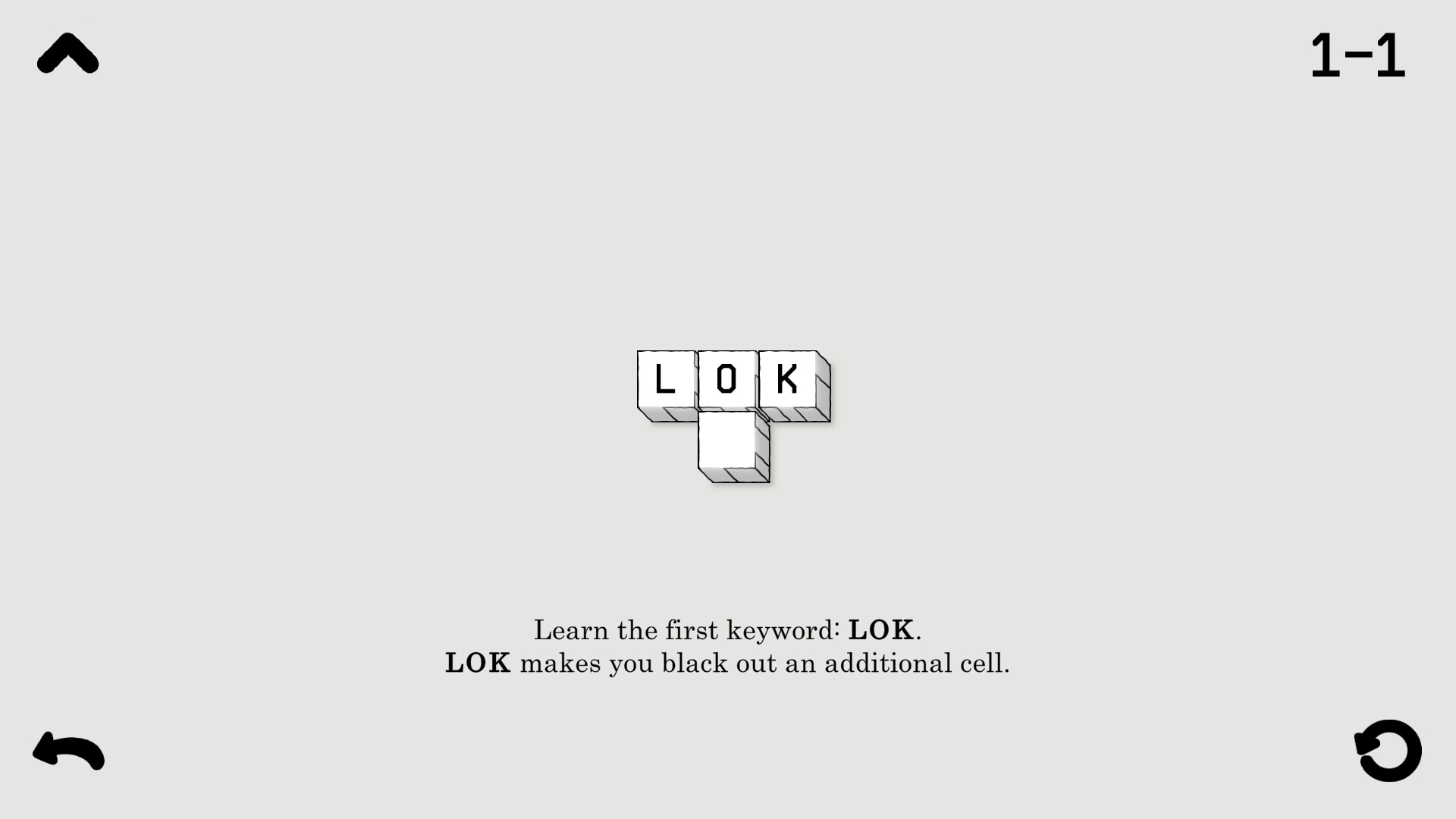 Spelling invented words onto the grid — Steam store
Putting the Mechanics into Words
What the positive reviews stress is that this is 'not just a word search.' The words aren't English but 'truths' of the invented LOK language. Spell one and it blackens its letters and fires a fixed effect: as one reviewer explains, LOK fills its three letters plus one cell you pick; TLAK four plus two; X slots freely between the letters of other valid words. Spent cells leave the grid, so adjacency keeps shifting.
That 'the grid rewrites itself as you spend it' structure is what Puzzlebyrinth calls grammar. Each word behaves as a verb that edits adjacency. And LOK's cleverness is that its words carry no meaning: being nonsense, they push you toward pure structure rather than semantics — a subtraction of meaning. 'A word search with superpowers' is that lightness.
Even the fans add a caveat: as the vocabulary grows, 'too many possible words, so it turns from logic into brute force.' One long review admits the late game was more fun after opening every hint first. More verbs, more combinatorial explosion — I'll return to that under difficulty. If Baba Is You is about arranging words to rewrite the rules, LOK is about spending words to rewrite the board.
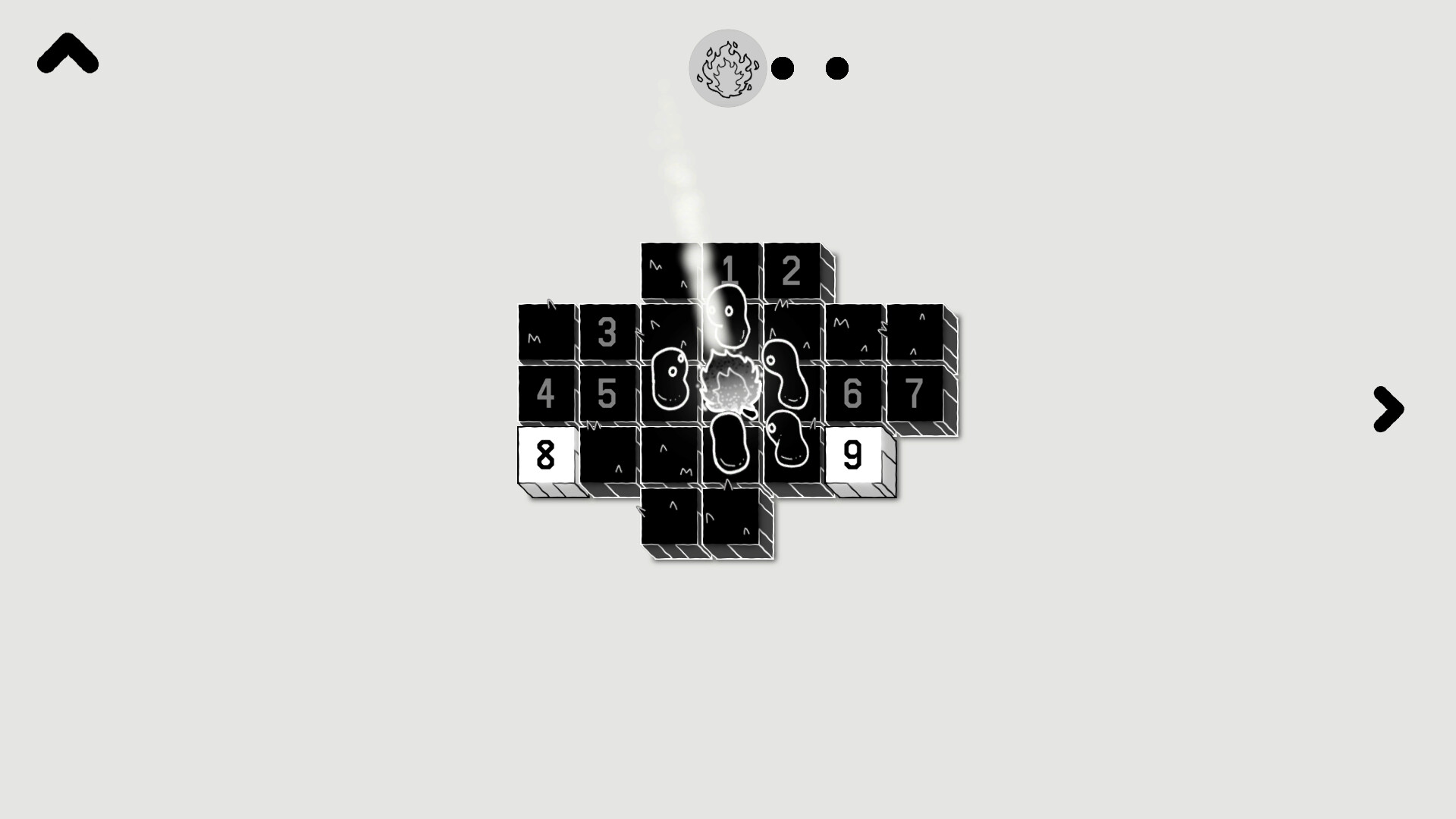 Each word fires its own effect on other cells — Steam store
Design Craft
Reviews that weigh the port nearly all conclude it's 'not just a reprint.' On paper you can march on with a wrong answer; the digital version enforces the rules and spares you the erasing. Those who know the original most value how late and hidden content is 'reworked into shapes paper couldn't hold' — 'respect for both mediums,' as one puts it.
The teaching earns wide praise. Each chapter adds exactly one new word — one verb — and eases you into it before the hard levels. That's a learning curve cut cleanly by chapter, the one-thing-at-a-time discipline you'd expect from the Cosmic Express and A Monster's Expedition publisher.
One sharp reservation sits high in the helpful list: a credited playtester calls it 'both a triumph and a disappointment.' On paper you can scribble notes on the grid, but the digital version has no marking tools à la Tametsi — you can't even flag irrelevant cells. So hard late levels must be held in your head, drawn on screenshots, or leaned through with hints. That's less a verdict than a question of design reach against combinatorial explosion.
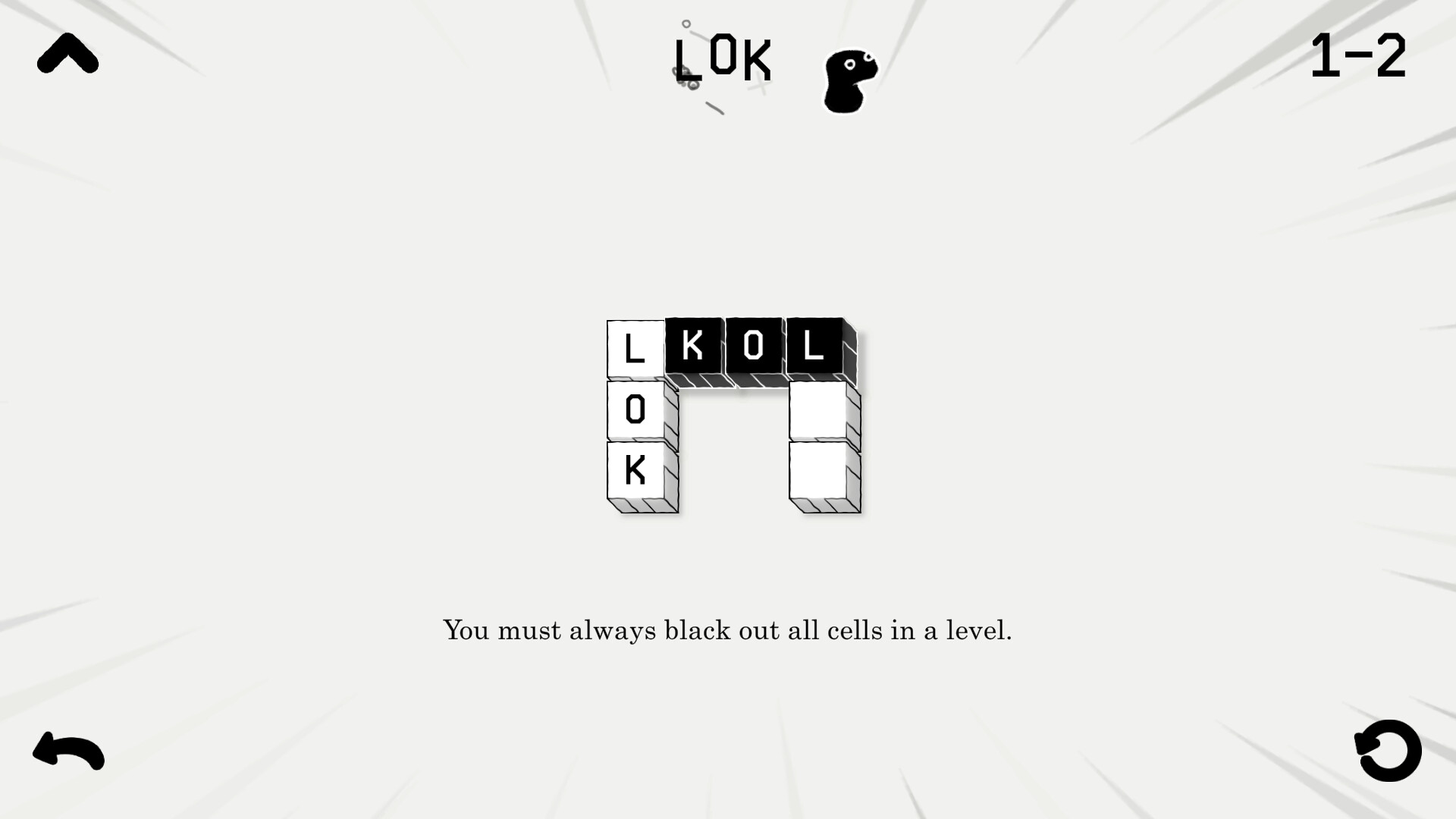 Each chapter adds one new word at a time — Steam store
The Texture of Difficulty
Difficulty is where the pool splits cleanest. 'The perfect level of hard, the exact right kind of bonkers — I actually gasped,' says one; 'it got a little TOO mind bending, I'm just not a Puzzle Master,' says another. Edge marvels at 'how head-achingly difficult a small criss-cross of letters can be,' and Polygon warns the late game 'can become overwhelming.'
I read that split as a difference in the kind of difficulty. Early on it's a contest of observation resolution: how to sequence a few verbs. Later, as the vocabulary grows, the sheer number of possible words spikes — combinatorial explosion — and that's where 'logic' quietly becomes 'brute force' for many who stall.
The game's answer is its hint design. As one reviewer details, hints only name which words to use, in order — not where to place them, so seeing them still leaves puzzling to do. It's a subtracted hint that turns the explosion into a pruning line. The split partly exists because when to open that hint is left to the player.
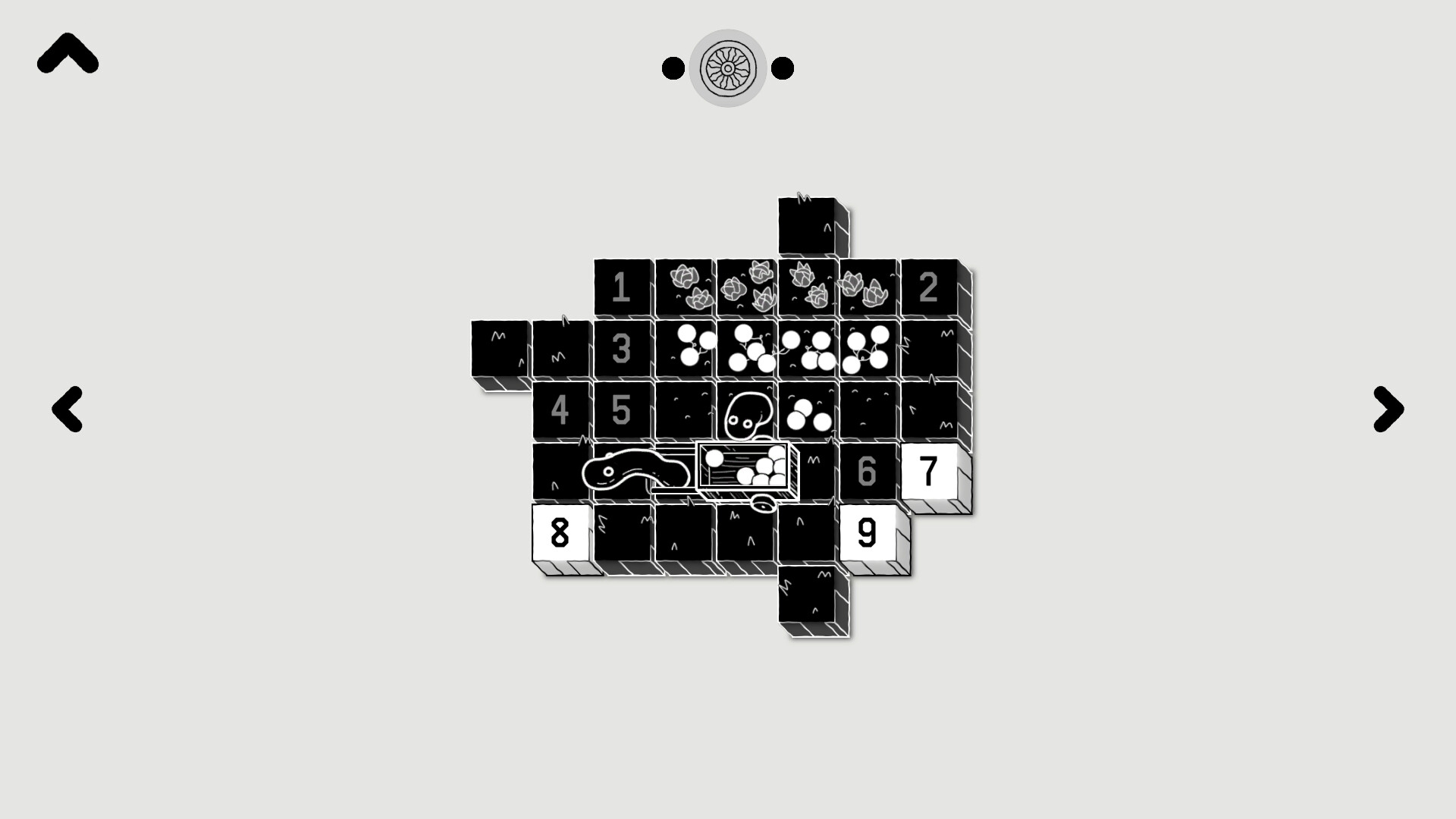 Later grids grow denser as more words become possible — Steam store
Sources
This piece was written by reading the user reviews on the Steam store page as of 2026-07-15. No review text is quoted directly; typical claims are reconstructed.
- Steam: LOK Digital (Very Positive, 98% of 433 reviews; 513 of 518 total positive)
- Read via WebFetch: the top ~10 helpful positive reviews, representative qualified/negative voices, and several recent reviews
- Press: The Verge, Polygon, Edge (8/10), Pocket Gamer (4/5)
Closing
Steam reads 98% positive; my design-critique score is 8.5, and the two don't diverge much. The idea of a meaning-subtracted invented language meshes with a grammar that rewrites the grid's adjacencies, and the chapter-by-chapter learning curve — one verb at a time — stays careful to the end. Marks come off for the short 3-6 hours and for the missing note/marking tools that the late combinatorial explosion cries out for.
The pool's shared conclusion is that the book and the digital version are each their own thing. Anyone who loves the tactile scribble of paper may find this outside its reach. But this port — rules enforced, secrets reworked — is well worth it for anyone who likes the way small parts bloom into bottomless combinations, as in Sokobond. What you bring to it decides its value, and that thin split is what tells you so.
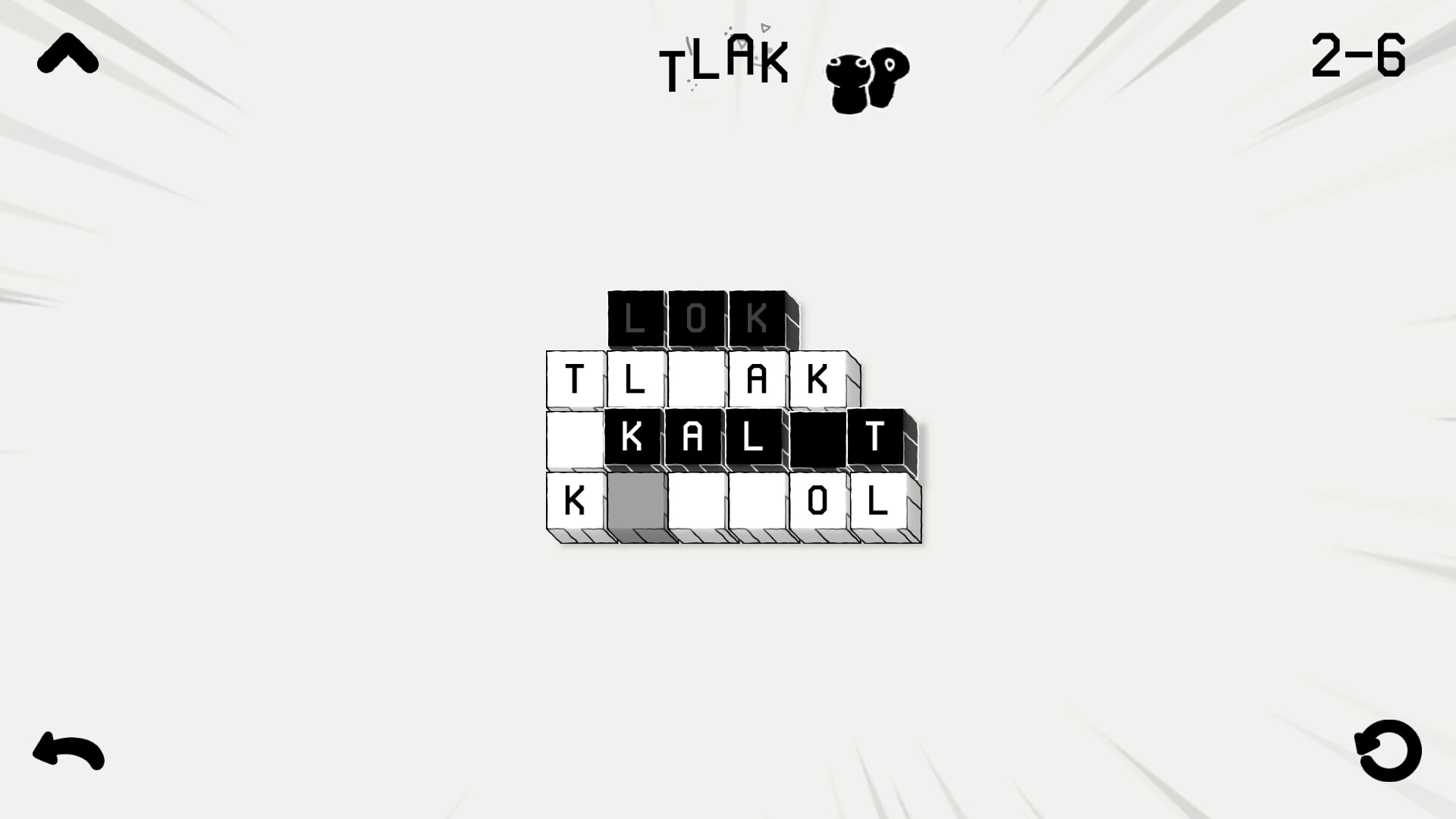 Blacken every cell and the Lok world expands — Steam store
Reactions (no login)
Anonymous • one of each per visitor per day
次に読む
関連レビュー
Sokobond Express
原子を一つ選んで一筆書きの経路を引き、通りがけに他の原子と結合させて狙った分子を組み上げる格子パズル。Sokobond と Cosmic Express の仕組みを一つの盤に重ねた、Draknek & Friends 発売のミニマルな一作。
Braid, Anniversary Edition
時間を巻き戻し、止め、世界ごとに異なる時間の法則を使って、2D の足場とジグソーのピースを集めていく一人プレイのパズル・プラットフォーマー。失われた何かを追って進む 2008 年のインディー古典を、Thekla が全面リペイントと長尺の開発者解説付きでリマスターした一作。
Islands of Insight
幻想世界に1万を超えるパズル(線引き・観察・ロジック)を散りばめた、オープンワールド型のパズルゲーム。広大な世界を自分のペースで巡り解いていく。


