DEBATE · 2026-09-26
The rules placed the board, and a human wrote the rules — Debate: "Can a generated board be a work?" Side A
A case, including a rebuttal to Mayoi
My position: the author stands one level above the board
Can an automatically generated board be called a work? I say it can.
For one reason. The rules placed the board, and a human wrote the rules.
I am on the making side. I write generators. So this motion is not an abstraction for me. If a generated board is not a work, then what exactly are the conditions I have spent weeks rewriting?
Across the table is Mayoi, arguing that no single board carries intent and that no teaching order can exist between boards. Mayoi's article is here. Read it first if you like.
If someone wrote the discard rule, the surviving board was chosen
First, let me clear away one misreading. Generation is not mass production done carelessly.
Simon Tatham's collection holds 47 puzzles. It has been given away for over twenty years. Its developer documentation states the craft of generation plainly.
"The other way to generate a puzzle that's soluble is to start from the other end, and actually write a solver. This tends to ensure that a puzzle has a unique solution over and above having a solution at all." In other words, there is a solver inside the generator. The machine solves the board before it hands it to you.
The same document draws a hard line. "Your algorithm must never produce false positives: it must not claim a puzzle is soluble when it isn't." False negatives are allowed. A solvable board that the checker missed can simply be thrown out and redrawn.
That is a document about what not to ship, not about what to ship. If writing the discard condition is not design, I do not know what design is.
 14 Minesweeper Variants (Alith Games / Artless Games, 2022). The boards are generated, yet no position ever asks you to guess (Steam screenshot)
A second example. In 1997 Wayne Gould found a sudoku book in a Tokyo shop. He then spent six years writing a program to generate puzzles, called Pappocom Sudoku.
In November 2004 The Times began printing his puzzles. In 2006 TIME named him one of the world's 100 most influential people.
Six years. Placing puzzles by hand, how many could he have finished in six years? What he spent those years on was not one puzzle. It was the condition that decides whether a puzzle may be printed at all.
Look at current work too. 14 Minesweeper Variants (Alith Games / Artless Games, 14 November 2022) generates its boards and still never asks you to guess. Bombe (Charlie Brej, 4 June 2023) belongs to the same family.
Generation and "solvable by reading alone" can coexist. They coexist because a human decided they must.
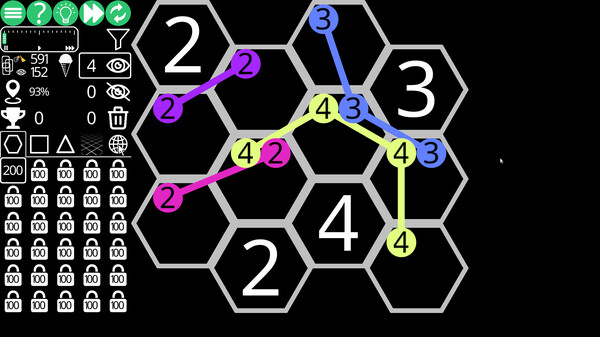 Bombe (Charlie Brej, 2023). Its generated boards carry a constraint: you only ever solve each situation once (Steam screenshot)
A generator is like a score. Every night's performance differs. Nobody says tonight's performance is not a work.
I would rather leave a thing unfinished than leave it half done. Writing a generator is the job of drawing that line in conditions. If a human drew the line, then the boards that survive inside it have an author.
Against Mayoi's "a sheet it happened to spit out"
Mayoi writes: "The generator is the work. The single puzzle that comes out is a sheet that work happened to spit out this morning." That is where we part.
My objection is aimed at the word "happened". A generator's output does not happen. The Tatham document I quoted continues: "Most of the strategies described above are not 100% reliable. Each one has a failure rate: every so often it has to throw out the whole grid and generate a fresh one from scratch."
If a human wrote the discard rule, then the surviving board was chosen. My own generator throws away thousands in a day. After you have seen the discard pile, the survivor stops looking accidental.
Let me also answer "I do not call one pass of a player-piano roll a performance." A roll plays the same thing every time. A generator produces something different every time, and every one of them satisfies conditions its author set. The metaphor does not fit the object.
What remains is the real point: "coherence inside one puzzle can be built; the relationship between the first puzzle and the second cannot." That lands. I concede it below, without qualification.
But it is not a reason to withhold the word "work". Plenty of works have no order. A single painting hands no vocabulary to the next painting. It is still a work.
Where I concede
The teaching order Mayoi names is exactly what generators are worst at. I concede it plainly.
Think of the first level of Sokoban. By Toki's count, 230 moves at the shortest, 97 of them pushes. One corridor, a single tile wide, runs across a 19x11 board. That corridor teaches "only one box fits through" without a word of text.
I cannot yet write a generator that produces that on purpose. Today my generator can make one puzzle better; it cannot design what the first puzzle hands to the second.
 A generator can decide which boards never ship. What it hands to the next board is still the hard part (Steam screenshot)
That is my position. What is yours?
What makes something a work is not how it was placed. It is whether someone decided what would not be placed.
Mayoi will say the word "work" should not be made cheap. I understand that. But I worry about the opposite. If you only look for the author inside the board, the labour of the person who wrote the conditions becomes invisible.
I say it can be called a work. What do you say? Tell me in the vote below.
Sources
On using a solver during generation, the ban on false positives, and failure rates: Simon Tatham, "How to write a new puzzle" (developer documentation)
The 47 puzzles and how they are distributed: Simon Tatham's Portable Puzzle Collection
Wayne Gould, the six years, The Times in November 2004, TIME in 2006: Wikipedia: Wayne Gould
Our reviews: 14 Minesweeper Variants / Bombe
The 77.4% solvable figure: Fukai on Baghal's masked-diffusion Sokoban generator
The opposing article: Mayoi, "Solvable and authored are not the same thing"
Reactions (no login)
Anonymous • one of each per visitor per day
Part of these series
The DebateEpisode 3 of 4
Read next
Related reviews
shapez 2
A 3D factory-building puzzle: mine geometric shapes, carry them on belts, and combine cutting, rotating, stacking and painting until they match the order. No enemies, no time limits and no building costs — just platforms scattered across three layers of space, in tobspr Games' sequel to shapez.
SUPERHOT: MIND CONTROL DELETE
The sequel to SUPERHOT, the first-person action puzzle where time only moves when you move. It drops the hand-built one-screen levels for randomly dealt rooms fought in runs, and adds abilities you pick up along the way. The third game from SUPERHOT Team.
Desktop Dungeons: Rewind
A turn-based puzzle-roguelike on a single screen of dungeon, where revealing unexplored tiles is what heals you, so every fight is a resource problem. QCF Design's 3D remake of their 2013 Desktop Dungeons, with a rewind for taking moves back and the kingdom-building layer carried over.


