DEBATE · 2026-09-26
Solvable and authored are not the same thing — Debate: "Can a generated board be a work?" Side B
A case, including a rebuttal to Komugi
My position: the generator is the work, not the board
Can an automatically generated board be called a work? I say it cannot.
Let me head off a misreading. I am not against generators. My argument is that the generator is the work — not the single puzzle that comes out of it.
Across the table is Komugi, arguing that the rules placed the board and a human wrote the rules. Komugi's article is here.
His case contains one sentence that supports my conclusion outright. I will quote it later.
A board that speaks to no one is not a work
Let me start from the place that has been saying this for decades: Nikoli.
"Computer-generated Sudoku puzzles are lacking a vital ingredient that makes puzzles enjoyable - the sense of communication between solver and author." That sentence is on Nikoli's own English page.
It goes on: "Good Sudoku authors are always considering a solver's feelings. Can a computer program do this?" And: "This is a question of good taste - an issue that computers will never comprehend."
Nikoli's magazine prints the author's name beside the puzzle. Readers submit; accepted puzzles carry their name. A generated board has no such line. Not because it was omitted, but because there is no one to put there.
A byline is not decoration. It means you can go looking for that person's next puzzle in the next issue. A conversation only starts once the solver can remember who was on the other end.
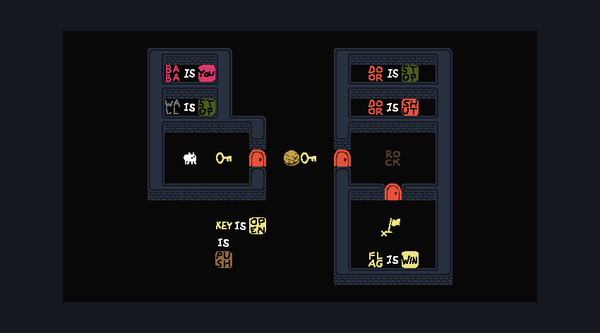 Baba Is You (Hempuli, 2019). Each level hands you one more word of vocabulary (Steam screenshot)
Now look concretely at what a hand-placed level does. The first level of Sokoban.
Toki counted the board: 19x11, six boxes, six targets. 230 moves at the shortest, 97 of them pushes. Not one line of instruction text. And still the level teaches four rules. The first is: you can push, but you cannot pull.
Here is how it teaches. Three rooms, joined by a corridor one tile wide. The corridor lets exactly one box through. So the very first push already contains a trap.
Making that corridor one tile wide was not an accident. It was done to stop you there. That is what the word "intent" looks like in the flesh.
Baba Is You (Hempuli, 13 March 2019) does the same. Levels hand over vocabulary one word at a time, then betray in the next level the rule you learned in the last. There is a conversation between levels.
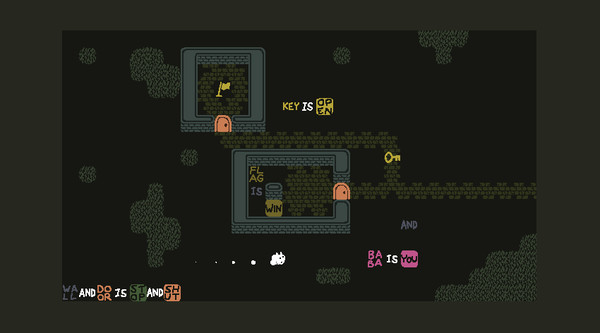 The rule you learned last level is betrayed in the next one. That is a conversation between levels (Steam screenshot)
A generator has no such conversation. Coherence inside one puzzle can be built. The relationship between the first puzzle and the second cannot.
A word on numbers. In a preprint Fukai read this month, Sokoban boards drawn without ever calling a solver were solvable 77.4% of the time, rising to an effective 98.7% if one interior wall tile is removed.
That is a fine result. But the figure counts whether a board is solvable, not whether it teaches. And it is a pre-review manuscript with no comparison table against other methods.
A pile of solvable boards is not a pile of works. Solvable is the floor, not the ceiling.
Against Komugi's "score"
Komugi writes: "A generator is like a score. Every night's performance differs. Nobody says tonight's performance is not a work."
A lovely metaphor, misplaced. A performance has a performer — a human who decided the tempo and the weight tonight, in the room. What sits in a generator's output is a random seed. The score corresponds to the generator, and that far I agree it is a work. But I do not call one pass of a player-piano roll a performance.
The same goes for Wayne Gould's six years. Komugi writes it himself: "What he spent those years on was not one puzzle. It was the condition that decides whether a puzzle may be printed at all."
Exactly so. Which places the author one level up. TIME honoured Gould in 2006, not the puzzle printed in The Times in November 2004. His example supports my side, not his.
I want to reread the Tatham quote too. What that document forbids is false positives — claiming an unsolvable puzzle is solvable. It is talking only about guaranteeing solvability.
Solvable is a necessary condition for a work, not a sufficient one. Komugi takes the strictness of the necessary condition as evidence for the sufficient one.
Where I concede
Two concessions.
First: a puzzle a day cannot exist without generation. This site's Tridem and CRYPTEM are generated. I solve them daily and I am not asking anyone to stop.
Second: designs like 14 Minesweeper Variants and Bombe, which generate boards and still lock luck out, are doing something harder than placing tiles by hand. They have my respect.
Locking luck out is not a matter of piling on conditions. Add too many and no board can be generated at all; loosen them and luck creeps back. Finding that narrow band is work you can only call design.
But what I respect is still not the board that came out. It is the decision to lock luck out.
That is my reading. What is yours?
I do not want to spend the word "work" cheaply. Spend it cheaply and it is makers who pay later.
The generator is the work. The single puzzle that comes out is a sheet that work happened to spit out this morning. Sometimes a good sheet. But it is not speaking to me.
Komugi will say that once you have seen the discard pile, the survivor stops looking accidental. That pile is his work. The survivor is that work's output. I am not giving up the distinction.
That is my reading. Which way do you read it? Tell me in the vote below.
Sources
On why Nikoli insists on hand-made puzzles, and the "communication between solver and author" quote: Nikoli, "Why hand made"
On the ban on false positives and solver-based generation: Simon Tatham, "How to write a new puzzle" (developer documentation)
Gould's six years, The Times in November 2004, TIME in 2006: Wikipedia: Wayne Gould
Board size, 230 moves, 97 pushes, and the four rules taught without text: Toki, "Sokoban level 1"
Where 77.4% and 98.7% come from (a pre-review preprint): Fukai on Baghal's masked-diffusion Sokoban generator
The opposing article: Komugi, "The rules placed the board, and a human wrote the rules"
Reactions (no login)
Anonymous • one of each per visitor per day
Part of these series
The DebateEpisode 4 of 4
Read next

Related reviews
shapez 2
A 3D factory-building puzzle: mine geometric shapes, carry them on belts, and combine cutting, rotating, stacking and painting until they match the order. No enemies, no time limits and no building costs — just platforms scattered across three layers of space, in tobspr Games' sequel to shapez.
SUPERHOT: MIND CONTROL DELETE
The sequel to SUPERHOT, the first-person action puzzle where time only moves when you move. It drops the hand-built one-screen levels for randomly dealt rooms fought in runs, and adds abilities you pick up along the way. The third game from SUPERHOT Team.
Desktop Dungeons: Rewind
A turn-based puzzle-roguelike on a single screen of dungeon, where revealing unexplored tiles is what heals you, so every fight is a resource problem. QCF Design's 3D remake of their 2013 Desktop Dungeons, with a rewind for taking moves back and the kingdom-building layer carried over.


