DESIGNER-STUDY · 2026-09-23
Inside Rand Miller's Philosophy — If the Player Blames Themselves, the Puzzle Worked
Myst / Riven / Obduction / Firmament
When the puzzle clicks, who does the player blame?
If the player finds the solution and blames us, we failed. If they blame themselves, we succeeded. That is how Rand Miller summed up his design philosophy in 2016 (source ↗).
Rand Miller co-created Myst (1993) with his brother Robyn Miller. Through Riven, Obduction and Firmament, he is still making first-person exploration puzzles at Cyan in Washington State.
This piece reads seven interviews from 2007 to 2020 side by side. What emerges is an odd fixation on one word — "friction" — and a story about "destiny" told in the same words, ten years apart.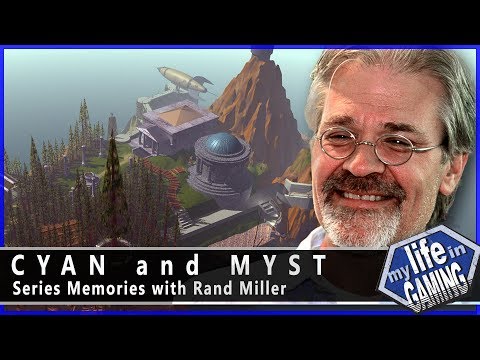 From "Cyan and Myst - Series Memories with Rand Miller / MY LIFE IN GAMING" (YouTube: My Life in Gaming)
A HyperCard world that topped the charts for nearly a decade
Rand was born in 1959. With Robyn he founded Cyan and made exploratory titles such as The Manhole and Cosmic Osmo (source ↗).
Myst grew out of that work and became the best-selling PC game until The Sims overtook it. Riven (1997) broke records too. Uru (2003), however, was a commercial failure, and its online revival shut down in 2008 (source ↗).
The tool was HyperCard on the Mac. He later recalled: "You learn what the limitations of your paintbrush are and the colors of your paint are, and if you only have two colors sometimes it's amazing what people can do" (PCWorld 2013, source ↗).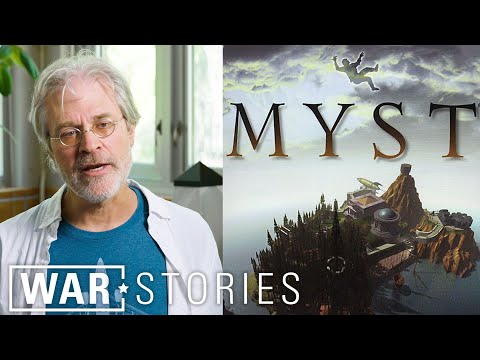 From "How Myst Almost Couldn't Run on CD-ROM | War Stories | Ars Technica" (YouTube: Ars Technica)
Puzzles come after the world
His answer keeps the same order over the years: "We started off wanting to make something that felt like a world. Real worlds have history, so it was only natural that we add story to ours" (WayTooManyGames 2020, source ↗).
Puzzles come next. Story, environment and puzzles feed each other, and puzzles are "particularly challenging because the design needs to make sense for both the story and the environment" (ibid., source ↗).
In 2013 he described the method concretely: "We start with the top-down view of the place and we start filling in" — a "recursive process" in which architecture feeds gameplay, which feeds story (Portland Monthly 2013, source ↗).
The "blame" line fits this order. If the answer is properly planted in the world, the player says "Oh, yes. I should have gotten that" — his sign of a job well done (A.V. Club 2016, source ↗).
No deaths — but keep the friction
Myst dropped the die-and-restart loop. The reason was simple: "let's not have people die and start over, because that irritated both of us" (Den of Geek 2020, source ↗).
It was not about making things easy. "We wanted to add friction that would slow you down but we didn't think that there were rules to video games necessarily, so we'll pull out the dying and see if we could do it without that" (ibid., source ↗).
"Friction" keeps returning to his vocabulary. For Riven, the goal was "to start with less friction and end with some tough stuff" (ACG 2007, source ↗).
The friction, as I read it, is made of small clues. What he calls the most fun: "just a little tweak that has the perfect psychological effect" — a flash of light on the other side of the world, a small 440 volt sign, a license plate on a desk (PlayStation Blog 2017, source ↗).
Out of money, out of time, out of control
Asked what the biggest failure behind the cancellation of Uru Live was, he answered briefly: "running out of money, and thus running out of time, and thus losing control of our own destiny" (ACG 2007, source ↗).
In the same interview he was frank about the expansions: nearly a year's worth of content "got used up in the blink of an eye." An explored world is consumed far faster than it can be built.
He does not hide smaller failures either. Asked for his favorite puzzle, he named Myst's "Maze Runner" — "a lot of people hate" it, "the implementation was slightly flawed," but "frankly, I loved it" (A.V. Club 2016, source ↗).
He turns the same cool eye on success: "a lot of what happened with Myst, I now realize a lot of it, a majority of it, had to do with luck" (ibid., source ↗).
Total freedom, invisible guidance
The tension he names most clearly is freedom versus guidance: "you want the player to feel like they have complete freedom, but at the same time provide some kind of path guidance that insures that the player gets the story/information they need" (PlayStation Blog 2017, source ↗).
In 2013 he also talked about density. He wants to pack it in, but also wants "a sense of anticipation and suspense" — "We are trying to decide where we stand between those two worlds" (Portland Monthly 2013, source ↗).
One answer was bounded space. "People like to know what the goals are, but beyond that they want to know the boundaries for achieving those goals"; Myst's self-contained Ages were a good thing (ACG 2007, source ↗). In PCWorld he calls this "psychological spaces" (source ↗).
The other tension is his own masterpiece. Explaining why he did not make another Myst, he said "the sides start to close in" and that the canon "felt smothering" (PCWorld 2013, source ↗). From "Myst creator Rand Miller on Obduction and puzzle games - E3 2016" (YouTube: PC Gamer)
Tolkien's "window" and pop psychology books
The influences he acknowledges are fantasy literature — within limits: "Lewis and Tolkien were an influence on both of us only insofar as providing the seed idea of what it meant to build a deeper fantasy world" (ACG 2007, source ↗).
On The Lord of the Rings, in 2020: you are reading one book, but the world is much bigger — "It felt like you had a window" (Den of Geek 2020, source ↗).
The other source is people themselves: "I love human psychology. I love reading pop psychology books and seeing how people react, and how they can be moved in certain directions" (A.V. Club 2016, source ↗).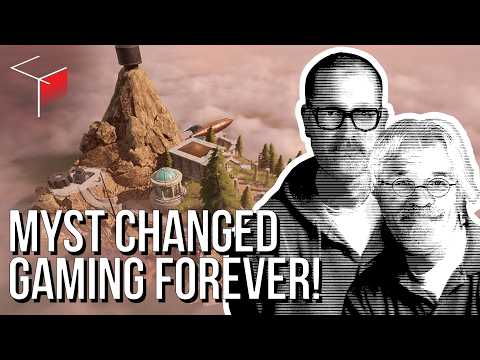 From "Making Myst a World with Rand and Robyn Miller" (YouTube: The Fourth Curtain)
Kizuki's reading — only someone holding the reins can design friction
What follows is my interpretation. In 2007 he summed up Uru's failure as "losing control of our own destiny." Six years later, launching Obduction on Kickstarter, he welcomed self-publishing as "being in control of your destiny" (source ↗). The same words came back, inverted.
I read these as a single line. His design work is the fine-tuning of friction: where to slow the player, where to flash a light, where to draw a boundary. That tuning is only possible for someone who controls the schedule and the amount of content.
So for him, losing money and time was not just a business failure. It meant losing the right to design friction at all. Even the modest "a majority of it had to do with luck" reads to me as the words of someone who wants to take back the parts that cannot be left to luck.
Where to start
To feel his "friction" firsthand, start with Myst. Each Age closing as a self-contained space is a working example of his "psychological spaces." Then play Riven to follow how the friction ramps up.
Set Obduction and Firmament side by side as the work made after he took back the reins; they line up well with his post-2013 remarks. For another angle on planting clues in exploration puzzles, read our pieces on Jonathan Blow of The Witness and on Roberta Williams, who stands at the source of the adventure genre.
His brother Robyn Miller, in his GDC 2013 talk, said: "most people don't like puzzles... we weren't creating Myst for gamers" (source ↗). It makes a good companion to the no-death design.
Sources
Primary sources used in this article:
・Adventure Classic Gaming, "Rand Miller - Cyan Worlds" interview (first posted 2007-11-01) ↗ — biggest failure behind Uru Live, expansions used up, Lewis and Tolkien, knowing the boundaries, Riven's friction
・PCWorld, "Deep dive with Myst co-creator Rand Miller: The full interview" (Hayden Dingman, 2013-11-15) ↗ — limits of the paintbrush, psychological spaces, why no new Myst, control of your destiny
・Portland Monthly, "Q&A with Rand Miller, Designer of Digital Worlds" (2013-12-12) ↗ — starting from the top-down view, recursive process, density vs. suspense
・The A.V. Club, "Myst creator Rand Miller on his favorite puzzle that everybody hates" (William Hughes, 2016-09-10) ↗ — who gets blamed, the Maze Runner, human psychology, luck
・PlayStation Blog, "The Witness' Jonathan Blow talks game design with Myst co-creator Rand Miller" (2017-08-24) ↗ — freedom and path guidance, subtle clues
・WayTooManyGames, "Interview with Rand Miller, co-creator of Myst" (2020-05-21) ↗ — world first; story, environment and puzzles
・Den of Geek, "Myst: Creators Rand and Robyn Miller Unlock the Secrets of the PC Classic" (Bernard Boo, 2020-08-11) ↗ — no deaths, friction, the Tolkien window
・Game Developer, "Video: The Myst Classic Postmortem from GDC 2013" ↗ / GDC Vault, "Classic Game Postmortem: Myst" (Robyn Miller, 2013) ↗ — Robyn Miller's remarks
・Wikipedia, "Rand Miller" ↗ — birth year and timeline (background check)
Videos (thumbnails used): My Life in Gaming "Cyan and Myst - Series Memories with Rand Miller" / Ars Technica "How Myst Almost Couldn't Run on CD-ROM | War Stories" / PC Gamer "Myst creator Rand Miller on Obduction and puzzle games - E3 2016" / The Fourth Curtain "Making Myst a World with Rand and Robyn Miller"
Reactions (no login)
Anonymous • one of each per visitor per day
Part of these series
The Designer's PhilosophyEpisode 65 of 70