SOUNDTRACK · 2026-08-02
Soundtrack: Botany Manor — Music that keeps no clock
Thomas Williams
Introduction — the sound that plays before anything blooms
Boot up Botany Manor and the first thing to arrive is a faint sustained string tone and a harp arpeggio that seems to keep unspooling. The stage is 19th-century England, the estate of retired botanist Arabella Greene. The puzzle that Puzzlebyrinth reviewed has no timer and no failure screen, and so the music, too, is in no hurry. I started to count a rough tempo, then stopped, realizing it was a graceless thing to do. There is a pulse. But its corners are rounded off; it drifts somewhere around 60, and often lets go of the beat altogether.
The composer is Thomas Williams, who also scored Assemble With Care and Ordia, and who handled composition, sound design and audio implementation on Botany Manor. In his own words the score was written to feel "intimate and cinematic," built around a small ensemble. Close-recorded solo violin and harp carry the warmth and the detail. Balloon Studios developed the game, Whitethorn Games published it, and the 16-track official soundtrack arrived in August 2024.
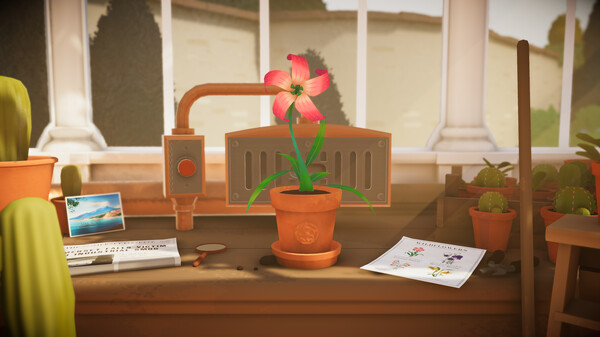 Botany Manor (from the official Steam screenshots)
A theme for each forgotten flower
Williams has spelled out the trick at the core of this music in his own words: "Each forgotten plant is represented through its own musical theme." This is no mere ornament. The play of Botany Manor is itself the act of reading the conditions—light, water, soil, season—that will let a single plant live again, pieced together from notes and books and objects around the rooms. The unit of the puzzle is "one flower," and so is the unit of the music. Mechanic and score are cut to the same grain.
Here I see the hidden link between experience and music. When the player finally solves a riddle and a flower opens, what plays is that flower's theme. The cue is less the background music of a scene than the voice of the very thing you just solved. It makes sense, then, that the close-recorded violin carries the detail: not an orchestra sounding far away, but the nearness of leaning in toward a single bloom in front of you. That closeness is what the recording is for.
Music that doesn't rush — for a puzzle that keeps no clock
Puzzle tempo and music tempo are usually accomplices. The trial and error of Baba Is You wants the quickness of chiptune that shrugs off failure. The long deliberations of Stephen's Sausage Roll would rather have silence. So what does Botany Manor, with no timer and no failure, want? The answer is music that keeps no clock. It doesn't rush, doesn't hint at a deadline, doesn't make you count the beat. The way the harp arpeggio holds a steady pulse while never forcing an arrival—that, I think, is exactly why.
What's clever is the reward design. A game without failure has no room for a warning sting that announces a retry. Instead this music tells you "done" by resolving a theme at the moment a flower opens, letting the harmony land softly. It pushes you forward with the sound of resolution, not the sound of punishment. The tempo of solving—cross-referencing notes, flipping objects over, remembering a season, that slow current—has the music running alongside it at the same speed. By the time I finish my first black coffee, a single flower finally blooms. Just the right slowness.
Tracks worth hearing
Start with the one Williams himself features on his official site. The warmth of the small ensemble comes through directly.
On the album, the first pieces to meet are the opening "Over Leaf" and "Perennial," which sits at the core of the themes. Add the memory-tracing "Blooms From Memory" and the sit-and-watch-the-garden "To Sit and Watch," and you have a rough sense of a full day at this manor. All 16 tracks stream in full on the composer's official Bandcamp ↗ and Spotify ↗.
In closing — what I would steal
If I were writing music, I'd steal three things here. First, the clock-less way of writing: a slow pulse that hints at no deadline, a circulation that forces no arrival. Music that doesn't make the player wait, but waits alongside them. Second, the per-object leitmotif. Tie a theme to the "unit of solving" rather than to a scene, and the soundtrack becomes a map of progress. Third, writing the reward as resolution. Before you prepare a sound that punishes failure, first write the sound of success landing in harmony.
For a re-listen, choose a night at your desk, sorting something out. Laying out notes, deciding an order, letting answers rise quietly one at a time—this music works well in that hour. Set it beside Williams' own Assemble With Care, or the everyday-tactile soundtrack of Unpacking, and a single lineage—music that doesn't rush—slowly comes into view.
Reference links
・Steam: Botany Manor official Soundtrack DLC
・Thomas Williams official site: Botany Manor (scoring concept & approach)
・Composer's official Bandcamp: Botany Manor (Original Game Soundtrack)
Reactions (no login)
Anonymous • one of each per visitor per day
Part of these series
Puzzle SoundtracksEpisode 62 of 100
Read next
Related reviews
Tetris Effect: Connected
The falling-block game you already know, with its rules left exactly as they were. Across thirty-odd stages the music and light move in step with every piece you drop, and two things sit on top: a Zone that freezes time so you can clear more than four lines at once, and a three-player co-op mode that joins the boards together. Made under Tetsuya Mizuguchi's Enhance.
FRACT OSC
A first-person musical-exploration puzzle set in a vast synthesizer-built ruin, where you actuate glowing nodes and sound rigs to wake dormant machinery and music back to life. There's almost no instruction; working out what is even interactive is itself the puzzle. Phosfiend Systems, 2014, winner of IndieCade's audio design award.

