SOUNDTRACK · 2026-08-08
Soundtrack: Grim Fandango Remastered — the first big-band beat in the land of the dead
Peter McConnell
Opening — in the land of the dead, the brass stands up first
I set down a sip of black coffee and drop the needle on the first track. Manny Calavera sits at his dim travel-agency desk, selling the dead their tickets for a four-year journey — and into the world this game's review covered, the first thing to arrive is a muted trumpet and a single plucked beat of upright bass. The tempo is a medium swing, big-band, roughly 110 to my ear. Not a sharp kick but brushed cymbals and a walking bass keep the time.
The composer is Peter McConnell — his work throughout, from the 1998 original to Double Fine's 2015 Remastered. The skeleton is film-noir jazz, but into it slip the folk sounds of Mexico's Day of the Dead: mariachi brass, the plain arpeggios of a guitar. And by the late-game 'End of the World' it opens out into orchestra. Jazz, folklore, and symphony switch within one album like the lighting of different rooms.
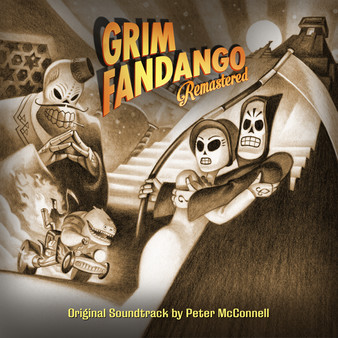 Grim Fandango Remastered (from the official Steam screenshots)
iMUSE — the machinery that lets the music live in game-time
This is the one thing I most want to carry home as someone who writes music. Grim Fandango's score runs on iMUSE (Interactive Music Streaming Engine), a system McConnell co-developed with Michael Land at LucasArts. It manipulates MIDI data in real time so that as the player moves between rooms and the situation shifts, the music changes over at a musically natural point — the top of the next bar, the seam between phrases. It does not chop the cue off with a hard cut. That is the crux.
During production, McConnell recorded Tim Schafer talking about every environment in the game and built a big interactive iMUSE chart where you could click a room and hear him describe that situation. You can see the design philosophy through it: the music is tied to place and situation, not to a progress bar. McConnell has repeatedly named the live jazz recordings as the thing he is proudest of in this score.
The 2015 Remastered kept that skeleton but renewed the sound itself. A team at Sony re-recorded about 45 minutes of live jazz, Pyramind in San Francisco replaced the aging samples in another 45 minutes, and the Melbourne Symphony Orchestra recorded roughly 30 minutes of orchestral material (conducted by Brett Kelly). Three teams carried three textures, and it still coheres as a single score.
The puzzle analogy — the music never rushes you while you're stuck
The time you spend solving a point-and-click adventure has its own rhythm. You wander, you examine, you get stuck, you walk back to a room you passed before. It isn't a one-way line forward but a loop that crosses the same places again and again. Lay a short event-triggered cue over that loop and the same few bars fire every time you return; the music quickly turns into a nagging 'hurry up.'
iMUSE's answer was to bind the music to place rather than progress. So when I sit and think in Rubacava's casino, the score stays big-band, circling through long, low-repetition phrases. When I fail and return to the same room, the music doesn't ask 'still here?' It simply waits, holding tempo, as the lighting of that place. The stall of the puzzle and the stall of the music can be made two entirely different things — and iMUSE does it by changing over quietly, on the beat. Here I see a model for deliberately decoupling the tempo of solving from the tempo of the music.
Tracks worth hearing
Start from the official behind-the-scenes. 'The Resurrection of Sound,' published on Double Fine's official channel, is a short film in which McConnell himself explains how he resurrected the Remastered score. The live-jazz and orchestral recording sessions speak the sound more eloquently than words.
To take the music itself in one pass, go to the official soundtrack: Grim Fandango Remastered (Original Soundtrack) — official Spotify album ↗ or the official soundtrack DLC on Steam ↗. From the opening noir jazz through mariachi to the closing orchestra, you can follow the flow that switches room by room like changing lights.
Closing — if I were writing it, here's what I'd steal
There is only one thing I would steal from this score for my own music: the principle that you bind the music to place, not to progress, and change over quietly on the beat. Firing a short cue per event is easy, but in a game full of backtracking it will always become a nag. Lay long, low-repetition phrases under a place and entrust the switch to a musical seam — the practice iMUSE showed a quarter-century ago is still fresh enough for interactive music today.
To re-listen, dim the lights late at night and play only the Rubacava jazz. Even if you don't know the game, that brushed rhythm, like cigarette smoke, will start drawing a story of its own. Wander over to Thimbleweed Park, which shares the same LucasArts blood, and this album's place comes into clearer view.
For me — someone with a habit of measuring the world in BPM — Grim Fandango is a rare record that makes me stop counting beats. Time flows as a four-year journey, and the music keeps pace with it, exactly.
References
・Steam: Grim Fandango Remastered (base game)
・Steam: Grim Fandango Remastered — official Soundtrack DLC
・Double Fine official: Grim Fandango Remastered Soundtrack out now
・Double Fine official YouTube: The Resurrection of Sound (Peter McConnell)
・VentureBeat: Grim Fandango's composer on the invention and remastering of his classic score
・FACT Magazine: Grim Fandango composer Peter McConnell interviewed
Reactions (no login)
Anonymous • one of each per visitor per day
Part of these series
Puzzle SoundtracksEpisode 68 of 104
Read next

Related reviews
Tetris Effect: Connected
The falling-block game you already know, with its rules left exactly as they were. Across thirty-odd stages the music and light move in step with every piece you drop, and two things sit on top: a Zone that freezes time so you can clear more than four lines at once, and a three-player co-op mode that joins the boards together. Made under Tetsuya Mizuguchi's Enhance.
FRACT OSC
A first-person musical-exploration puzzle set in a vast synthesizer-built ruin, where you actuate glowing nodes and sound rigs to wake dormant machinery and music back to life. There's almost no instruction; working out what is even interactive is itself the puzzle. Phosfiend Systems, 2014, winner of IndieCade's audio design award.

