SOUNDTRACK · 2026-08-07
Soundtrack: Samorost 3 — When playing the flute becomes the journey
Tomáš Dvořák (Floex)
Introduction — a flute falling from the sky
A tiny space gnome sits alone on a cliff. Then, from the sky, a single flute comes falling down. Samorost 3 is a story that begins from that one note. Raise the flute you picked up to your lips, and the sounds of a world that felt far away suddenly crowd in close to your ear. The first track, 'Samorost 3 Main Theme,' is a piece like the opening of a film: a warm clarinet melody, with the reverb of cello and choir and distant, folk-tinged percussion layered beneath it. The tempo is maybe around 70 or so. It's slow enough that you'd rather count your breaths than the beats, and the air swells slowly.
The composer is Tomáš Dvořák, a Prague clarinetist known under the name Floex, who has walked alongside Amanita Design since Samorost 2 and Machinarium. For this point-and-click journey across nine planets — reviewed here on Puzzlebyrinth — he prepared a sonic cosmos of 27 tracks and roughly 88 minutes. On March 24, 2016, the soundtrack was released alongside the game.
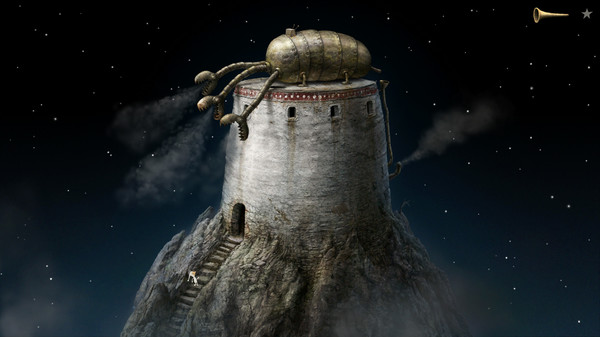 Samorost 3 (from the official Steam screenshots)
The flute is a mechanic — 'making a sound' becomes the verb
In an ordinary point-and-click game, music is close to background wallpaper. It simply plays behind the verb of clicking. But in Samorost 3, blowing the flute you picked up is itself the game's action. Through the flute, the small sounds of the world grow loud, hidden melodies can be gathered, and a puff of breath can calm creatures and contraptions or set them moving. In other words, 'making a sound' is the very verb you solve puzzles with.
This structure, I think, comes from the same idea as Outer Wilds' Signalscope, which 'turned the sound of an instrument into a tool of exploration.' The music isn't a BGM sitting outside the UI — it's in the player's hands. By embedding fragments of the score directly into the mechanics, Amanita's design dissolved the boundary between listening and solving. In this game with not a single line of dialogue, the flute stands in for language and is, at the same time, a controller.
The choice of live instruments — copying nature's complexity into sound
Floex's sound avoids the uniformity of programmed sequencing. Tomáš Jamník plays cello, viola da gamba, and even the erhu; the voices of Bára Kratochvílová and Miloš Dvořáček are added; and 'found sounds' — like strumming strings with a lollipop stick — are mixed in too. Mastering is by Matouš Godík. Amanita founder Jakub Dvorský has said, 'live instruments are warmer, more detailed, and simply more powerful than pure electronic music. We love the complexity of nature.' Their picture-making, which layers photographed textures onto the backdrops, is congruent with how they make sound.
Dvorský likens game design itself to a music album. 'The first time you buy a record, you listen from beginning to end. Then later you come back and listen again from the start, or just a few favorite tracks. A good game should be playable that way too.' So this OST is not a set of looping cues that stoke anxiety, but a body of through-composed pieces you can listen to end to end. At IGF 2014 it was an Excellence in Audio finalist, and PC Gamer named it among the best game music of the year, calling it 'captivating and unpredictable — one moment it fills the room like a dramatic film score, then pivots to being grounded, Bohemian, and playful.'
The analogy with the puzzle — a fail-free journey, a fail-free score
Samorost 3 is a game with no failure. You advance with the mouse alone, and when you're stuck a hint book opens; it's a journey of about five hours. The tempo of solving is not one of tense, frozen hands, but a strolling kind, where the answer comes undone as you touch and observe things here and there. The through-composed, album-like score fits this feel astonishingly well. Because there are no short, driving loops, the music doesn't scold me when I hit a wall. It simply stays there, air still swelling.
I always have a habit of measuring music in BPM, but in this work BPM nearly loses its meaning. Rather than ticking in beats, it stretches and contracts with breath. Just as the puzzles have no 'time's up,' the music has no deadline. It turns even the time you can't solve anything into time worth listening to — that, I think, is the kindness of music dwelling in a game with no failure.
Tracks worth hearing
First, the full soundtrack published by Amanita Design's official channel. From the clarinet of the opening 'Samorost 3 Main Theme,' it flows through as a single album.
If you'd rather savor the theme as a single track, there's Samorost 3 Main Theme (Floex) ↗. And if you want to touch the behind-the-scenes, the English-narrated making-of by Floex himself, The creative process behind Samorost 3 soundtrack ↗, is a good one — you can see how the live instruments and the 'found sounds' were assembled.
In closing — what I'd steal
If I were writing music, this is what I'd steal: the single idea of 'taking the instrument the player uses to make music and making it the tool of play itself.' Not playing a BGM, but giving meaning to the act of making a sound. A flute, a bell, footsteps — anything. The moment sounding becomes touching the world, music turns from something heard into something used. Both the Signalscope and this flute cross that line.
For a re-listen, I'd want night, only the desk lamp on, and to run it through as a single record from the top. It suits the time you spend not moving your hands, just waiting for the air to swell. Line up Floex's own Machinarium, Amanita's Botanicula, and the tool-of-sound Outer Wilds in a row, and a lineage of the idea of 'playing the music' should come into view.
References
・Steam: Samorost 3 (Amanita Design)
・Floex — Samorost 3 Soundtrack (InnerFX / Bandcamp)
・Amanita Design official YouTube channel
・Floex official site — Samorost 3 soundtrack
・Game Developer: How Samorost 3's stunning soundtrack came together
Reactions (no login)
Anonymous • one of each per visitor per day
Part of these series
Puzzle SoundtracksEpisode 67 of 103
Read next

Related reviews
Tetris Effect: Connected
The falling-block game you already know, with its rules left exactly as they were. Across thirty-odd stages the music and light move in step with every piece you drop, and two things sit on top: a Zone that freezes time so you can clear more than four lines at once, and a three-player co-op mode that joins the boards together. Made under Tetsuya Mizuguchi's Enhance.
FRACT OSC
A first-person musical-exploration puzzle set in a vast synthesizer-built ruin, where you actuate glowing nodes and sound rigs to wake dormant machinery and music back to life. There's almost no instruction; working out what is even interactive is itself the puzzle. Phosfiend Systems, 2014, winner of IndieCade's audio design award.

