SOUNDTRACK · 2026-08-06
Soundtrack: Thimbleweed Park — music that decided never to give a hint
Steve Kirk
Introduction — the sound that plays when you cross the bridge into town
A body turns up under a bridge on a rainy night. Two agents step down into a run-down town at the edge of the tri-county area, Thimbleweed Park. In this point-and-click adventure that Komugi reviewed, the music Steve Kirk wrote leans quietly against that first step. The tempo is roughly mid-paced, the beat lounge-leaning, the sway gentle. What you hear is the thin whine of a theremin, a low sustain of organic instruments, and the occasional stab of experimental prog. Over a town that is supposed to be 1987, a faint whiff of sci-fi bleeds in.
Kirk composed, arranged, recorded, mixed and mastered the whole thing alone. Sixteen pieces (nineteen tracks on the digital release). What he aimed for feels like Twin Peaks meeting The X-Files with a single spoonful of creepy circus music. He raises no showy theme; instead the timbre alone tells you which corner of town you are standing in.
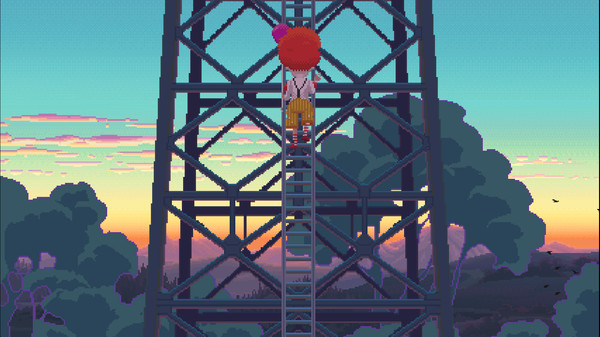 Thimbleweed Park (from the official Steam screenshots)
The pool system — split one piece, shuffle it, keep it from wearing out
The way this music is built is the interesting part. Kirk first writes, for each location, one long piece of about two to three minutes, composed straight through for continuity. Rather than looping that as-is, he cuts it into five or six sections, gathers them into a 'pool,' and while you stay in that location the pool plays back in a random shuffle. Even if the player lingers in one room, it is hard to notice that anything is looping in a fixed order.
A point-and-click has no clock. A player might leave a screen in a few seconds, or sit stuck and groaning for minutes. A single fixed-length loop gives itself away the moment you overstay: 'I heard this already.' The pool is an invention that postpones that recognition. Because it is written as one continuous piece the seams are natural, and because it is cut and shuffled it never sounds the same. Ron Gilbert's love of guitars means some of these pools end up shaped like little concertos for baritone guitar and an oddball orchestra.
The hidden link — the sound tells you nothing about the answer
This is where the Thimbleweed Park music made me sit up. Kirk's score holds no clue about the game's logic. The music does not change when a solvable contraption is nearby, and it does not swell as you approach the correct item. It plays only to paint the fact that this is a functioning habitat. That is deliberate. It is the opposite of a score like Portal 2 that reacts to your inputs; here the sound is the color of a place, not a gauge for the puzzle.
Point-and-click puzzles are made of observation and association. If the music whispers 'this is suspicious,' the player's ear finds the answer before the eye does, and the joy of searching thins out. So Kirk gave the music the single job of quietly coloring a location. Where the sound does step forward is inside the fiction: turn on the in-game radio and you hear 'No Quarter' by the fictional band Razor and the Scummettes, sung by Steve Kirk himself. The cheap jingle at the Quickie Pal convenience store and the too-classy muzak in the Edmond Hotel elevator are the same idea; the music only comes to the foreground when it is a source that exists inside the story. Not a diagnosis, but scenery. The line is drawn strictly.
The analogy — for a way of solving without a clock, a music without a clock
I always measure music by the tempo of solving. Stephen's Sausage Roll's long deliberation wants silence; Baba Is You's trial and error wants a short chiptune loop. So what fits the exploration of a point-and-click with no time limit? Thimbleweed Park's answer is clear: a sound that cycles loosely, with no clear start or end. As the player moves in and out of screens and thought drifts back and forth, the pool structure with no fixed bar lines maps onto it directly.
Solving here is not a straight line but a roaming. You walk the town, return to the same place, remember what you saw earlier. If the music had a clear beginning-middle-end, it would fall out of step with that roaming. So Kirk gave the pieces no 'conclusion,' designing them to settle no matter where you start listening or where they are cut off. If the player's thought moves in a circle, the music moves in a circle too. That is how I read it.
Tracks worth hearing
The official audio lives on the developer Terrible Toybox's own Bandcamp. Start with Thimbleweed Opener ↗. Theremin and uneasy strings lay out, in one breath, both the murder mystery about to begin and its creepy humor.
Then Town ↗, the heart of the pool you hear while walking the town, where lounge and a little sci-fi dissolve into each other. Listen long and check the 'pool' design with your own ears.
For the whole picture, the full album (Steve Kirk / Terrible Toybox) ↗. Down to the elevator muzak and the circus melody, it shows how many layers this town has.
Closing — if I steal anything, it is the courage to stay quiet
If I were writing music, I would steal two things here. One is the pool technique: write one long piece, then cut and shuffle it. It works directly for exploration games or ambient work where you want to hide the seams of a loop. The other matters more: the courage to keep hints out of the music. A composer is always tempted to swell the sound at the important moment. But if you want the player to think, the music can just quietly color the place. It steps forward only when a source exists inside the story. That line is what I most want to steal from Kirk.
To relisten, put it behind a thin layer of rain or town ambience. The pieces fall back into scenery, and the discipline of never sounding a hint stands out. As it happens, in the summer of 2026 Ron Gilbert announced Thimbleweed Park 2 (due 2028), and it was revealed that Steve Kirk returns as composer. Music that plays no hint is coming back to that town. It is a good time to let the first game's pools settle into your ear.
References
・Steam: Thimbleweed Park Soundtrack (official DLC)
・Steve Kirk / Terrible Toybox official Bandcamp (Original Soundtrack)
・Official forum: Steve Kirk talks about the TWP soundtrack (the pool method)
・Soundscape Magazine: Steve Kirk – Thimbleweed Park OST (theremin / the radio song No Quarter)
Reactions (no login)
Anonymous • one of each per visitor per day
Learn — Curriculum
LearnPart 7 Sound — Music That Supports ThinkingChapter 17 Sound That Never Becomes Wallpaper9 / 10
Part of these series
Puzzle SoundtracksEpisode 66 of 101
Read next

Related reviews
Primordia
A 2D point-and-click adventure in which a robot called Horatio and his small companion Crispin lose their power core and descend into the city of Metropol. You combine salvaged parts to restart broken machines, and read the ruins for traces of who built you. Made by Wormwood Studios and published by Wadjet Eye Games.
The 7th Guest: 25th Anniversary Edition
A first-person puzzle adventure set in an empty mansion, where six invited guests and twenty-one room-sized contraptions stand between you and the house's secret. This is MojoTouch's 2019 reissue of Trilobyte's 1993 landmark, the game that showed what a CD-ROM could hold.
Lumino City
A hand-built point-and-click adventure whose entire city was constructed from paper and card, then photographed to become the screen. You climb a tower-like town looking for your grandfather, fixing windmills, gears and fuse boxes to bring the power back. Made by State of Play, the British studio behind Lume.


