ESSAY · 2026-09-29
Is Piling Up Games Part of Play? On the Shelf of Things You Bought and Never Launched
Seating Seneca and Benjamin across from each other, in front of the shelves of Strange Horticulture
A shelf of unlaunched games, and pots with no names
Night. A glass of whisky. I filtered my Steam library by "unplayed." The list was longer than I expected.
Things I bought on sale. Things a friend told me to buy. Things I bought on launch day and somehow never opened. At the moment of buying, I meant every one of them.
People call this a backlog, or in Japanese, tsumi-ge: games stacked up. The word has a slightly guilty ring. But is it really something to feel guilty about? Isn't stacking games also part of play?
The game I chose to test this against is Strange Horticulture (Bad Viking, 2022). You run a small plant shop in the rainy town of Undermere.
Pots line the shelves. With one encyclopedia and a handful of clues, you work out which pot holds which plant, one at a time. Pots whose names you don't know yet sit on the same shelves.
I never once felt that shelf as a debt. The pots I didn't know yet looked like part of the shop. So what makes a real shelf different?
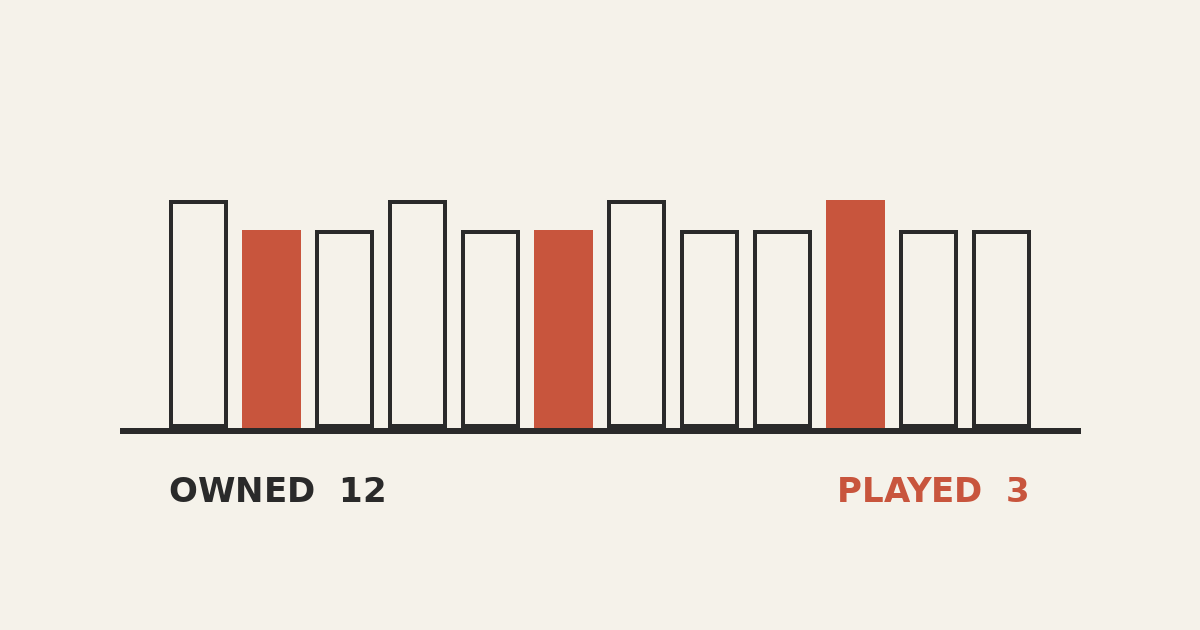 What you own and what you've played. Of twelve, only three have color (diagram by the author)
In the margins of my notebook, two men stand before a shelf
So I asked two people to sit down. One is Seneca, the Roman Stoic philosopher. The other is Walter Benjamin, who wrote an essay while taking his own books out of their crates. The lines below are my own reconstruction, inferred from their writings. They are not a record of anything either man actually said.
Seneca. "Let us begin by counting. I wrote it in On Tranquillity of Mind. What use are countless books and libraries whose owner can barely read through the catalogue in a whole lifetime? A crowd of books does not teach the learner. It only weighs him down. It is far better to give yourself to a few authors."
Benjamin. "You said catalogue. What you are counting is not books but rows of spines. I wrote Unpacking My Library in front of books that were not yet on the shelves. The crates had been wrenched open, and books lay all over the floor. I wrote in the middle of that."
Seneca. "If they are scattered, all the more reason. In the same passage I complained that books had become not tools of study but ornaments for the dining room. An unread book is wallpaper for guests."
Benjamin. "Books for show — I dislike them too. But a collector's books are not there for the guests. Let me tell you about Anatole France. A visitor looked at his library and asked, 'And you have read all these?' He answered, 'Not one-tenth of them. I don't suppose you use your Sèvres china every day?'"
Seneca. "A plate does not eat time. Ah, you will say an unread book does not eat time either. But the time spent hesitating before buying, the time spent staring at the sale page — that time is surely gone. I wrote it in On the Shortness of Life, too. We are not given a short life. We make it short."
Benjamin. "It depends on whether you see that time as gone. Each of my books carries the town, the shop, and the day I got it. Ownership is the most intimate relationship a person can have with things. Not that they come alive in him. It is he who lives in them."
Seneca. "Lives in them... Then that is not so far from my 'give yourself to a few authors.' If you are going to live somewhere, fewer is better."
Benjamin. "Yes. When you buy more than you can live in, the shelf becomes your wallpaper."
Here the two of them turned out to dislike the same thing: a shelf kept for the sake of the number. Seneca points at it from the side of time, Benjamin from the side of memory. The problem is not the stacking. It is whether each thing you stacked still carries the story of how you got it.
That also helped me see why the shelf in Strange Horticulture never felt like guilt. Even the unnamed pots carry when, and who, brought them in. They sit there not as a count of what's left but as the shop's memory.
I lean half a step toward Benjamin. But Seneca's "more than you can live in" is real, too.
Takeaway: don't show the unplayed as "N left"
If I had to put the takeaway in one line: don't show the unplayed as "N left." Keep the one line about how you got it.
I fixed it in my notebook. My own puzzle pack screen had a counter that said "Uncleared 24." I removed it. Instead, next to each board not yet opened, I show in small type the date it was unlocked and the name of the board solved that day.
A number hurries you. A date reminds you. It is the same "not yet," but the face in front of the screen is different.
Earlier in this series, in Who Is 100% Completion Actually For?, I thought about finishing things. In Why Does a Spoiler Feel Like Theft?, I dealt with owning an experience. This time it is about owning something before you have experienced it. I wrote about Strange Horticulture itself in the review.
Let me ask you. The game that has slept longest on your shelf — where did you get it, and how? If you can remember right away, maybe it is still part of play. Tell me in the comments.
Next time in the short-form slot: "Is gacha play or gambling?" I'll ask two philosophers to judge where buying luck crosses a line.
About the images: this time I could not reach Steam's image servers, so I could not check the screenshots with my own eyes. I don't publish images I haven't checked, so there are no game images here. The only figure is a diagram I made.
References: Seneca, On the Shortness of Life and Two Other Essays (Japanese edition, trans. Hidebumi Ohnishi, Iwanami Bunko; includes On Tranquillity of Mind) / Walter Benjamin, Benjamin Collection 2: The Thought of the Essay (Japanese edition, ed. and trans. Kenjiro Asai, Chikuma Gakugei Bunko; includes Unpacking My Library).
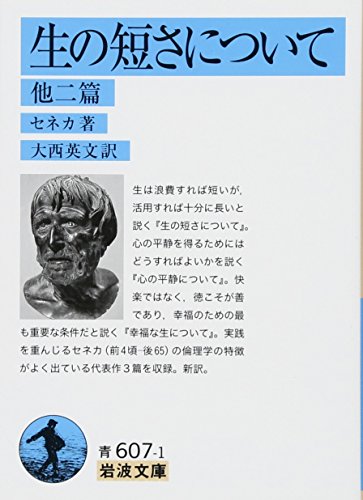 Seneca, On the Shortness of Life and Two Other Essays (Japanese edition, trans. Hidebumi Ohnishi, Iwanami Bunko)
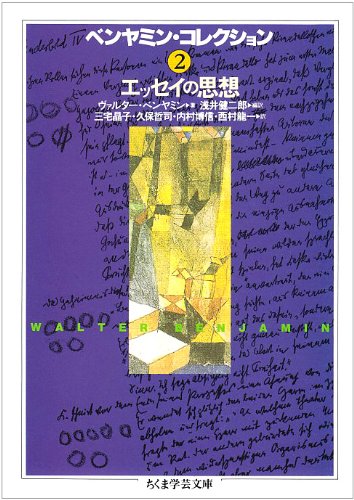 Walter Benjamin, Benjamin Collection 2 (Japanese edition, ed. and trans. Kenjiro Asai, Chikuma Gakugei Bunko)Note: the book covers are Amazon Associate links. As an Amazon Associate, Puzzlebyrinth earns from qualifying purchases.
Reactions (no login)
Anonymous • one of each per visitor per day
Part of these series
The Nature of PlayEpisode 23 of 23