ESSAY · 2026-09-25
Why Can't a World of Pure Merit Stand on Its Own? — Reading Caillois, Part 4
"The Nature of Play," long-form slot. In Part Two the book turns around and starts reading society through play. Holding up the society of merit from below were two pillars: luck and admiration
Four nights stuck on whether to add a weekly leaderboard
It's night, my whisky is half gone, and I keep drawing a leaderboard frame in my blueprint notebook and erasing it. Should my homemade daily puzzle get a weekly ranking?
I know it would liven things up. What scares me is the top ten names being the same every week. For anyone ranked 11th or lower, that table becomes a notice board that says: you cannot win.
Tonight I opened Part Two of Caillois's Man, Play and Games. As promised last time, this is where the book turns around. Instead of applying play to society, it starts reading society through play.
By the end I had found an idea that speaks directly to my leaderboard problem. That's tonight's topic.
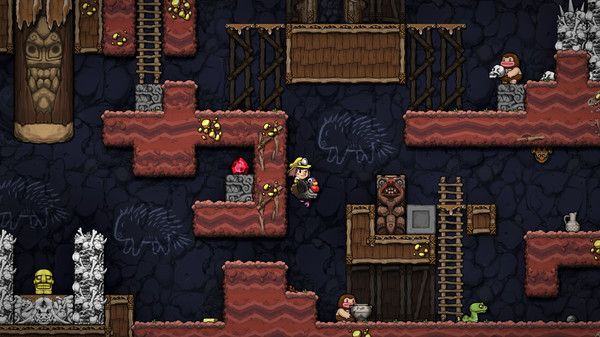 Spelunky 2 in play — image 1 as listed on the Steam store page (Steam store screenshot)
Part Two reads a society by the games it loves
Around the start of Part Two, Caillois puts forward a big idea: look at which games a society prefers, and you can read that society's character. Play isn't decoration on top of culture. It's where a culture's habits show most honestly.
The later chapters run on this idea: "Simulation and Vertigo," "Competition and Chance," and "Resurgence in the Modern World." The four boxes built in Part One are now held up against society itself.
Caillois splits societies into two broad kinds. In one, masks and possession — pretending and dizziness — sit at the center. In the other, competition and chance — skill and luck — sit at the center. He describes the move from the first to the second as the path toward civilization.
The chapter on simulation and vertigo describes a world where the one who puts on a mask truly becomes a god or a spirit. Dancing and drums make you dizzy until you are no longer yourself. There, play, faith and politics have not yet come apart.
In the other society, the one of competition and chance, the masks come off. People compete on skill with their own faces and draw their luck. Rules, records and rankings become the tools that run society.
I want to read that stage theory with a discount. Like many books of 1958, it's a map that puts the West at the finish line. I said so two readings ago, so tonight I'll leave it aside. The interesting part is in the details that follow.
A society of pure merit leaves losers nowhere to go
In the chapter on competition and chance, Caillois looks at modern society from the side of competition. On paper, everyone stands at the same starting line and skill decides the order — exams, promotions, sports.
But he quickly adds that the starting line is never really even. The family you were born into, where you grew up, the teacher you happened to meet. Luck is mixed in from the very start.
This is the part that hit me. Following Caillois's argument, chance isn't only competition's enemy. It also works as an escape route from competition. People who can't win on skill pin their dreams on the lottery. Before the draw, everyone is equally powerless — and so everyone has equal hope.
The second escape route he names is identification with stars and champions. People who can't win themselves see themselves in someone who does, and borrow a small share of that victory. He reads this as the play of masks surviving into the modern world in a new form.
But this identification has a shadow. You stop running yourself and feel satisfied just watching others run. As far as I can read, Caillois does not praise it without reservation. An escape route can also become a place that shuts people in.
In other words, a society run on merit alone can't stand without two supports: luck and admiration. Pure competition leaves the loser not a single excuse. Every loss becomes your fault.
Spelunky 2's Daily Challenge gives everyone the same luck
Let's check this against a game. Spelunky 2 (Mossmouth, 2020) is an action game whose caves change shape every time you go in. On a normal run, some days your luck is good and some days it's bad.
The Daily Challenge is different. Everyone in the world gets the same seed — the same cave blueprint. You get one attempt per day. Whether you die or win, you can't play again until midnight UTC.
This is evening out the starting line taken to the extreme. Luck hasn't disappeared; everyone has been dealt the same luck. So what remains on the leaderboard is almost pure skill.
If the starting point is exactly the same, only decisions make the difference. Which pot to break, where to get greedy. Every line on the leaderboard becomes a record of that day's decisions.
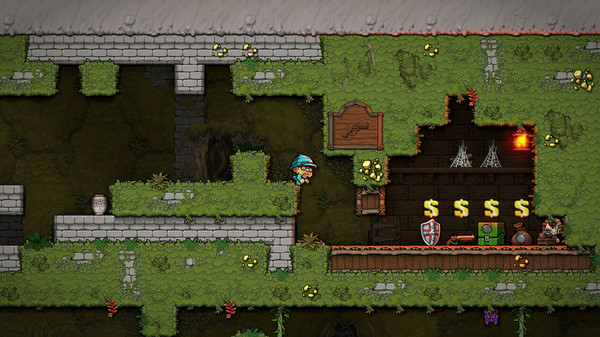 Spelunky 2 in play — image 2 as listed on the Steam store page (Steam store screenshot)
What's interesting is that the same game's normal mode runs the opposite kind of society. Because the cave is different every time, someone who dies can say, “that was a bad layout.” One game holds two societies side by side: one with excuses and one without.
That's probably why some players find the daily leaderboard harsh. There, every loss comes straight back to you.
Fall Guys scatters luck and hands out crowns
Now the opposite example. Fall Guys (Mediatonic, 2020) sends dozens of players racing through obstacle courses at once, knocking them out round by round until one is left.
Here luck is scattered everywhere. The stage is picked round by round, and the wobbly bodies bump into each other and roll off in unexpected directions. Even a skilled player can fall because of one collision.
In exchange, someone playing for the first time can sometimes win the crown. Not every time. But there's a “maybe.” The equality Caillois sees in front of the lottery has been built right onto the course.
The loser can laugh and say, “I got pushed.” A bit of your own clumsiness dissolves into luck. And so you can press the button for one more round.
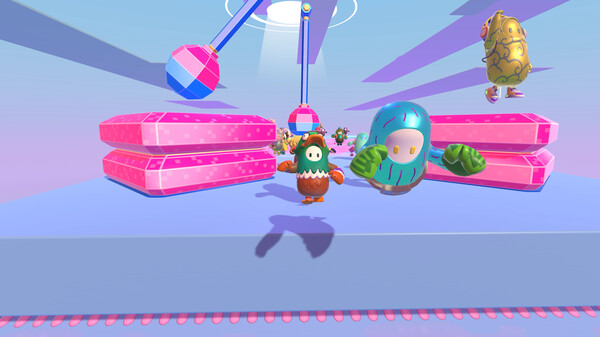 Fall Guys in play — image 1 as listed on the Steam store page (Steam store screenshot)
Putting the two games side by side, I noticed something. I used to think luck was a tool that breaks fairness. Seen through Caillois, though, luck is more like a cushion that catches the loss. The question isn't how much luck there is. It's where a loss lands — inside the player, or inside luck.
When I wrote Is a Victory Won by Luck Really “Yours”?, I was thinking about the winner. Tonight is about the loser.
Takeaway — if you show a ranking, put a place for losing on the same screen
If I had to put the takeaway in one line: if you show a leaderboard, prepare a place for the people who lose, on the same screen.
I wrote three things in the notebook. One: the daily stays the same board for everyone. Competition with evened-out luck is beautiful in its own way. Two: no weekly leaderboard.
Three: from everyone who finishes that day's puzzle, one person is picked by lottery. Their solving path is shown next to the next day's board, for one day only. Speed doesn't matter. If you finished, you can be picked.
The lottery hands out excuses and hope. The featured path becomes a place where others can look and see themselves. I plan to plant, beside one small board, the two supports Caillois found under modern society.
One thing is already decided: nobody bets money or items on this lottery. As I read in Reading Caillois, Part 3, games of chance collapse into superstition and gambling once they lose their frame. What you win is one day beside the board, and that is enough.
My position leans half a step toward Caillois. A table of skill is beautiful. But a place that runs on that alone quietly sends everyone below 11th place home.
When I read the chapter on combinations in Reading Caillois, Part 2, competition and chance sat together as “tools for settling things.” What I learned tonight is that inside a society, the pair also works to keep winners and losers in the same place.
So let me ask you. In the game you've played the longest, is there somewhere you can say “that was bad luck” when you lose? Or does every loss come back to you? Which one keeps you playing? Tell me in the comments.
The next long-form slot returns to the matching type. Using Kant's idea of “purposiveness without purpose,” I'll ask why a beautiful puzzle board is beautiful. Reading Caillois, Part 5 — “Resurgence in the Modern World” — comes in the reading slot after that.
Reference: Roger Caillois, Man, Play and Games (Japanese edition: trans. Michitaro Tada and Mikio Tsukasaki, Kodansha Gakujutsu Bunko).
 Caillois, Man, Play and Games (Japanese ed., trans. Tada & Tsukasaki, Kodansha Gakujutsu Bunko)As an Amazon Associate, Puzzlebyrinth earns from qualifying purchases.
Reactions (no login)
Anonymous • one of each per visitor per day
Part of these series
The Nature of PlayEpisode 22 of 23