DESIGNER-STUDY · 2026-09-14
Inside Eiji Aonuma's Philosophy — Refusing to Let a Puzzle Have One Answer
The Legend of Zelda, from Ocarina of Time to Tears of the Kingdom / designing dungeons and the moment players get stuck
What is Eiji Aonuma's design philosophy, in one line?
"Don't let a puzzle have just one answer." That is where Eiji Aonuma stands today. He has led The Legend of Zelda at Nintendo for more than twenty-five years. In 2023 he put it this way: "Now, I'm happy that we've arrived at this method where we're giving people lots of options, and there are many answers to a single problem, and all of them can potentially be correct" (Game Informer, May 2023 source ↗).
What is interesting is that he did not always think this. In 2015, remaking Majora's Mask, he kept telling his staff the opposite: "I repetitively told the staff to never make this game easier" (Iwata Asks: Majora's Mask 3D source ↗).
One man moved, in ten years, from "never make it easier" to "any of them can be correct." This article follows that move using only his own words. It is about how a designer's thinking changed, not about the games themselves. From The Legend of Zelda: Tears of the Kingdom – Official Trailer #3 (YouTube / Nintendo of America)
Who is Eiji Aonuma, and what has he done?
He is well known in Japan, but for readers elsewhere: Eiji Aonuma is a producer at Nintendo and the person in charge of The Legend of Zelda. He joined Ocarina of Time (1998) as a dungeon designer and has worked on nearly every entry since.
By his own account, getting onto Ocarina of Time took some nagging. "I pestered Miyamoto-san about it and he said, 'We don't have enough people for The Legend of Zelda: Ocarina of Time, so come on in for a spell.'" And: "Of those of us here today, I joined the project last" (Iwata Asks: Ocarina of Time 3D source ↗).
What he was given there shaped everything after. "I designed a total of six early and mid-stage dungeons, most of the enemy characters, and enemy and boss battles" (ibid.). He came into Zelda through dungeons — through rooms of puzzles strung together — not through story or characters.
What does he keep saying, across the years?
Line up several interviews and one thread appears: keep the player willing to try again. On A Link Between Worlds (2013) he said, "another theme this time was making sure that players don't lose their desire to try again" (Iwata Asks: A Link Between Worlds source ↗).
In the same interview, designer Shikata names the problem: "more than a few people get stuck somewhere as they're playing and can't get beyond that point. I feel like that is a big problem" (ibid.). Aonuma's answer was not to lower the difficulty. It was to free the dungeon order and rent the items out: "You can rent the appropriate items for each dungeon and beat them in any order" (ibid.).
This is the key, as I read it. He is not reducing difficulty; he is reducing dead ends. When you are stuck, some other door should already be open. That idea runs straight into "many answers can be correct" ten years later. From the A Link Between Worlds launch trailer (YouTube / Nintendo of America)
The other refrain is "Zelda-ness." In 2006, on Twilight Princess: "The idea of what defines the essence of Zelda becomes the most important thing. That is really the only absolutely fundamental criterion" (Iwata Asks: Twilight Princess Part 3 source ↗). In 2023 he says almost the same: "Making sure that Zelda-ness or that Zelda feel is really in the game. I think that's a really important point" (Game Informer, 2023).
What does he keep coming back to?
One is letting players cheat. In 2023: "When you think about people... cheating is fun! They like it! Finding that shortcut is enjoyable" (Game Informer, 2023).
That is not a throwaway line. It is another way of saying the design should let you walk outside the route its author imagined. Item rental, and puzzles solved by combining abilities, both point the same way.
The other is the wish to surprise. On watching his dungeons take shape: "Each day, I experienced the reward of seeing the practically empty world that I had first designed with only squares and triangles rapidly become more real" (Iwata Asks: Ocarina of Time 3D).
These are two sides of one thing, as I read them. Fill an empty box with mechanisms, then wait for someone who does not know what is inside to open it. He builds dungeons, but the work resembles building puzzle boxes.
What failures has he admitted in public?
The clearest admission concerns how helpful Skyward Sword (2011) was. In 2014: "When we created Skyward Sword, I really felt the need to make sure that everyone playing the game understood it. But I also understand now, in hindsight, that when you go out and buy a game, you buy the game because you want to play it, and you don't want to have any obstacles in the way" (from a Kotaku interview, June 17, 2014 source ↗).
He then diagnoses the failure as one of ordering: "In a game, it's when you get stuck, when you want that help. And I kinda frontloaded all that in Skyward Sword, and it doesn't really help to get that information when you don't know what to do with it. So that was a real learning experience for me." And: "So I'm going to be careful not to do that" (ibid.).
Note that this is not "we explained too much." It is "we explained at the wrong moment." The subject is timing, not volume. I think it is his most accurate piece of self-analysis. From the Skyward Sword HD launch trailer (YouTube / Nintendo of America)
He has also described a much older failure: item and dungeon ordering on Ocarina of Time. "Even if we had an item, we wouldn't know where to put it. We decided the number of items at the start. But that ended up causing us trouble." And: "After I'd designed the early dungeons, a new item would be done and someone would tell me, 'Make sure there isn't any trouble when Link enters the dungeon with this item.' I thought, 'Come on! You should have told me that at the beginning!'" (Iwata Asks: Ocarina of Time 3D).
Items first, or rooms first? Anyone who builds dungeon-shaped puzzles runs into this. He ran into it twenty-five years ago, while holding six dungeons at once.
Where does he say he is caught?
The first is between difficulty and drop-off. In 2015, on Majora's Mask 3D: "I repetitively told the staff to never make this game easier." He described the original's stance as, "It's like we're saying to them 'can you clear this?'" (Iwata Asks: Majora's Mask 3D).
Two years earlier he had said the theme was making sure players don't lose their desire to try again. It looks like a contradiction. I do not quite read it as one: he is fighting on two fronts, keeping the difficulty while closing off dead ends. But he has never claimed the two always coexisted comfortably.
The second is being caught by a format he built. In 2023, on Ocarina of Time: "I think it's correct to say that it did kind of create a format for a number of titles in the franchise that came after it. But in some ways, that was a little bit restricting for us" (Game Informer, 2023).
Trapped by your own template. That is the classic dilemma of anyone minding a long series, and he is one of the few who admits it publicly. In the same interview he says of Breath of the Wild that "it has created a new kind of format for the series to proceed from" (ibid.). Break one template, and another appears.
The third is the weight of the series itself. Asked to remake Majora's Mask, his reaction was: "I didn't want to open that lid again!" (Iwata Asks: Majora's Mask 3D).
What influences does he acknowledge?
The one name he states plainly is Shigeru Miyamoto. His entry into Zelda was a direct appeal to him: "I pestered Miyamoto-san about it and he said, 'We don't have enough people... so come on in for a spell'" (Iwata Asks: Ocarina of Time 3D).
The other influence he names is, of all things, his own team's past work. Saying that Ocarina of Time "created a format for a number of titles in the franchise that came after it" is praise and an acknowledgement of inherited weight at the same time (Game Informer, 2023).
There is a widely repeated story that he built mechanical dolls as a student. I could not verify the original source of that quote for this piece, so I leave it out.
My reading — he designs the shape of being stuck, not the difficulty
What follows is my interpretation. He has not said this himself.
Line up twenty-five years of Aonuma and what he has been adjusting is not difficulty but the shape of being stuck. The difficulty itself was not lowered — not in 2015, when he said never to make it easier, and not in the recent games. What changed is what a stuck player can do next.
In A Link Between Worlds, he opened another dungeon for you. In Tears of the Kingdom, he opened another solution to the same problem. Neither is a difficulty tweak; both are adjustments to the number of exits. Read that way, "many answers can be correct" is less a statement of kindness than a technical report that his handling of stuckness reached its final form.
That reading also makes the Skyward Sword regret coherent. There, instead of adding exits, he pinned every signpost at the entrance. Explain everything before the player is stuck and you delete the chance to design being stuck at all. His 2014 line — help is wanted when you get stuck — may be the moment he noticed he had thrown that chance away.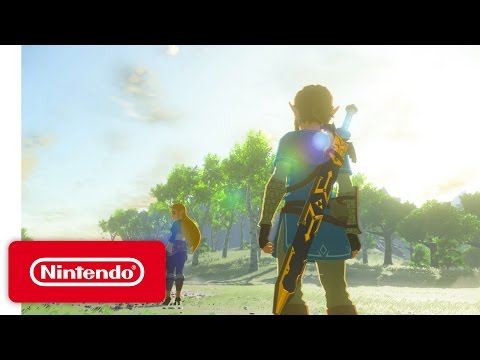 From the Breath of the Wild Nintendo Switch Presentation 2017 trailer (YouTube / Nintendo of America)
Where to start, if you want to understand him
To meet Aonuma the designer, A Link Between Worlds is the clearest entry. Dungeon order is free and the items are rentals. His idea of designing stuckness sits there in plain mechanical view.
Then play Skyward Sword and you will feel what his regret means. You learn what it is like when help arrives too early. Taking those two in sequence looks like a detour and is actually the shortest route.
For designers who think along similar lines, we have written about Jeppe Carlsen (puzzles built on trust) and Andrew Shouldice (designing the time you spend not knowing). On where a game should let stuckness go, see designing the overworld.
Sources
Primary sources used in this article:
・Iwata Asks: Ocarina of Time 3D (Original Development Staff, Part 1)
・Iwata Asks: Twilight Princess, Part 3 (2006)
・Iwata Asks: A Link Between Worlds (2013)
・Aonuma's remarks from a Kotaku interview (June 17, 2014), via Nintendo Life, June 2014
・Iwata Asks: Majora's Mask 3D (2015)
・English summary of an RTL Nieuws interview (July 2023) — Fujibayashi on "one answer for one problem"
Video thumbnail sources (all YouTube / Nintendo of America official channel):
・The Legend of Zelda: Tears of the Kingdom – Official Trailer #3
・Nintendo 3DS - The Legend of Zelda: A Link Between Worlds Launch Trailer
・The Legend of Zelda: Skyward Sword HD - Launch Trailer
・The Legend of Zelda: Breath of the Wild - Nintendo Switch Presentation 2017 Trailer
Reactions (no login)
Anonymous • one of each per visitor per day
関連シリーズ
The Designer's Philosophy第59回 / 全63回