TAG
#level-design
0 篇评论 · 22 篇随笔
相关随笔
Macchi et al.: Letting people touch it changed nothing; drawing it as parts raised solving by 33 points — Fukai Reads
A peer-reviewed paper by Laura Macchi and colleagues at the University of Milano-Bicocca (Journal of Intelligence, 9 May 2026) testing the received wisdom that handling a problem's materials makes insight more likely. Asked to build four equilateral triangles from six pencils, participants given the real pencils went from 27.3% to 32.6% — no significant difference. But swapping a matchstick arithmetic puzzle for a photograph of real matchsticks lifted solving from 46.7% to 79.3%, with nothing to touch. What worked was not the hand, but the picture saying "I am made of parts."
Baek et al.: Ordering a Level That Is 75% Zelda and 25% Mario, in Plain Words — Fukai Reads
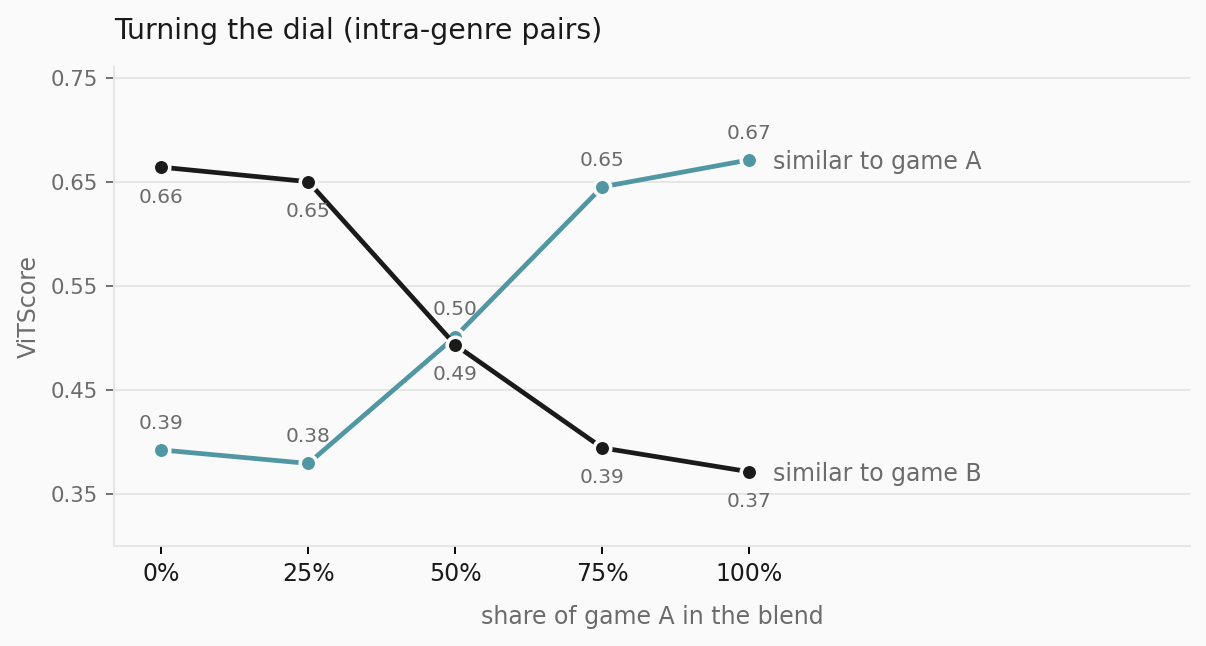
A paper by In-Chang Baek and four co-authors at GIST and Dongguk University (arXiv:2603.26782, an un-peer-reviewed preprint). They put 5,576 levels from Zelda, Dungeon, Lode Runner and Super Mario Bros into a single latent space so that levels can be blended across games using text and a mixing ratio. Sharing one model instead of four costs about 4.4% in overall similarity, and turning the ratio dial swaps similarity between the two source games as intended. Blending through a single written instruction, however, remains weak.
Siper et al.: Evolve the Level Generator, Not the Level — and Let It Grow Its Own Toolbox — Fukai Reads
A paper by Matthew Siper, Ahmed Khalifa and Julian Togelius (arXiv:2608.17947, accepted at IEEE Conference on Games 2026). Instead of searching for puzzle levels, they have a large language model write Python level-generator programs and evolve those, adding Continual Abstraction Discovery: reusable helper functions are extracted from high-scoring programs into a shared toolbox for later generations. Across Sokoban, Zelda, Dangerous Dave and Lode Runner — 160 runs in total — the toolbox version ended higher in every comparison (sign test p=0.008).
Elshamy et al.: Read the player's skill, then redraw the level itself — Fukai Reads
A Scientific Reports paper from Elshamy and colleagues at E-JUST on inferring player skill and rewriting the terrain of the level itself. Where conventional dynamic difficulty adjustment tunes enemy health and item drops, this pipeline rearranges floors, gaps and enemies in place. Skill classification reached 97.82% accuracy; 74.1% of rewritten levels remained completable.
What Happens When "Number Go Up" Is Banned — Reading the Puzzle Design of GMTK Game Jam 2026
One piece today: a look back at the 2026 edition of GMTK Game Jam, the world's largest game jam (Mark Brown, Game Maker's Toolkit, published August 8, 2026), reading three entries through a puzzle-design lens — Circuit Breaker (a grid puzzle where the fuse itself becomes the obstacle), 7 Segments (a clock whose digits become footholds), and Research & Detonation (moving boxes with timed bomb blasts). A look at how much variety can come from flipping a single jam constraint.
Gao & Dubé: Letting a machine do the first read of player-made math levels — Fukai Reads
An arXiv preprint by Jie Gao and Adam K. Dubé of McGill University. A children's math learning game has a Creative Mode in which advanced players build their own levels, but reading every submission by hand does not scale. The authors extracted features from 206 levels (86 by experts, 120 by players) and trained a classifier to do the first read. Random forest gave the best recall and F1, scoring 82.42±5.71% accuracy and 72.70±9.22% F1 in the outer loop.
Xu与Verbrugge:把"重力方向"与"时间"变成关卡生成的坐标轴 — Fukai解读
麦吉尔大学的Kaijie Xu与Clark Verbrugge发表于FDG 2026、通过同行评审的论文。关卡自动生成一直以来都是先做好地形,再对重力反转、移动脚手架之类的机关做事后检验。这篇论文把机关本身升格为坐标轴,提出在(x, y)基础上加入"层"与"时刻"的大型图上寻路的HDPCG。切换间隔的误差降到了0.000~0.002,迂回路径的存留率是无引导基线的9~10倍。
Han et al.: Sorting Out When Learning Order Matters, by Computational Complexity — Fukai Reads
A paper by Han and four colleagues at UC Davis and partner institutions on the computational complexity of instructional sequencing. They formalise the ordering of prerequisite-linked concepts as a stochastic shortest-path problem, prove that the stochasticity of retry-after-failure collapses exactly by dividing cost by success probability, show that optimal ordering nonetheless remains NP-hard, and give a cheap diagnostic that upper-bounds the value of sequencing before any optimisation. On 70,893 real interactions from an introductory CS course that headroom was under 0.2%, while on a constructed trap greedy sequencing lost 28.3-45.1%. arXiv preprint, submitted 5 August 2026, not peer reviewed.
Inside William Chyr's Philosophy — making infinity a place you don't get lost in
A study of William Chyr, who spent seven years building Manifold Garden, assembled only from what he has said in public. The balloon installation artist driven into games by a latex allergy. His two constraints: everything visible is reachable, and no invisible colliders. His insistence that the leap must come from the player's agency, not the designer's instruction. The coinage he threw out — "exampuzzles". The 2015 slump and the switch from sprint to marathon. The dilemma between authorship and keeping a studio alive. And the influences he names himself: Escher, Tadao Ando, Frank Lloyd Wright, Portal, Starseed Pilgrim. Six primary sources, closing with Kizuki's own reading.
Ponnock & Ho: The Order of Mario 1-1 Has a Measurable Teaching Effect — Fukai Reads
A reinforcement learning and level design paper by Jesse Ponnock and Lucas Ho (arXiv preprint, not peer-reviewed). Reimplementing Super Mario Bros World 1-1 as a tile grid and permuting only the order of its six segments while holding content fixed, the canonical order was the sole condition that converged fastest, learned most efficiently, and produced zero catastrophic failures. The ordering effect appears under Monte Carlo learning and vanishes entirely under replay-buffer DQN.
From the same skeleton to a different puzzle: the Thinky Collective's “inherit just one thing” design experiment
One piece today. I read, in the original English, a Thinky Games article (by Corey Hardt, published July 24, 2026) from the edited puzzle-focused outlet. It covers how the Thinky Collective — a loose community of puzzle gamedevs — built the browser game The Snake That Eats Puzzle Game Mechanics. Normally they pass a single large PuzzleScript project around, each adding levels, art, or refinements. This time the method changed: each dev received just one piece of the previous person's game and had to make a miniature, single-level game from that shared element. The result is that adjacent games might share sprites while their mechanics have swapped, or keep the same level shape while a new look and context turn the puzzle into something else entirely. A constraint produced divergence, and a dozen-plus one-screen games were strung together. As an aspiring designer, I carried this home as a design template I want to try.
The Grammar of Solving Together — Co-op Puzzle Design and Information Asymmetry
Puzzle design theory quietly assumes a single player. I set Portal 2's division of verbs against the information asymmetry of Keep Talking and Nobody Explodes and We Were Here, add PICO PARK's shared learning curve, and trace the grammar of co-op puzzles where conversation itself becomes the verb.
Handcrafted or Generated — A Design Theory of Procedural Puzzle Levels
Who authors a puzzle's boards? I set the handcrafted lineage of Nikoli and Tametsi's 160 levels against the generated lineage of Simon Tatham's collection and Hexcells Infinite, ask what procedural generation drops, and look at the daily puzzle as a third way between generation and curation.
同一道命题诞生两款不同的游戏——Alan Hazelden 谈「收敛的构想与分岔的设计」
今天只有一篇。我读了专注于解谜的编辑媒体 Thinky Games 每月连载专栏「Thinky Third Thursday」的2026年7月号(作者是 Draknek & Friends 主理人 Alan Hazelden,2026年7月17日发布,英文原文)。我把重心放在 Alan 本人在该期中写下的一段话上。从 Dom Camus 主办的 Thinky Puzzle Game Jam 6(题目为「Locked Room」,投稿超过80款)中,他把自己团队的作品《All the Gold in Fort Locks》与 ELAiNE 的《Every Door a Portal》并列介绍。两款作品几乎共享同一个构想——「用哪把钥匙开门,门后的现实就会被改写」——却因钥匙的处理方式(在盘面上推动,还是放进背包携带)以及关卡结构(单一相互连通的挑战,还是11个独立关卡)这几点判断的不同,而变成了截然相反的体验。Alan 将其评价为「一个绝佳的例子,说明相似的游戏构想能够多快地分岔成截然不同的体验」。构想可以共享,但设计判断才是分出体验的关键。作为一名有志于设计的人,我认为这段话是今天最值得带走的收获。
Inside Kim Swift's Philosophy — Manipulating the Player Into Feeling Clever
"After people play our game, I want them to feel clever." That is how Kim Swift describes designing Portal. She is a designer who bet not on hard puzzle walls but on invisible guidance — steering the player's eye and feelings without them noticing. Her philosophy, obsessions, failures (a boss fight that died three times), dilemmas and influences, read through her own interviews and a GDC postmortem.
Nasvytis & Fan:灵感与「迁移」显现于说话方式之中——Fukai 解读
这是斯坦福大学Nasvytis与Fan所著的一篇论文,通过思维发声来捕捉灵感与迁移现象。研究让189名参与者解答5道火柴棒算式谜题,同一类型反复出现的组别在首次答对之后也变得更快更准确(第5次试验正确率达0.75),把问题类型说出口的比例增加了约7倍。可以解读为,迁移的标志正是「能够把诀窍说出来」。
好谜题"想被解开"——Tom Hermans 以 Sokoban 讲述的三层:呈现、简洁、抱负
今天一篇。我以英文原文通读了解谜开发者 Tom Hermans(Auroriax)发表在 Game Developer(旧 Gamasutra)上的特稿博客《How to make a good puzzle - An explorable explanation(如何做出好谜题——可玩的解说)》。虽是 2018 年的文章,却是经久的入门经典:借助可实际游玩的 Sokoban 关卡,从呈现(Presentation)、简洁(Elegancy)、抱负(Aspiration)三层讲述何为好谜题。好谜题应当"想被解开";用最小的空间与步数搭建;理解可能性空间;每一关都教玩家新东西;并以独创的核心机制与神秘世界给予动机。作为被编辑媒体收录的实务者一手设计论,符合本汇总的可信度门槛。稍旧,故标注日期处理。
解谜关卡不是"等"来的——Patrick Traynor 公开的关卡构思工具箱
今天一篇。我以英文原文通读了《Patrick's Parabox》作者 Patrick Traynor 发布在个人站点 cwpat.me 上的《Puzzle Level Idea Strategies》(2022)。他把构思解谜关卡视为可用工具与练习反复运转的流程,而非等待灵感,并列出他实际使用的 25 条以上构思策略:强制某种交互、列举所有机制两两组合、在无解与可解关卡间相互转换、构建正向设计链、实现小装置与涌现现象等。在偏重"评价"(什么是好谜题)的设计讨论中,这是少见地填补"构思"(量产点子)实务空白的一手资料,是制作者会收藏重读的文章。稍旧,但已标注日期。
Inside Maddy Thorson's Philosophy — Keep It Hard, Make It Kind
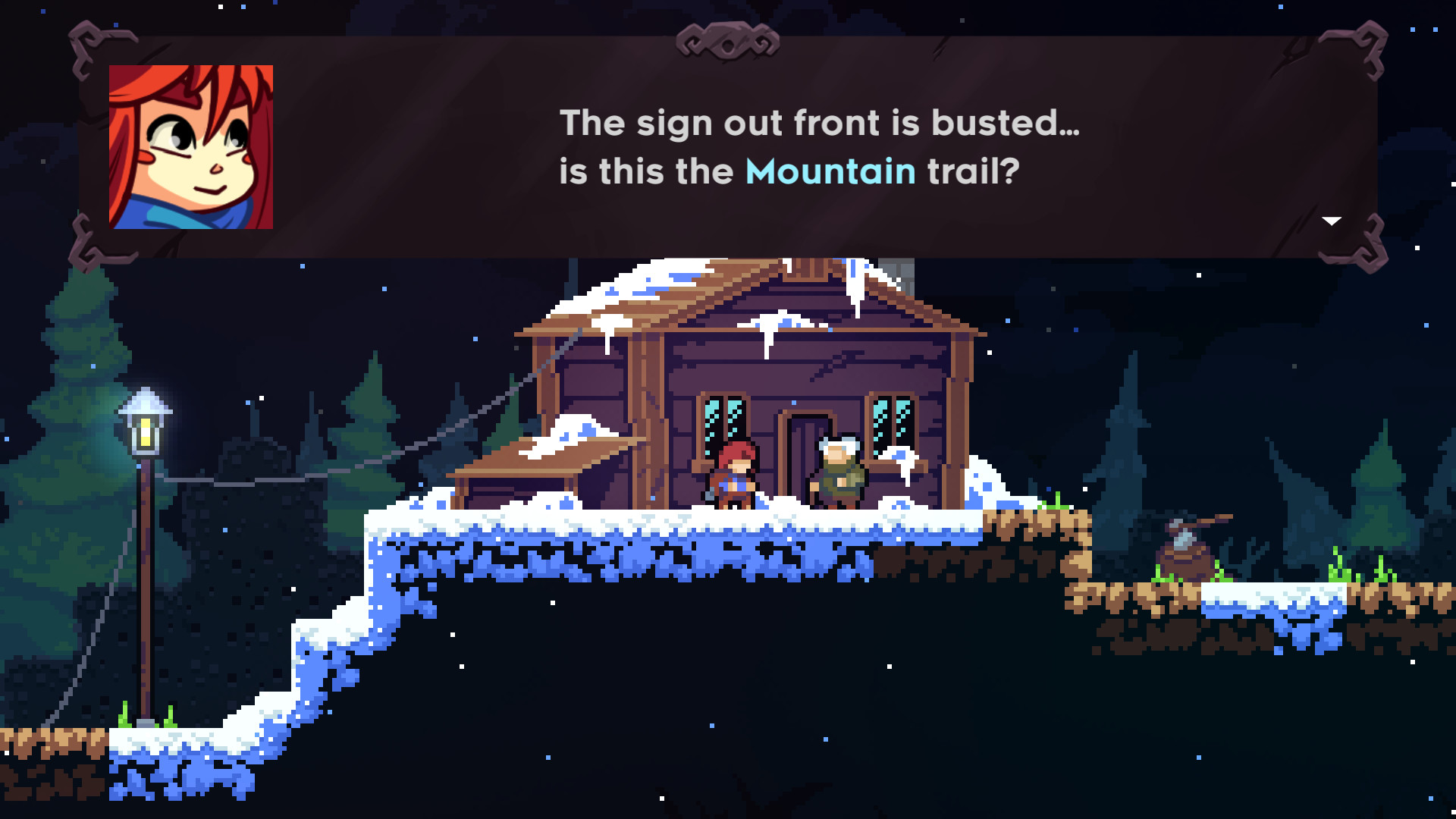
A study of Maddy Thorson (TowerFall, Celeste) built from her own blog, interviews, and GDC talk: a philosophy of keeping difficulty while making it kind, an obsession with fudging things "a little" in the player's favor, and the dilemma of authorial intent versus letting go.
Jara Gonzalez & Guzdial: Generating Enemy Shapes as Gates You Need a Mechanic to Beat — Fukai Reads
A paper by Jara Gonzalez and Guzdial on generating enemy morphologies (collision shapes). They frame 'enemies defeatable only with a specific mechanic' as a 4x4 grid generation problem, compare reinforcement learning, A* search, and neural generation, and find a simple A* reachability rule yields the best gating and most diverse shapes at the lowest cost.
封闭于一画面的设计 — 单屏谜题所锻炼的密度
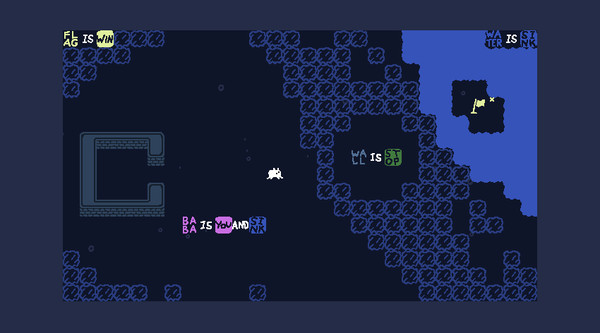
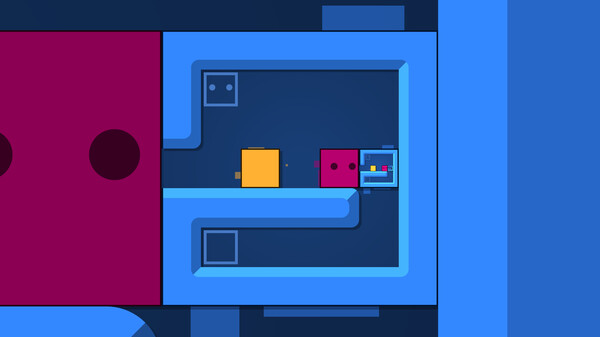
仓库番、Baba Is You、Snakebird、Patrick's Parabox。思考系谜题的核心作品,都将盘面收纳在一画面之内。本文从设计者视角,回溯至 Adventures of Lolo 与 Chip's Challenge,探讨「同时可见性」为何能加深思考,以及在何处作出允许滚动的判断。
Tsumiki 设计讨论摘要 — 2026年6月5日
今日一篇。2026 年 6 月 1 日,Thinky Games 在骄傲月企划中刊出了对《Blobun》游戏导演 Ashe 的访谈。机制始于一个角色逆转的问题:如果玩家自己就是方块呢?结构原则被直接陈述:每个世界引入 2-3 个谜题元素,分别深化,再相互组合,最终世界 Victory Road 是考验所有元素的综合终章。团队还制作了免费 PICO-8 简化版,验证核心机制脱离了高完成度画面后仍然成立。