ESSAY · 2026-09-20
The Verb of Noticing — Puzzles Where the Answer Was Always on Screen
From Blue Prince to ANIMAL WELL, puzzles that hide nothing but delay when you see it
Introduction
Some puzzles hide nothing. The answer sits on screen from the very first frame — the player's attention simply hasn't arrived there yet.
The site's mechanics glossary calls this environmental observation: the world itself is the puzzle statement, its rules read off the landscape rather than explained. 35 catalogued games use it as of September 2026. This essay reads three that bet on delay rather than concealment: Blue Prince, ANIMAL WELL, and The Looker.
Blue Prince — The Floor Plan Changes, the Clues Don't
Blue Prince redraws its mansion's floor plan every run, but the meaning of its clues never changes. A number on a wall, a statue's angle, a shelf of books — they point to the same fact no matter how many times the house reshuffles.
So what the game hides isn't randomness, it's timing. A first-time player walks past that wall number as decoration. Ten runs later, it turns out to be a door code. Noticing arrives through accumulated observation, not luck.
To stretch that delay, Blue Prince makes you walk the same room again and again, each time with a different question in mind.  Blue Prince (Steam store)
ANIMAL WELL — Tools With No Instructions
ANIMAL WELL hands you tools early and explains none of them. You carry an item past a wall or ceiling, half-guessing that something should happen there.
Most of these triggers were already visible the first time you walked past — a hairline crack, a faint ring on the ceiling, a shift in floor color. You only connect them once you return holding the right tool.
This works because the map is contiguous and always revisitable. Knowing you can come back removes the anxiety of missing something on a first pass. 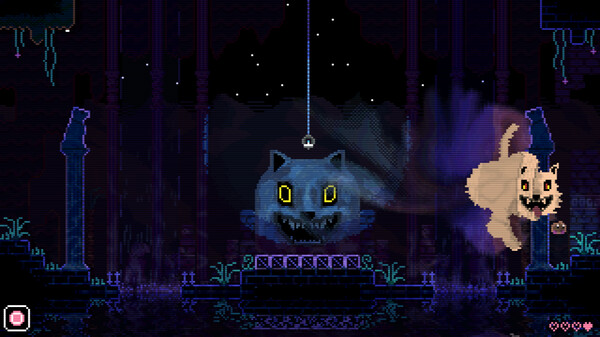 ANIMAL WELL (Steam store)
The Looker — A Puzzle Game Laughing at Its Own Genre
The Looker faithfully imitates first-person observation puzzles, then mocks the form from inside. A panicked caretaker rushes you room to room as you shoot through wall-mounted panels.
Early puzzles echo The Witness's line-drawing logic, but as the game goes on they get trivially easy while the caretaker's voice gets louder and more absurd — the genre's core pleasure held up and laughed at.
What The Looker gets right is that observation puzzles run on the delay between seeing and noticing. Compress that delay to nearly zero and the genre turns into comedy — which tells you the delay was the real material all along. 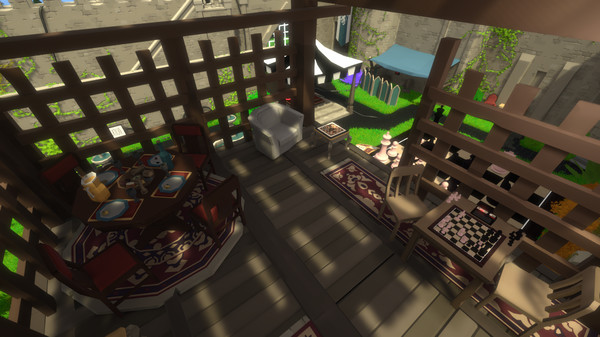 The Looker (Steam store)
The Shared Grammar: Why 'It Was Right There' Works
All three refuse to hide information. The number, the ring, the panel — everything is on screen from frame one. What the designers actually control is timing: when a player's attention finally lands on it.
Three levers do the work: repetition (revisit the same space with new knowledge each time), safety (guarantee a way back, so missing something isn't costly), and self-reference (break the genre's own conventions so players start watching their own blind spots).
Puzzles That Turn Looking into Play made looking the only verb. These three push one step further, turning 'seeing without noticing' itself into design material — and the observation-puzzle lineage still has room to grow from here.
Closing
Designing for delayed noticing is harder than designing for concealment. Hide something and the payoff is guaranteed the moment it's found. Delay it, and there's no guarantee players will feel curious rather than annoyed at what they missed.
If I built a puzzle on this verb next, I'd manage the delay by run count on purpose — a layout unreadable on a first pass, with a clue that only pays off on the second. The real design question is which run that moment of recognition should land on.
Reactions (no login)
Anonymous • one of each per visitor per day
Part of these series
Read next

Related reviews
Please, Don't Touch Anything
You are covering a colleague's bathroom break in front of an unmarked console with a single red button, and you have been told not to touch anything. A pixel-art point-and-click puzzle by Four Quarters about reading the clues hidden in the posters and the wiring to dig out its 25 endings.
Machinika: Museum
A first-person puzzle box in which you scan alien devices of unknown origin delivered to a museum, peer inside them and reprint their missing parts until they run again. A short piece from Littlefield Studio that opens seven machines one at a time, with the touch of science-fiction archaeology.
Tacoma
A first-person exploration adventure set aboard an emptied space station in 2088, where you replay, rewind and walk around volumetric recordings of its six-person crew to reconstruct the days before they left. From Fullbright, the studio behind Gone Home.


