ESSAY · 2026-09-14
The Verb of Drawing the Map — When Moving Forward Becomes the Map Itself
Four Map-Building Puzzles, from Blue Prince to Terra Nil
Introduction
A map is usually there before you take a single step. National land surveys, in-game minimaps — they're records of a space that already existed. But a handful of puzzle games flip that order: the map grows as you walk, the paths appear as you place them, and in one case you erase your own map at the end.
The site's mechanics glossary calls this "Map Building": you choose and append the space as you go, so the map becomes a record of your decisions rather than a fixed object. The map isn't the result — it's the process itself, written down.
I'm looking at four cases: 2025's Blue Prince, where you redraft the mansion's rooms every day; 2020's Carto, where you drag terrain tiles by hand to make a path; 2022's Dorfromantik, where an irreversible move builds up the landscape; and 2023's Terra Nil, which erases its own traces once the map is finished. In all four, building the map is the puzzle.
Blue Prince — Every Room You Draft Becomes the Floor Plan
In Blue Prince (2025, Dogubomb), the mansion sits on a 9x5 grid, but only the Entrance Hall and Antechamber are fixed each day. Every other room exists only after you "draft" it, picking one of three randomized floor plans each time you open a door.
The trade-offs shift every run. A study might reveal clues but seal off a corridor; a greenhouse opens the garden but its doors might not line up with the next room. Each choice fixes a little more of the mansion into place.
You start with 50 steps, and each move into a new room costs one. Run out, and the day ends — your loot is gone, but puzzle knowledge and a few permanent upgrades carry over. The "map" is nothing but a record of where you went and where you ran out of steps. No two days ever share the same floor plan.
The question I raised about designing the overworld — where do you send a stuck player? — doesn't even apply here. The neighboring room that could be an escape route doesn't exist yet. Blue Prince (via Steam store)
Carto — The Terrain You Move Becomes the Path You Walk
Carto (2020, Sunhead Games) grew from a simple idea: what if you could walk on the tiles you place, Carcassonne-style? The terrain isn't connected from the start — you pick up hexagonal map tiles from off-screen and slot them in, any orientation, any spot, and only then does the world connect.
What's striking is that you can move tiles again after placing them. Lift the mountain blocking a river, shift it aside, and a new path opens. When an NPC asks for directions home, you don't read the map — you rearrange the terrain itself and hand them the answer.
This is a puzzle whose solution isn't hidden somewhere on the board — it's in the hand doing the rearranging. Dorfromantik uses the same hex tiles but picks the opposite constraint, as the next section shows.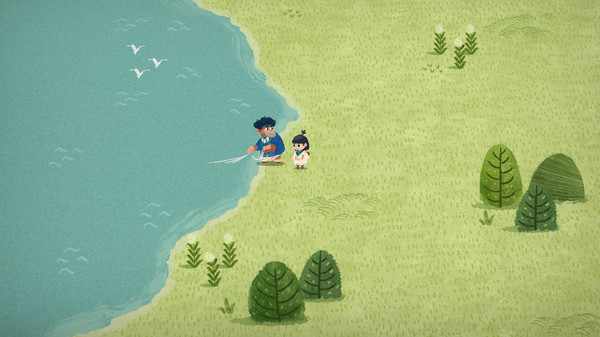 Carto (via Steam store)
Dorfromantik — One Irreversible Move at a Time Builds a Quiet Landscape
Dorfromantik (2022, Toukana Interactive) also spreads a map by laying hexagonal tiles — forest, field, rail, river. Unlike Carto, once a tile is down, it stays down. You choose where to place the one in your hand, but the moment you place it, it becomes permanent landscape.
That irreversibility changes what the map means. Matching terrain scores more, so you're never just asking "where can I stash this tile" — you're betting on how it will mesh with tiles you haven't drawn yet. The map isn't a set of correct answers; it's the sum of every bet you've made.
The game's hushed music and unhurried pace earn it the "chill puzzle" label, but underneath is an unbroken chain of undo-free decisions. As I wrote in hand-built rooms, machine-built rooms, the question of how a human arranges procedurally generated fragments shows up here too, just in a different shape.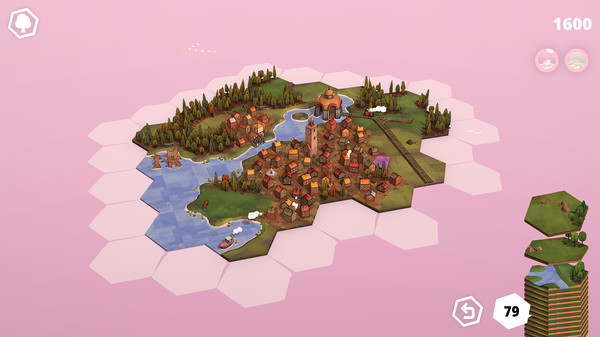 Dorfromantik (via Steam store)
Terra Nil — Finish the Map, Then Erase Your Own Trace
Terra Nil (2023, Free Lives) is usually described as a "reverse city-builder": you plant wind turbines and water purifiers to green a wasteland. What's truly distinctive is the ending. Once the land is restored, you recycle every structure you built into an airship, and fly away.
What's left on the map isn't a trace of human hands — just green, water, and wildlife. Here, "map building" isn't about finishing the map; it's about subtracting your own presence from it. The last move erases every footstep that came before.
Where Blue Prince and Carto find joy in adding to or rearranging the map, Terra Nil pushes the same mechanic toward subtraction. The verb of map-building can add just as easily as it can take away.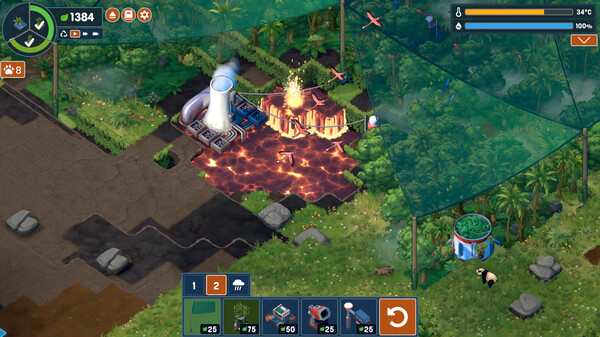 Terra Nil (via Steam store)
Closing
Blue Prince, Carto, Dorfromantik, and Terra Nil all treat the map as something a player produces, not a precondition they're handed. The verbs differ — walking, placing, erasing — but in every case, the map itself is the object the verb acts on.
Once the map stops being fixed, there's no correct answer waiting somewhere off the board. The only answer is in the next tile you're about to place. This design keeps handing the player's own choices back to them, shaped as terrain.
If I ever design with this verb myself, I want to ask one more question the moment the map is finished: does this map, as it now stands, satisfy you as a record of every choice you made to get here? And if it doesn't, I want to leave room — like Terra Nil — to erase a piece of it with one last move.
Reactions (no login)
Anonymous • one of each per visitor per day
Read next
Related reviews
shapez 2
A 3D factory-building puzzle: mine geometric shapes, carry them on belts, and combine cutting, rotating, stacking and painting until they match the order. No enemies, no time limits and no building costs — just platforms scattered across three layers of space, in tobspr Games' sequel to shapez.
SUPERHOT: MIND CONTROL DELETE
The sequel to SUPERHOT, the first-person action puzzle where time only moves when you move. It drops the hand-built one-screen levels for randomly dealt rooms fought in runs, and adds abilities you pick up along the way. The third game from SUPERHOT Team.
Desktop Dungeons: Rewind
A turn-based puzzle-roguelike on a single screen of dungeon, where revealing unexplored tiles is what heals you, so every fight is a resource problem. QCF Design's 3D remake of their 2013 Desktop Dungeons, with a rewind for taking moves back and the kingdom-building layer carried over.


