SOUNDTRACK · 2026-08-04
Soundtrack: Telling Lies — one-sided music, playable in any order
Nainita Desai
Introduction — live acoustics under a one-sided conversation
A laptop, late at night. You type a single word into a search box, and a stranger's face turns toward you and starts talking. You never hear the reply. Only one half of each conversation reaches you, in fragments, out of order. In this 'video-database investigation' that Sam Barlow made after Her Story (Komugi's review), the music was written by Nainita Desai, a BAFTA Breakthrough Brit. What reaches your ear first is not the cold of electronics but the raw resonance of piano and harp.
The score is fully acoustic, performed by the London Contemporary Orchestra: strings, woodwinds, piano, harp. The tempo sits, roughly, slower than a walk, with gaps so wide you stop trying to count. Desai usually blends electronics with live playing, but here she wanted 'to get that intimate atmosphere across with only the purity and rawness of organic sounds.' When I reach for my needle to measure it, what I find isn't a BPM but the held-breath quiet of having peered into someone's private life.
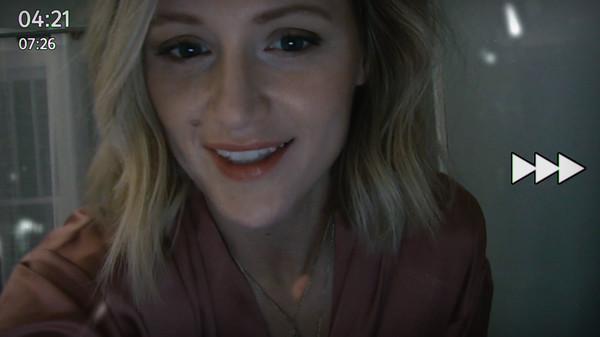 Telling Lies (from the official Steam screenshots)
Puzzle-native — a searching silence, music that holds in any order
In this game, 'solving' means typing keywords, reordering clips that play back in no useful sequence, and assembling the truth. So the music must not collapse no matter which order the footage arrives in. Desai reveals that 'the score is modular, built from blocks that need to flow in any order.' Each block carries three layers: 'the base foundation is usually the piano and harp on their own, and when we want to ramp up the intensity we have all three layers playing together.' It is sound engineered to survive a story told out of sequence.
And then, silence. Beneath a conversation you only half-hear, Desai stripped the music down hard. 'There is also so much dialogue in the game that you have to be careful not to overload the player with too much music... we didn't want to detract from the detailed nuances of the performances.' In a puzzle game, silence is not laziness but design, I always think. Here the quiet itself becomes a UI element ordering the player to lean in and listen.
Each character's theme was given a code name to avoid spoilers -- Order, Control, Intimacy. The central figure's theme, Order, is built from 'interlacing lines of strings, and string slides which represent this slippery, dark, mysterious side to him.' Dig deeper and 'you unveil a different side to his character, and that unravels a hidden loop in the music.' The more clues you gather, the more the music shows a different face -- a melody that is a direct translation of the act of investigation itself.
The hidden link — the 'scrub' of a bow, and a title theme in 7/4
Here is the coincidence that got me. In the title track the orchestra uses 'spectral scrubbing' -- scrubbing the bow against the bridge of the instrument to produce an airy, floating, gritty texture. And in this game, the player scrubs the video timeline back and forth with a finger, hunting for clues. The player scrubs footage; the players in the orchestra scrub the bow. The same verb, 'scrub', hides on both sides -- in the controls and in the sound. Even if it is accidental, I would rather not call it an accident.
The title theme was the last piece Desai wrote, and it opens in 7/4. 'Because of my background learning Indian classical music as a child, I'm really interested in unconventional rhythms and time signatures,' she says, using that asymmetric meter and sharp, angular strings to build something 'unsettling and chaotic in a mysterious way.' 'Aggressive staccato string lines interweave and bounce off each other to illustrate them fighting for their places within the game.' A 7/4 pulse that won't divide evenly maps cleanly onto the player's work of sifting testimony that won't resolve.
What fascinates me is that Desai wrote every theme without seeing any footage -- it hadn't been shot yet, so Barlow handed her only detailed notes about the characters. Of one, he told her to 'think of it like joyless sex,' and she instantly understood: 'Yeah, okay, I know what to write.' The interior of a character exists before the image, and the music anticipates it -- a mirror image of the structure in which the player confirms it afterward, through video.
The analogy — a finger reordering fragments, and a score with no fixed order
The way I hear it, the tempo of solving Telling Lies is a loop of 'type, wait, rewind.' You enter a word, watch fragments spat out in no order, scrub back with your finger, and reassemble them in your head into the right sequence. This isn't the pace of reading a linear story; it's the pace of hauling a non-linear one toward you.
Desai's modular score sits right against that pace. Because no block breaks no matter what order it sounds in, whatever route the player takes to the truth, the music always shows a face matched to the depth of understanding at that moment. The instant the hidden loop unravels lines up exactly with the small 'it connects' of landing the right keyword. The structure of the melody is quietly propping up the structure of thought -- and that, I think, is this soundtrack's most silent invention.
Tracks worth hearing
Start with Dawn ↗ -- brittle, drifting strings at the edge of daybreak. It's the official audio on Nainita Desai's channel (Provided to YouTube by TuneCore / (P) 2019 Annapurna), and the 'airy but gritty' texture of the spectral scrubbing comes through clearly.
For late-night tension, try Midnight ↗. It runs under a minute, but it distills how much air the 'base layer' of piano and harp alone can hold.
In closing — what I'd steal
What I'd steal for my own work is the code-named, order-agnostic modules and the hidden loop tucked inside them: a mechanism that never breaks however the story branches, and shows a different face only when the player's understanding deepens. It's an idea a linear film score would rarely need, yet in a non-linear puzzle it becomes the spine.
The other lesson is not to fear silence. When dialogue or mechanics are the lead, the music can step back and play the role of making you 'lean in and listen.' If you revisit Telling Lies, do it late at night, on headphones, remembering the one-sided voices. This quiet that holds up in any order is a record I'll keep returning to whenever I think about the sound of 'assemble-the-truth-from-fragments' games like Return of the Obra Dinn or Immortality.
Reactions (no login)
Anonymous • one of each per visitor per day
Part of these series
Puzzle SoundtracksEpisode 64 of 100
Read next

Related reviews
Tetris Effect: Connected
The falling-block game you already know, with its rules left exactly as they were. Across thirty-odd stages the music and light move in step with every piece you drop, and two things sit on top: a Zone that freezes time so you can clear more than four lines at once, and a three-player co-op mode that joins the boards together. Made under Tetsuya Mizuguchi's Enhance.
FRACT OSC
A first-person musical-exploration puzzle set in a vast synthesizer-built ruin, where you actuate glowing nodes and sound rigs to wake dormant machinery and music back to life. There's almost no instruction; working out what is even interactive is itself the puzzle. Phosfiend Systems, 2014, winner of IndieCade's audio design award.

