DESIGNER-STUDY · 2026-09-03
Inside Dave Grossman's Philosophy — Let the Player Be the Clever One
Day of the Tentacle, Return to Monkey Island, and refusing to choose between hard and kind
What has Dave Grossman been saying for thirty years?
"Your job is not to make yourself feel clever, it's to make the player feel clever" (Adventure Classic Gaming, 2009 ↗). Of everything Dave Grossman has said, this is the line I quote most.
He has been making adventure games since 1989. The interesting part is not that this claim has barely changed in thirty years. It is that he never let it stay a slogan.
In 2010 he sat his own mother-in-law down, had her play one of his games, wrote up every place she got stuck, and published it. The conclusion was blunt: "Assume nothing. Nothing!" (Game Developer, 2010 ↗)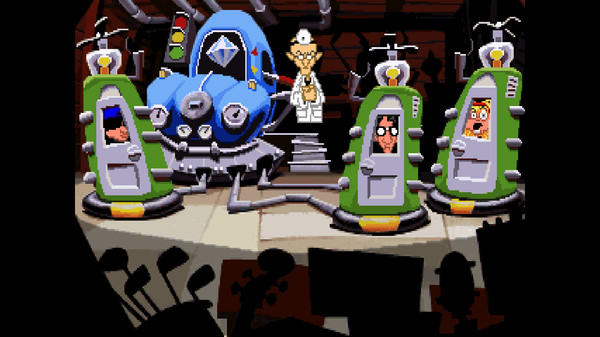 Day of the Tentacle Remastered (2016), official screenshot from its Steam store page
This article reads across seven sources — interviews with him and one essay by him — for his philosophy, his obsessions, the failures he has admitted in public, his dilemmas, and his acknowledged influences. It is a study of the person, not a review of the games.
Who is Dave Grossman?
Dave Grossman is an American game designer and writer. He joined Lucasfilm Games (later LucasArts) in 1989 and worked on The Secret of Monkey Island (1990) and Monkey Island 2: LeChuck's Revenge (1991) alongside Ron Gilbert and Tim Schafer. In 1993 he co-designed Day of the Tentacle with Tim Schafer (career timeline via Wikipedia ↗).
By his own account he got in by accident. "Back in 1989 things were quite different. You couldn't just walk into a studio and ask the CEO for a design job the way you can these days." "I managed to get in, and then, bafflingly, they hired me. I don't know why" (Arcade Attack, 2016 ↗).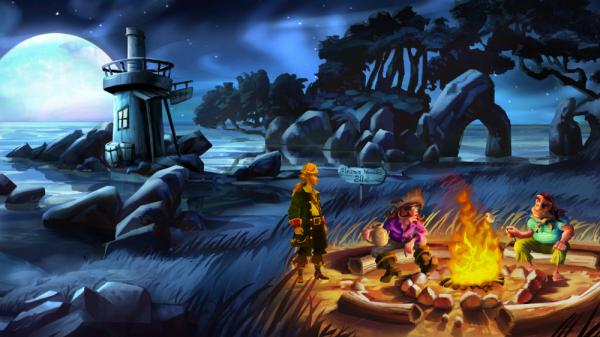 The Secret of Monkey Island: Special Edition (2009), official screenshot from its Steam store page
He is less famous in Japan than his colleagues Tim Schafer and Ron Gilbert, but the games are known. Day of the Tentacle Remastered is a point-and-click puzzle adventure built on time manipulation, released by Double Fine Productions / Shiny Shoe in 2016. Grossman co-designed the 1993 original.
He left LucasArts in 1994 and worked on children's games at Humongous Entertainment, the studio Ron Gilbert founded. In 2005 he joined Telltale Games, designing the Sam & Max series and Tales of Monkey Island (2009). He left Telltale in August 2014 for the audio-drama company Reactive Studios, later renamed Earplay (Adventure Gamers, 2015 ↗).
Then in 2020 he teamed up with Ron Gilbert again. Return to Monkey Island is a point-and-click puzzle adventure released by Terrible Toybox in 2022, with Grossman on writing and design — back in the series he had helped start three decades earlier.
Why does he insist the player is the clever one?
His philosophy fits in one sentence: a puzzle is not where the author displays intelligence, it is where the player confirms their own. "Your job is not to make yourself feel clever, it's to make the player feel clever" (Adventure Classic Gaming, 2009).
The same claim shows up in his accounts of the LucasArts years. "Our general philosophy was that we were on the player's side, and although we wanted them to have to think and be clever, our ultimate goal was not to stump them but to have them solve puzzles and feel good about it" (Arcade Attack, 2016).
What is easy to miss is that he never says "make it easier." In the same 2009 interview he adds: "Avoiding player frustration while continuing to provide an experience that lets you be and feel clever has been a particular cornerstone for me."
That is not a claim about lowering difficulty. It is a claim about separating difficulty from frustration. Most arguments run along a single dial — harder or easier. He adds a second axis: being stuck and being abandoned are not the same thing. Day of the Tentacle Remastered (2016), official screenshot from its Steam store page
What obsessions recur across his games?
The first is total consistency with the fiction. On Day of the Tentacle he says: "Everything is in service of this one goal of making you feel like a cartoon character... Nothing was in argument with the central aesthetic" (Splice Today, 2017 ↗).
Puzzles sit under that goal. "The puzzles are designed so I have to think like a cartoon character" (same interview). The logic of a solution is derived from the tone of the work. It need not work by real-world reasoning — but it must always work by cartoon reasoning.
The second is putting a second layer under the jokes. "The counterpoint between the gags on the surface and the deeper story underneath is one of the things that makes these games stick with you" (Adventure Classic Gaming, 2009). Getting a laugh is not, by itself, the point.
The third is a wariness: anything you put on screen will be read as meaning something. From his 2010 essay: "anything you see on screen can be interpreted as being significant." He has the example to prove it — his mother-in-law watched Max pick his teeth and concluded that Max had eaten the cheese.
The three look unrelated but share a root. What the author places is not read the way it was placed, so the fiction has to be built to catch the misreadings.
What failures has he admitted in public?
He talks about failure in an unusual way: not as a failure of the game, but as a failure of his own assumptions. His 2010 essay "A Journey Across the Main Stream: Games for My Mother-in-Law" is the case in point. He had his mother-in-law — "Subject M" in the piece — play Sam & Max, and counted off every place it went wrong.
What surfaced was a run of broken assumptions. She did not realise she was the one acting, and simply watched the characters look for the cheese. She did not exhaustively click on things either.
He writes: "It is not uncommon in game design to assume that the player will eventually explore all of the clickable items in an environment. Clearly, this is not a safe assumption."
The inventory box showed no pop-up text, so she judged it to be inert decoration. On the puzzle of shooting cheese with a gun, she objected that shooting it would just make holes, not Swiss cheese. Grossman concedes she has a point.
In the following season, the opening was rebuilt so that Sam addresses the player directly and explains their role. Admit the failure, fix it in the next version. That order is his pattern.
There are smaller admissions too. On Day of the Tentacle: "It was loads of fun, but the time travel research was brutal!" (Arcade Attack, 2016). On voice work: "Casting Bernard was the hardest bit... we really wanted him to sound like nothing" (Splice Today, 2017). Not dramatic, but it shows what he counts as hard.
Longtime fans or first-timers — which does he choose?
The conflict he keeps returning to fits in one line: "I want Monkey Island fans from way back to enjoy our games, but I want my mother-in-law to be able to play as well" (Adventure Classic Gaming, 2009).
That is harder than it sounds. One group wants resistance; the other wants clarity. He drops neither, and works on widening the entrance instead. In the revised opening described in his 2010 essay, Sam welcomes the player, explains the role, and only when they are still stuck says the specific thing: use the gun from the inventory box to make holes in that cheese. Help arrives in stages.
The position shows up in our own ratings. In this site's catalogue, Day of the Tentacle Remastered is difficulty 4 (hard) and Return to Monkey Island is difficulty 3 (standard), as of September 2026. Same designer involved, same lineage of studio — and the later game is the gentler one. "Not to stump them" did not stay a slogan.
A second dilemma is the shape of the controls. On Return to Monkey Island: "With a controller, you have to do things quite differently. If you put pointy edges in there, people will get caught on them" (Game Developer, 2022 ↗). Dropping the verb list for something simpler reads as the same judgement.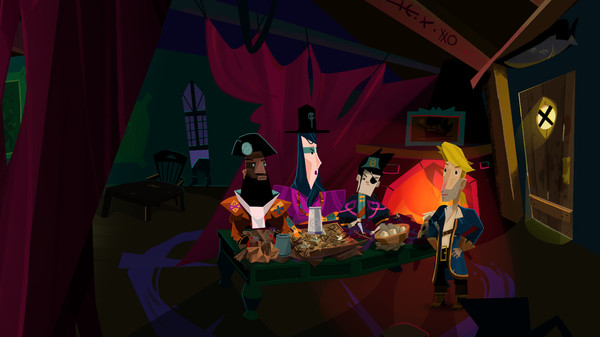 Return to Monkey Island (2022), official screenshot from its Steam store page
The same shape appears in how he leaves jobs. On leaving LucasArts in 1994: "It was just like, I like this, but there are certain things about it that didn't work [for me]." On leaving Telltale in 2014: "It doesn't really need me anymore," "My life is just different now" (Adventure Gamers, 2015). The test he applies is whether he is needed.
Whose influence does he acknowledge?
Honestly, this section is thin. Across the seven sources I read, Grossman names exactly one person as an influence: Shigeru Miyamoto.
In the 2010 essay he cites Miyamoto's practice of picturing one specific person while designing — in Miyamoto's case, his wife — and says it is what led him to use his own mother-in-law as a test subject. The influence is methodological, not aesthetic.
Beyond that, I could not find him naming influences. He describes Ron Gilbert and Tim Schafer as people he worked with, not people he was influenced by. This is not a gap to fill with guesses, so I stop here.
He does talk about the environment, though: "there I was, doing things I enjoy, with interesting co-workers and we were making a comedy about pirates without any concrete mandate other than, 'do something good'" (Arcade Attack, 2016). Less an influence than the soil his philosophy grew in.
Kizuki's reading — how I read him
What follows is my own reading. It goes beyond what he has said.
I read Grossman as the adventure designer who made observation part of the job. Most of his generation set difficulty by instinct and in-house testing. He brought in someone from outside the house, wrote down every place she got stuck, and published it as a flaw in his own game. Plenty of designers have a slogan; few document the moment their slogan fails.
And this: "let the player be the clever one" reads to me as a division of labour, not modesty. If the author takes the cleverness, a puzzle becomes an exam with a right answer. If the player takes it, a puzzle becomes a place to try ideas. What he kept constant for thirty years is not an attitude but where he draws that line.
Where should you start with him?
Start with Day of the Tentacle Remastered. The 1993 game he co-designed is playable as-is, and its chain of time-manipulation puzzles holds to cartoon logic all the way through — his "nothing in argument with the central aesthetic" made literal.
Then Return to Monkey Island. You can see how the same designer, thirty years later, rebuilt the hinting and the controls. Played back to back, the two make it concrete what "separate difficulty from frustration" means in implementation.
If you read only one thing he wrote, make it the 2010 essay. It works less as a design article than as a record of watching someone play.
Related designer studies on this site: his colleague Tim Schafer, and Ron Gilbert from the same LucasArts lineage. Gilbert's insistence on not wasting the player's time sits right next to Grossman's insistence on handing the cleverness over.
Sources
Primary sources used in this article:
・Adventure Classic Gaming interview (Jonathan Yalon / Philip Jong), 2009-09-01
・Arcade Attack interview, 2016-11-28
・Splice Today interview (Jon Hochschartner), 2017-04-11
・Adventure Gamers, "Dave Grossman" (fov), 2015-01-02
・Game Developer, "Sam & Max's Dave Grossman on Design" (Frank Cifaldi), 2006-07-26
Secondary source, used only for the career timeline:
・Wikipedia, "Dave Grossman (game developer)"
Japanese quotations in this article are my own translations from the English originals; the originals can be checked at the links above.
Reactions (no login)
Anonymous • one of each per visitor per day
関連シリーズ
The Designer's Philosophy第53回 / 全53回
次に読む
関連レビュー
Eliza
AIカウンセリングアプリの「代弁者」として、画面に出る台本を声に出して読む仕事に戻った女性の数日間を追うビジュアルノベル。Opus Magnum などのパズルで知られる Zachtronics が、Matthew Seiji Burns の脚本で作った一本で、付録に株札を使うソリティアが入っている。
Röki
北欧の民話をなぞる雪の森を歩き、道具を拾って組み合わせながら、姉を探す少女トーヴェの旅を進めるポイント&クリックの冒険。戦闘も失敗もなく、手描き調の風景と喪失の物語で進む Polygon Treehouse の一作。
Phoenix Wright: Ace Attorney Trilogy
弁護士・成歩堂龍一として法廷に立ち、証言の一行と手持ちの証拠を突き合わせて嘘を崩していく法廷アドベンチャー。2001年から2004年にかけて発表された原作3作・全14話を、絵を1コマずつ描き直してひとつにまとめた Capcom の集成版。


