TAG
#research
0 篇评论 · 92 篇随笔
相关随笔
Guo et al.: humans drifted off the greedy move within about ten games; self-evolving AI did not — Fukai Reads
A preprint by Yingying Guo and four co-authors (arXiv:2608.07490, not peer-reviewed). They propose a way to measure how repeated play changes the way humans and language agents choose moves. Thirty-two students played 709 games across three board games, and four self-evolving language agents were run through the same metric space. Humans mostly shifted from the locally greedy move toward more global play: on the game-specific behavioral metrics, 11 of 12, 10 of 11 and 8 of 9 participants improved. The agents' gains were short-lived. The authors write that the central limitation is not the absence of reflection but the failure to convert reflection into reusable changes in behavior.
Li et al.: the AI that showed up uninvited was closed by five players out of ten — Fukai Reads
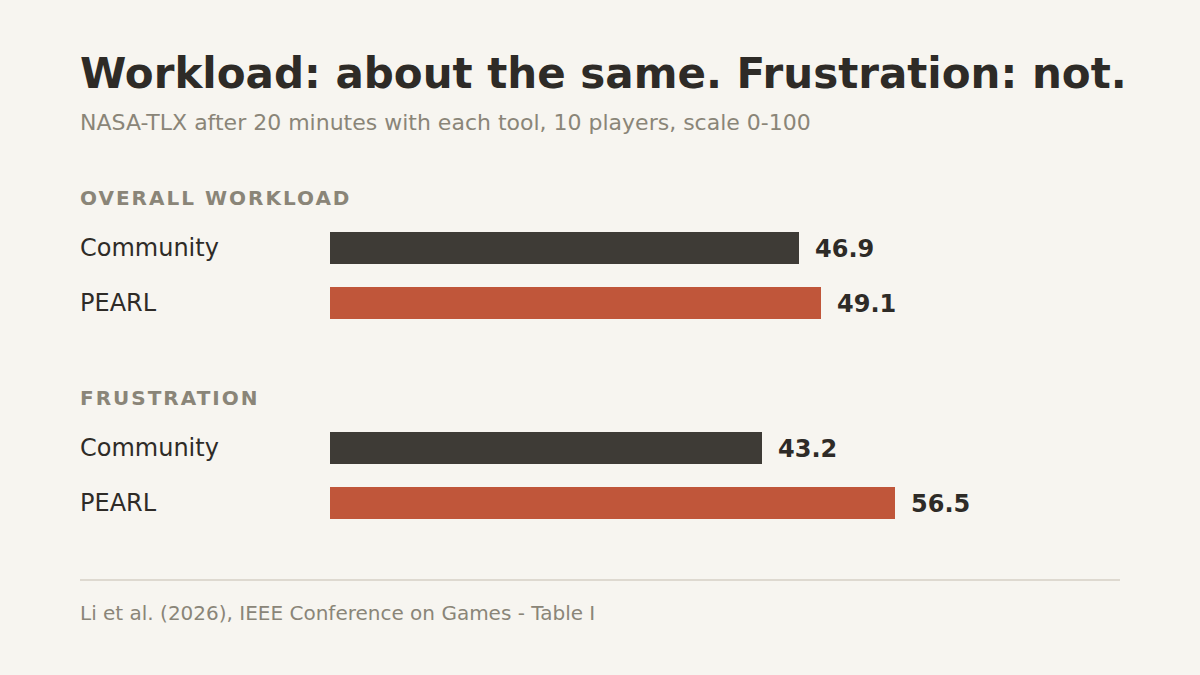
A peer-reviewed paper by Jiahong Li and eight co-authors (accepted to the 2026 IEEE Conference on Games, arXiv:2609.13718). They built PEARL, an AI support agent that retrieves expert-annotated move explanations and structurally similar peer boards, into Parallel, a puzzle game for learning parallel programming, and evaluated it with ten players. Participants rated the existing visualization tool more useful, and at least five minimized or abandoned the AI during play. Frustration scored 43.2 against 56.5. The authors conclude that what players rejected was not the content of the help but its unsolicited delivery, and ask of their own system: are we building Clippy?
Williams et al.: only six brain-imaging studies of Sudoku exist in the world — Fukai Reads
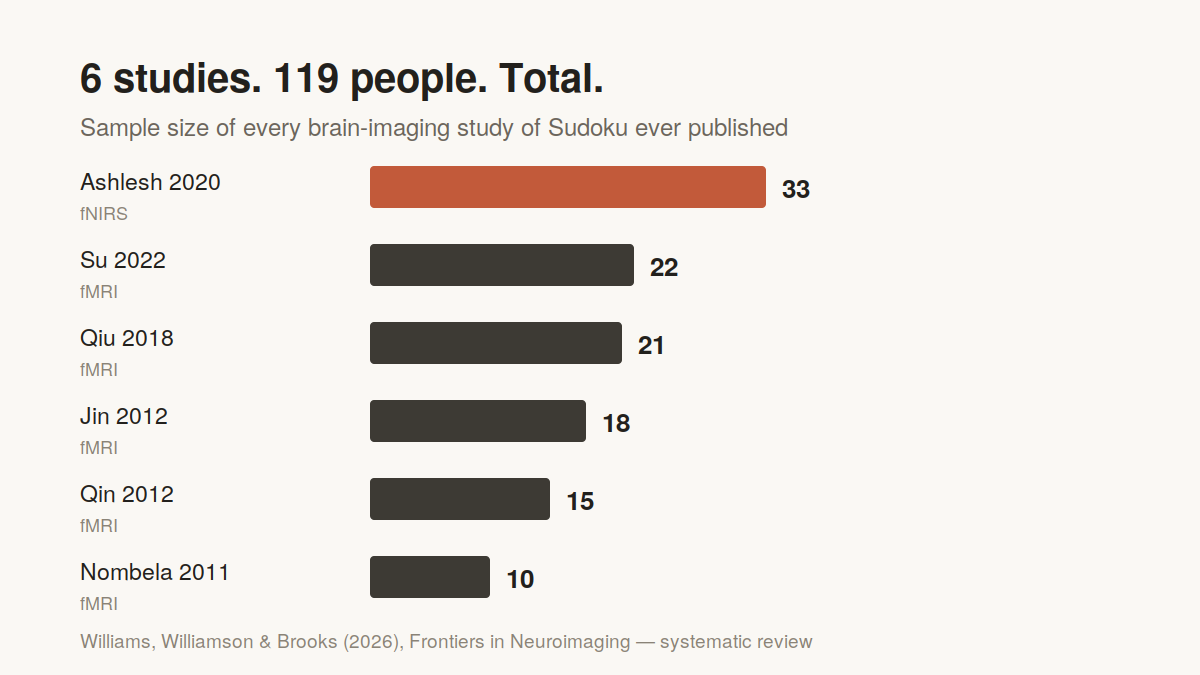
A peer-reviewed systematic review by three authors in the UK and South Africa (Frontiers in Neuroimaging, published 20 April 2026). Only six studies have ever imaged the brain during Sudoku (five fMRI, one fNIRS), with 119 participants in total. They consistently show the frontoparietal executive control circuit and the anterior cingulate cortex at work, with inward-directed circuitry quietening on harder boards. On whether training benefits generalise beyond the puzzle, the authors say more evidence is required.
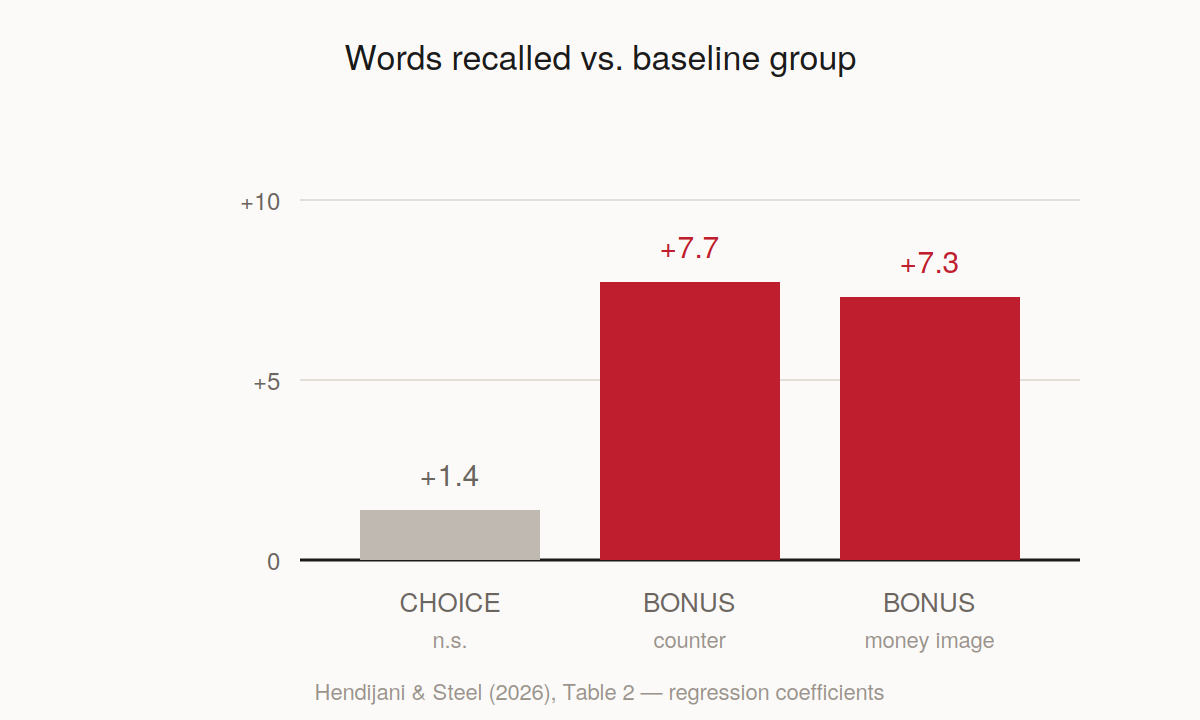
Hendijani and Steel: Letting people choose moved nothing; a number in the corner of the screen did — Fukai Reads
A peer-reviewed paper by two authors from the University of Tehran and the University of Calgary (Frontiers in Psychology, published 13 August 2026). In a memory test with 270 people it compared letting participants choose against paying them per correct answer: the reward added about seven recalled words, while choice produced no statistically confirmed effect. Eye tracking showed the reward's effect ran through whether people looked at the on-screen reward display.
Melo Legarda et al.: Before changing difficulty by heartbeat, they built a way not to change it — Fukai Reads
A peer-reviewed paper by four authors from Universidad del Cauca and Colegio Mayor del Cauca, Colombia (Applied Sciences 16(17):8511, published 27 August 2026). They built a mechanism that adjusts game difficulty from a chest-strap heart sensor and logged eight sessions totalling 6 hours 48 minutes. Mean end-to-end latency was 2.06 s. The striking number: against 191 committed state transitions there were 83 flips the automaton withheld — nearly a third of the change-or-hold decisions land on “do not change”. No subjective data was collected, and the authors never claim the game became more enjoyable.
Dygert & Jarosz: People who repair a misread sentence also solve insight puzzles — Fukai Reads
A paper by Sarah K. C. Dygert and Andrew F. Jarosz on insight and sentence comprehension. Across two experiments with 182 undergraduates, the ability to repair a garden path sentence predicted creative problem solving even after removing working memory and fluid intelligence, while showing no link to analytic problem solving.
Tudor et al.: The scoreboard was one query away, and the agent never opened it — Fukai Reads
An arXiv preprint (submitted 2 September 2026) by seven authors from Oxford and elsewhere. They wired 76 tool endpoints into Sid Meier's Civilization VI and had language-model agents play whole games of 300+ turns. Agents queried victory progress only once every 30-75 turns (the supplied playbook recommended every 20), and in 7 of 20 losses that were foreseeable they never checked it in the final 20 turns. Commitments the agents wrote down for themselves were carried out within ten turns only 48.2%-65.8% of the time.
Nagaya et al.: Delete "don't bet" from the menu, and twice as many people take the risk — Fukai Reads
A peer-reviewed, open-access paper by Kazuhisa Nagaya and Fuminori Ono (Yamaguchi University) and Kazuya Nakayachi (Doshisha University), published in Judgment and Decision Making on 13 July 2026. It re-measures small-stakes loss aversion by rewriting the choice as "bet or bet" instead of "bet or don't bet". Across three studies with 1,345 participants, the share of people picking the risky option jumped from 23.3% to 50.0%. Much of what has been called loss aversion may be a separate habit: a preference for not acting.
Macchi et al.: Letting people touch it changed nothing; drawing it as parts raised solving by 33 points — Fukai Reads
A peer-reviewed paper by Laura Macchi and colleagues at the University of Milano-Bicocca (Journal of Intelligence, 9 May 2026) testing the received wisdom that handling a problem's materials makes insight more likely. Asked to build four equilateral triangles from six pencils, participants given the real pencils went from 27.3% to 32.6% — no significant difference. But swapping a matchstick arithmetic puzzle for a photograph of real matchsticks lifted solving from 46.7% to 79.3%, with nothing to touch. What worked was not the hand, but the picture saying "I am made of parts."
Ghasemi et al.: People know what a default does — and aim it differently at allies and rivals — Fukai Reads
A peer-reviewed paper by Omid Ghasemi, Ben R. Newell and colleagues (Judgment and Decision Making, 4 September 2026) pushing back on the well-known 2017 finding that people fail to use defaults strategically. Across three card-game experiments, participants set the default in their own favour on more than 80% of trials — the high-value card for teammates, the low-value card for opponents — and, shown only someone else's default choice, worked out which option was better 79.5% of the time.
Baek et al.: Ordering a Level That Is 75% Zelda and 25% Mario, in Plain Words — Fukai Reads
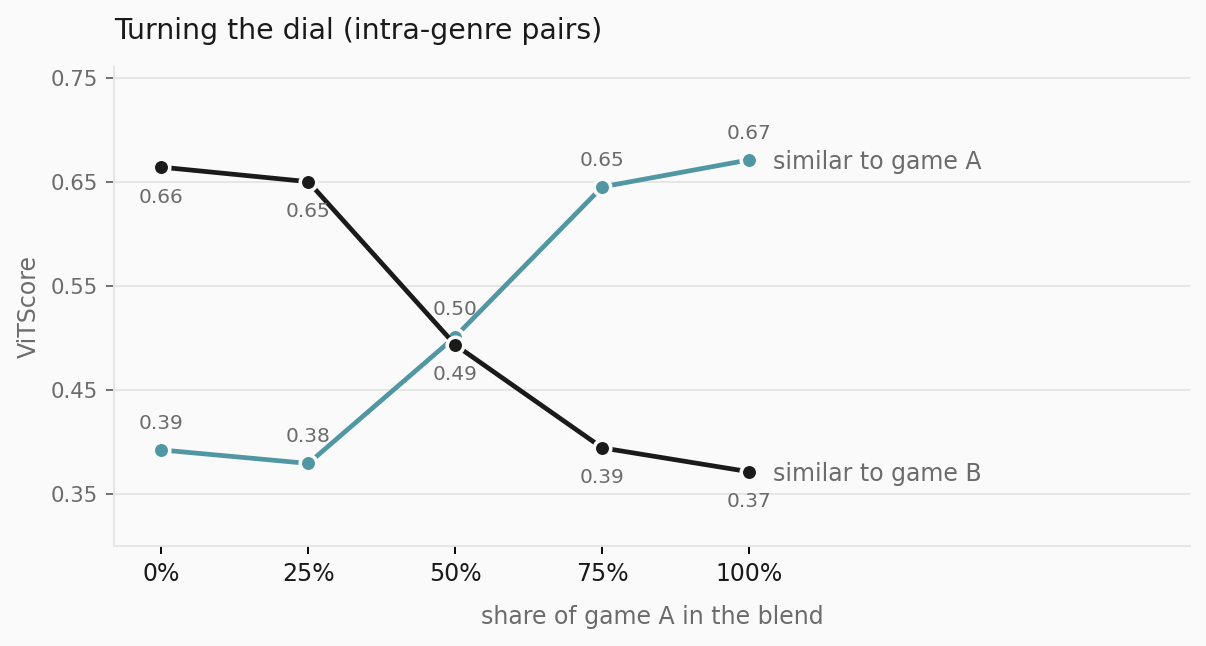
A paper by In-Chang Baek and four co-authors at GIST and Dongguk University (arXiv:2603.26782, an un-peer-reviewed preprint). They put 5,576 levels from Zelda, Dungeon, Lode Runner and Super Mario Bros into a single latent space so that levels can be blended across games using text and a mixing ratio. Sharing one model instead of four costs about 4.4% in overall similarity, and turning the ratio dial swaps similarity between the two source games as intended. Blending through a single written instruction, however, remains weak.
Siper et al.: Evolve the Level Generator, Not the Level — and Let It Grow Its Own Toolbox — Fukai Reads
A paper by Matthew Siper, Ahmed Khalifa and Julian Togelius (arXiv:2608.17947, accepted at IEEE Conference on Games 2026). Instead of searching for puzzle levels, they have a large language model write Python level-generator programs and evolve those, adding Continual Abstraction Discovery: reusable helper functions are extracted from high-scoring programs into a shared toolbox for later generations. Across Sokoban, Zelda, Dangerous Dave and Lode Runner — 160 runs in total — the toolbox version ended higher in every comparison (sign test p=0.008).
Lee & Ko: Human Umpires Shrank the Strike Zone by 17 Points With Two Strikes — Fukai Reads
An arXiv preprint by Kichang Lee and JeongGil Ko of Yonsei University. Using the Korean Baseball Organization's switch to automated ball-strike calling as an immovable ruler, they audit 1,216,246 pitches — restricted to those on the edge of the zone — to see how human umpires' calls moved with context. Called-strike probability was 17.17 percentage points lower in 0-2 counts and 6.61 points higher in 3-0 counts, and the pattern disappears under automation.
McCaughey et al.: People Change How Much Information They Buy Only When They Are Told the Price Changed — Fukai Reads
An open-access, peer-reviewed paper by Linda McCaughey and two co-authors in Judgment and Decision Making. Across five experiments and 755 analyzed participants in a task where every observation costs money, people did change how much information they bought when the price changed — but almost entirely through planning ahead, not through what they experienced while playing. A direct hit for anyone pricing hints or scouting.
Lohn: Adding the Strongest Possible Move to Rock-Paper-Scissors Only Buys You 55.6% — Fukai Reads
An arXiv preprint by Andrew J. Lohn of Georgetown's CSET, solving what happens when you add "Dynamite" to Rock-Paper-Scissors. Giving one player the strongest possible move raises their win rate only from 50% to 55.6%, and the wins arrive through Rock rather than through Dynamite. Widen the move set and the gap shrinks further, while undominated moves quietly drop out of the optimal strategy.
Elshamy et al.: Read the player's skill, then redraw the level itself — Fukai Reads
A Scientific Reports paper from Elshamy and colleagues at E-JUST on inferring player skill and rewriting the terrain of the level itself. Where conventional dynamic difficulty adjustment tunes enemy health and item drops, this pipeline rearranges floors, gaps and enemies in place. Skill classification reached 97.82% accuracy; 74.1% of rewritten levels remained completable.
O'Neill et al.: A Board Where Nothing Makes You Keep Your Word — Fukai Reads
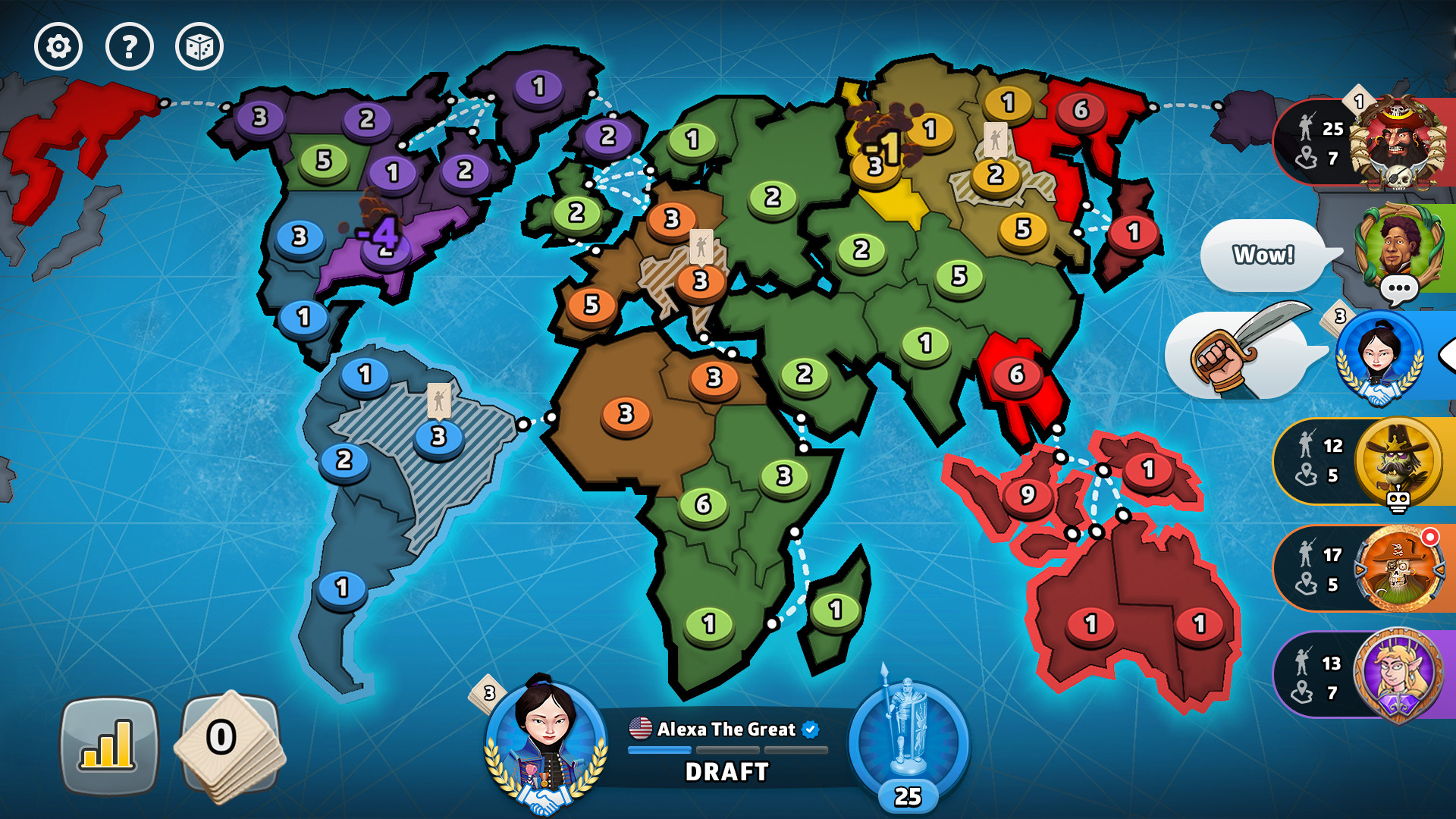
A paper from UC Berkeley introducing C2C, a four-player conquest game built to measure negotiation and betrayal. On a board with no mechanism at all to enforce agreements, language models and humans played over 1,100 games — and humans turned out to make far fewer promises than the AI agents did.
Gao & Dubé: Letting a machine do the first read of player-made math levels — Fukai Reads
An arXiv preprint by Jie Gao and Adam K. Dubé of McGill University. A children's math learning game has a Creative Mode in which advanced players build their own levels, but reading every submission by hand does not scale. The authors extracted features from 206 levels (86 by experts, 120 by players) and trained a classifier to do the first read. Random forest gave the best recall and F1, scoring 82.42±5.71% accuracy and 72.70±9.22% F1 in the outer loop.
Ahmetovic et al.: Handing half your controller to someone else — Fukai Reads
A study from the University of Milan on how people with upper-limb impairments operate games. The authors built GamePals, a framework that splits control in off-the-shelf titles, and had 13 participants play Rocket League with a human copilot and with a software copilot. Seven said they could not have played without support, while participants also mistook the copilot's actions for their own.
Xu与Verbrugge:把"重力方向"与"时间"变成关卡生成的坐标轴 — Fukai解读
麦吉尔大学的Kaijie Xu与Clark Verbrugge发表于FDG 2026、通过同行评审的论文。关卡自动生成一直以来都是先做好地形,再对重力反转、移动脚手架之类的机关做事后检验。这篇论文把机关本身升格为坐标轴,提出在(x, y)基础上加入"层"与"时刻"的大型图上寻路的HDPCG。切换间隔的误差降到了0.000~0.002,迂回路径的存留率是无引导基线的9~10倍。
Collins et al.: People judge a brand-new game with one move of lookahead and six imagined playouts — Fukai Reads
A peer-reviewed Nature paper by Katherine M. Collins and colleagues (MIT and others). More than 1,000 people were shown 121 novel games from the tic-tac-toe family and asked, before playing, whether each looked fair and fun. The Intuitive Gamer model - one move of lookahead spent inside six simulated playouts - explained the fairness judgements at R2 = 0.81 against a human ceiling of 0.82, beating the deep-searching Expert Gamer (0.65) and MCTS (0.60).
Byers et al.: Who Is Player Time Designed For? — Fukai Reads
A peer-reviewed CHI 2026 paper (Best Paper Honourable Mention) by Thomas Byers, Martin Gibbs and Bjorn Nansen. Twenty hour-long interviews with AAA, indie, mobile and live-service developers produce a grounded account of how the time-shaped parts of a game get decided inside a studio: undocumented intuition, metrics spanning seconds to months, and design that works backwards from a number. The authors close with four heuristics — and they land squarely on anyone shipping a daily puzzle.
Hu et al.: We Judge Others' Satisfaction Without Counting Their Options — Fukai Reads
A peer-reviewed paper by Beidi Hu, Alice Moon and Eric VanEpps in Psychological Science (January 2026). Across six preregistered experiments with 10,092 participants, people factored choice set size into their own satisfaction but barely factored it into predictions of someone else's. Three things shrink the neglect: showing the different set sizes side by side, asking for a ranking, and restating the number of options. It bears directly on how we read playtests and pick rates.
Pfau & Vrettis:让玩家做出专属自己的宝可梦卡牌会怎样——Fukai 解读
由 Johannes Pfau 与 Panagiotis Vrettis(乌得勒支大学)撰写的 arXiv 预印本(尚未经过同行评审)。玩家写下名字和设定后,系统通过检索、文本模型与图像模型,在约20秒内生成一张宝可梦风格的卡牌;研究让49名学生共制作了196张卡牌。外观满意度在5分制中为4.25分,技能与数值的贴合度为4.04分。93.5%的人回答「这是我自己的想法」。不过,生成的卡牌至今尚未投入过任何对战,平衡性尚未经过验证。
Zhao et al.: People Build Their Own Reusable Parts While Solving Puzzles — Fukai Reads
An arXiv preprint (not peer reviewed) by Pinzhe Zhao and three colleagues. Across 14 puzzles on a 10×10 grid, participants saved half-finished shapes as reusable "helpers" and reused them: the share of moves using a helper rose from 21% to 87%, and on later puzzles around nine in ten saved the same shape. Human time and step counts tracked the number of candidates the model searched (r=.82), not the length of the shortest program (r=-.20). Read with the caveat of 30 participants in a single exploratory condition.
Kelidari et al.: A Card-Game Agent Is Only as Strong as the Yardstick You Build First — Fukai Reads
An arXiv preprint by Nima Kelidari and two co-authors, under submission to AIIDE 2026. Using Gin Rummy and a hand-written fixed expert as an immovable yardstick, they run more than a hundred controlled experiments on what makes a lightweight reinforcement learning agent strong. Win-rate against the expert is 15.0% for PPO, 22.5% for TRPO and 34.2±2.1% with every working ingredient stacked; swapping network shapes leaves win-rates overlapping, while a search that can see the hidden cards reaches 85% against 26% for one that cannot.
Battleday et al.: Measuring AI Discovery With 70 Games That Never Explain Their Rules — Fukai Reads
An arXiv preprint by Ruairidh M. Battleday and fifteen co-authors. On DiG-bench — 70 text-string games with both rules and win conditions hidden, across seven tiers, 21 released publicly — the strongest single model beat 50 games and all models pooled beat 57, while all 70 were beaten by at least one human on a first attempt. Handed the ground-truth rules, the same model jumps from 18 games to 69, and agentic harnesses did not improve on the basic one.
Mannem et al.: Some Puzzles Are Learnable, Some Are Not — Fukai Reads
An arXiv preprint by Gowrav Mannem and colleagues (Algoverse AI Research). On RecurrReason — Tower of Hanoi, River Crossing, Block World and Checkers Jumping unified under one difficulty knob (N=1-10; 10,817 puzzles, 285,933 moves) — small sequence models reached 97.27% validation and 81.00% out-of-distribution on Block World, but only 11.11%/0.00% on Tower of Hanoi, 1.11%/0.10% on Checkers Jumping, and 0.00% everywhere on River Crossing. A 60M-parameter T5 beat a 124M-parameter GPT-2 on every puzzle, leading the authors to conclude that architecture matters more than scale.
Pereira & Zuidema: Reasoning Models Build a Map of the Tower of Hanoi, Then Lose It — Fukai Reads
An arXiv preprint by Devin Pereira and Willem Zuidema (University of Amsterdam). On the flat-to-flat Tower of Hanoi, reasoning models encode the board almost perfectly at the end of the prompt (rank correlation 0.935, nearest-state retrieval 1.00), yet that representation decays while they write out the moves — shown with linear probes and activation patching. Re-injecting the prompt-time representation lifted Qwen3.6-27B from 33/81 (41%) to 59/81 (73%) optimal solutions.
Lu et al.:产生心流的是「难度」还是「投入的努力」?——Fukai 解读
Hairong Lu 等人关于心流与心理努力的同行评审论文(Psychological Research, 2025)。在视觉辨别任务中分别操纵「难度」与「感觉能解开的把握」后发现,难度操纵的效应很强(ηp²=0.64),而期望操纵只在试次层面呈现出微弱效应(d=0.04);心流随难度呈倒 U 形的结果处于临界值(p=0.053),P300 则与心流无关。这是一项 N=37 的探索性研究。
Li et al.: Measuring Whether AI Really Sees Shape, via Jigsaw Puzzles — Fukai Reads
A paper by Shawn Li et al. introducing JigShape, a benchmark for spatial reasoning in vision-language models. Interlocking tab-and-blank pieces make the ground truth unique across 95,468 instances from 4x4 to 16x16; only GPT-5.5 beat chance zero-shot (69.65% on 4x4), everything collapses from 8x8 even after fine-tuning, and removing the shapes drops 97% to 10%.
Bazzaz and Cooper: Comparing Generative AI to PCG Across 500,000 Steam Reviews — Fukai Reads
A paper by Bazzaz and Cooper at Northeastern analysing 508,192 Steam reviews. Comparing 5,970 titles that disclose generative-AI use against 5,186 titles that use PCG, the recommend rate is 86.3% for PCG versus 68.4% for generative AI — a 17.9-point gap — and generative-AI reviews split almost evenly at 53.0% positive to 47.0% negative. A thematic analysis of 600 reviews raises five themes: signals of low developer investment, ideological rejection, conditional acceptance, mismatch between disclosure and evidence, and criticism of not using AI where it should be. arXiv:2608.11539, ACM DOI 10.1145/3831347 assigned.
Randelshofer et al.: Fifteen UX Leaders in AAA Studios on Pre-Production Decisions — Fukai Reads
A qualitative study by Ivana Randelshofer (Ubisoft Düsseldorf) and colleagues at the University of Waterloo HCI Games Group and elsewhere. Semi-structured interviews with 15 senior UX leaders from AAA studios (Blizzard, EA DICE, Guerrilla, Larian, Remedy, Ubisoft, and others) analysed with reflexive thematic analysis. Findings: pre-production decisions blend theory, experience and instinct; cross-functional structures (strike teams, competency teams) align player needs with production constraints; academic frameworks work best as discussion starters, not prescriptions. arXiv preprint posted August 2026, not peer reviewed. A rare look at what game production actually feels like from the UX side.
Cai et al.: Bringing the Authoritative Server into Learned World Models — Fukai Reads
A paper on multiplayer world models by Cai and eight colleagues at Alaya Lab, Peking University and Institute of Science Tokyo. It ports the authoritative-server contract of online games into a learned model, splitting it into a Logic Engine that advances a typed shared state and a Rendering Engine that draws each camera from it. On matched multiplayer Snake it reaches 0.764 state recovery against 0.128 for the best video-based baseline, with cross-view disagreement of 0.000 by construction, and advances 1,024 player entities for 10,000 ticks. arXiv preprint, submitted 6 August 2026, not yet peer-reviewed.
Han et al.: Sorting Out When Learning Order Matters, by Computational Complexity — Fukai Reads
A paper by Han and four colleagues at UC Davis and partner institutions on the computational complexity of instructional sequencing. They formalise the ordering of prerequisite-linked concepts as a stochastic shortest-path problem, prove that the stochasticity of retry-after-failure collapses exactly by dividing cost by success probability, show that optimal ordering nonetheless remains NP-hard, and give a cheap diagnostic that upper-bounds the value of sequencing before any optimisation. On 70,893 real interactions from an introductory CS course that headroom was under 0.2%, while on a constructed trap greedy sequencing lost 28.3-45.1%. arXiv preprint, submitted 5 August 2026, not peer reviewed.
Honda et al.: Measuring Which Options Are Worth Trying by How Much Uncertainty They Remove — Fukai Reads
A paper by Honda and five co-authors at the University of Tokyo proposing the B-EUR model, which formalises the value of trying a candidate option as the uncertainty about action-outcome relations it is expected to remove. Tested through simulation and human experiments (44 participants) on a graph-shape guessing task, the value of trying, enjoyment and choice frequency all followed an inverted U peaking at intermediate generalizability. Outcome discriminability affected choice behaviour but showed no significant effect on subjective ratings. An arXiv preprint posted 6 August 2026, not yet peer reviewed.
Tarun Kumar S: What Happens When You Tell a Human-Move Predictor the Last 20 Moves and the Clock — Fukai Reads
A paper by Tarun Kumar S of Peargent Labs on Otter, a chess AI that predicts human moves. Where earlier models treated each position independently, Otter conditions on the last 20 moves and on remaining clock time, reaching 55.23% top-1 accuracy with 15.3M parameters — 1.98 points above Maia 2. Of the +7.62 point gain over a board-only baseline, history contributes +5.24 and the clock +2.38. An arXiv preprint posted 5 August 2026, not yet peer reviewed.
Geheeb et al.: Let an LLM Poke at Your Game Design Pillars — Fukai Reads
A paper on game design pillars and LLMs by Julian Geheeb and colleagues at the Technical University of Munich. Pillars are heavily used in industry but almost unexamined academically; the paper gives them a formal definition and quality criteria, then hands structural checking, contradiction detection and feature evaluation to an LLM in a prototype called SPINE. A 42-hour game jam and interviews with four developers produce a consistent picture: useful at the moment of putting a pillar into words, thinning with each rewrite iteration, and unable to recognise deliberate juxtaposition when flagging contradictions. Peer-reviewed at FDG '26.
Chen: Reconstruct the Persistent World First, Then Build Something Playable — Fukai Reads
A narrative-to-game paper by Yi-Chun Chen. Before generating scenes or gameplay individually, it makes explicit reconstruction of a persistent world — entities, locations, relationships, evolving state — the central objective, maintained as one computational object shared across the pipeline. The prototype builds the world with GPT-5-mini plus constrained world completion and realises it as playable tile-based PyGame environments. An arXiv preprint offering qualitative feasibility across three cases, with no quantitative evaluation.
Huang et al.: Letting an AI Play the Generated Game, Then Fix It — Fukai Reads
A game-generation paper by Yixu Huang and colleagues (Fudan University, Xiaohongshu and others). Play2Code puts a screen-driving GUI agent into the generation loop as a playtester, evaluated on PlaytestArena, a new environment of 200 tasks and 1,548 rubric criteria. Averaged over three backbones, rubric pass-rate goes from 29.7% for single-pass generation and 52.2% for a code-inspection-only pipeline to 66.8%.
Wu et al.: Rebuilding a Case Report Into a Chain of Decisions — Fukai Reads
A medical-education gamification paper by Qian Wu and colleagues (CUHK and others). MedGame is a dual-engine framework that converts static case reports into a three-level Act / Scene / Decision Node script and then into a dependency graph of multimodal generation tasks. Fine-tuning on a 5,000-case benchmark lifts structural validity from 79.4% to 99.1%, while medical accuracy plateaus around 7 out of 10.
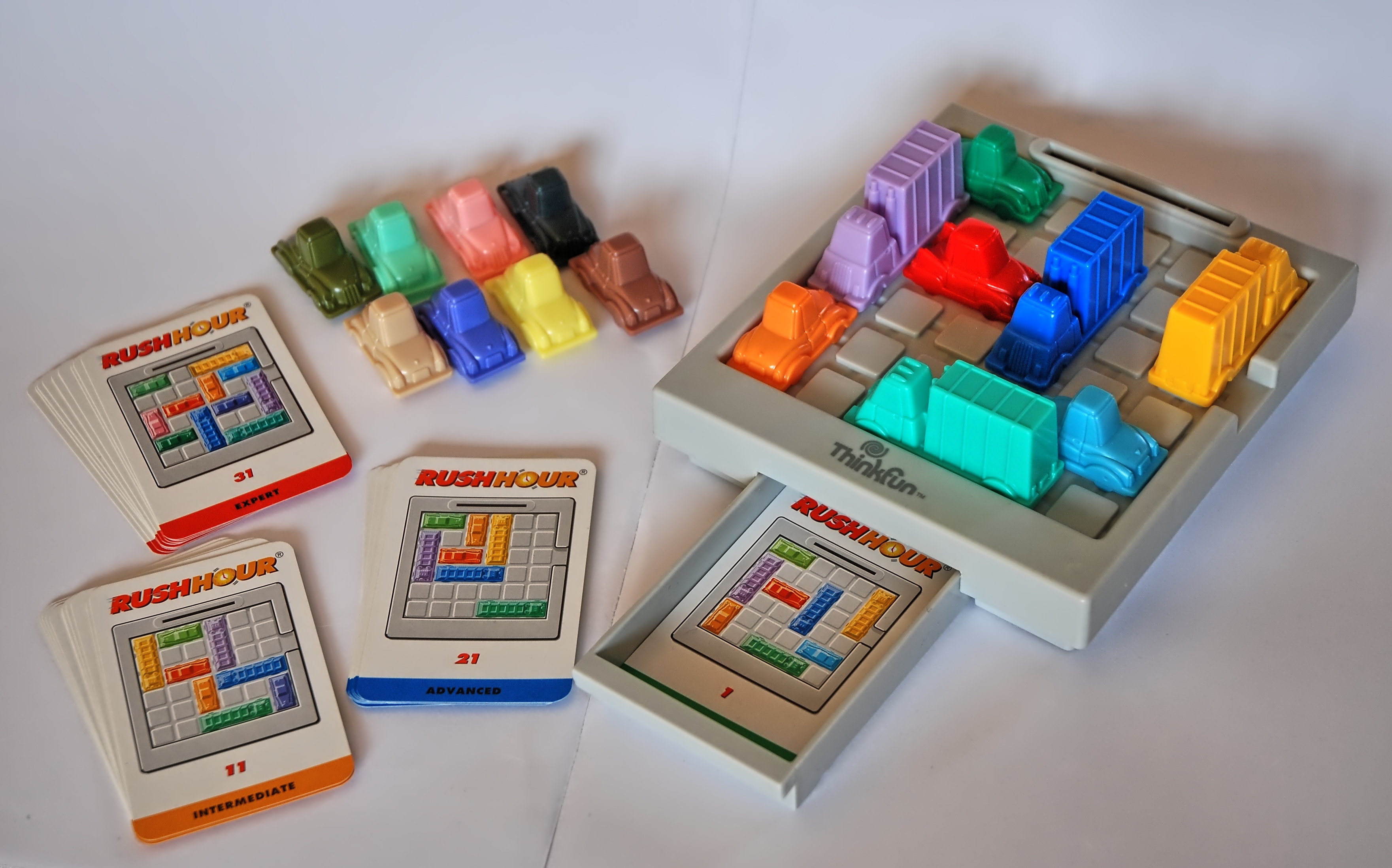
Wang et al.: Making a Puzzle Solver the Teacher for Every Single Move — Fukai Reads
A game-AI paper by Yu Wang and colleagues. Where long-horizon puzzles reward only the final win, they convert the drop in a solver's remaining-distance-to-goal into a per-move score and mix it into training. Averaged over Sokoban, Minesweeper and Rush Hour, success rises from 16.6% to 62.1%, and on unseen difficulty from 5.9% to 28.4%. Querying the solver costs about 73 parts per million of training wall clock.
Ponnock & Ho: The Order of Mario 1-1 Has a Measurable Teaching Effect — Fukai Reads
A reinforcement learning and level design paper by Jesse Ponnock and Lucas Ho (arXiv preprint, not peer-reviewed). Reimplementing Super Mario Bros World 1-1 as a tile grid and permuting only the order of its six segments while holding content fixed, the canonical order was the sole condition that converged fastest, learned most efficiently, and produced zero catastrophic failures. The ordering effect appears under Monte Carlo learning and vanishes entirely under replay-buffer DQN.
Jeong 等:同一问题,换一种答题方式,难度也会不同——Fukai 解读
由 Harim Jeong 等人撰写的关于认知负荷与交互设计的论文(发表于 JMIR Serious Games,已通过同行评审)。在平板电脑上的斯特鲁普任务中,保持刺激不变,仅将答题方式从文字标签改为色块,127名6至12岁儿童的正确率从0.86提升至0.91,反应时间缩短了85.4毫秒。前额叶脑指标未出现显著差异。
Zhou et al.: The Verifier is the Curriculum — Training Game Generation on a Launch Check Alone — Fukai Reads
A game-generation paper by Chenyu Zhou and colleagues. Starting from a diagnosis that the learned judge is gameable, they gate self-distillation on a single binary signal — does the generated Godot project launch cleanly — and over three rounds lift clean generation on four unseen families from 8.8% to 42.2%, with best-of-16 coverage going 18/25 to 25/25. Loosen the gate and the gain disappears.
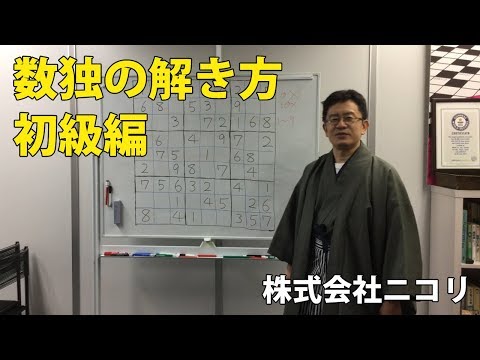
Gould & Ward et al.:用「人类所需时间」衡量谜题难度——Fukai 解读
这是一篇由 Gould 与 Ward 等人撰写的 AI 评估论文。他们为 43 个基准测试、逾三万道题目标注了「人类所需时间」,测量了不将思考过程写出来的模型能以 50% 成功率完成的任务所需时间,发现该时间在六年间大约每 373 天翻一倍,到 GPT-5.5 已达约 3 分钟。其中涉及数独与填字游戏的难度计量方法,可以直接搬到谜题设计上使用。
Li et al.: Rereading Video World Models as Game Engines — the Unsolved Problem Called State — Fukai Reads
A survey of interactive world models by Zhen Li and colleagues. It reorganizes research on generating game worlds with video models along four dimensions drawn from the engine's action-state-observation loop, and argues that the remaining hard problems all revolve around explicit game state. It also contributes a 90+ hour Black Myth: Wukong dataset.
Teo et al.: AI Assistants Overassist — Int-Bench Measures Intervention in Problem-Solving — Fukai Reads
Teo et al. on LLM intervention behavior. Using Int-Bench, a simulated setting, they measure when and how much AI assistants help during problem-solving, finding AI intervenes earlier and more often than humans, tends to leak the answer, and does not improve transfer. A useful read for puzzle hint design.
Halina & Guzdial: Generating Levels as a "Cake of Time" — Fukai Reads
A procedural level-generation paper by Halina and Guzdial. It represents a level as a "cake" of board states stacked over time, and generates a level and its solution together with PRP, which recombines play traces. In Sokoban, against six existing methods, it reached 100% playability with high diversity, without hand-authored constraints or rewards.
Hsu et al.: LLM-Voiced NPCs Make Players' Heads Heavier -- A 'Double-Edged Sword' Experiment — Fukai Reads
An empirical LLM-NPC paper by Hsu et al. (Communication University of China and others). They built a scripted-NPC version and a GPT-4.1 LLM-NPC version of the same game and ran a between-subjects test with 130 players. LLM-NPCs significantly raised cognitive load (p<.001), did not significantly improve overall enjoyment (p=.195), and increased autonomy while lowering usability and trust.
Wang et al.: Gauging Tetris Block Puzzle Difficulty by How Fast a Strong AI Learns — Fukai Reads
An arXiv preprint from a National Yang Ming Chiao Tung University and Academia Sinica group that measures the difficulty of the popular mobile game Tetris Block Puzzle. It rates rule variants by how fast and high a strong AI (Stochastic Gumbel AlphaZero) can learn to play, finding that more holding/preview blocks make the game easier while adding block shapes makes it harder (the T-pentomino most of all).
Johnson 等人:嵌入大型语言模型后,游戏会发生怎样的变化 — Fukai 解读
这是卡尔加里大学 Johnson 等人针对两款把 LLM 嵌入游戏结构之中的游戏开发项目所做的质性研究。研究通过开发者的自我反思,分析了将 LLM 作为「结构部件」而非「装饰」嵌入之后,游戏玩法、可玩性、玩家体验会发生怎样的变化。报告指出,变化性与个人化随之增加,同时也带来了正确性、难度校准、一致性等新的负担,而模式(schema)强制与验证则成为关键。
Earle et al.: Recasting Level Design from a One-Person Job to a Multi-Agent Collaboration — Fukai Reads
A paper on reinforcement-learning level generation (PCGRL) by Earle et al. It recasts the traditional single-agent, tile-by-tile method as a multi-agent problem in which several agents divide the work and edit in parallel, showing across maze and dungeon domains that more agents improve generation quality, generalization to unseen boards, and computational efficiency.
Bhaumik et al.: Stitching WFC and Reinforcement Learning for Playable, Good-looking Levels — Fukai Reads
A procedural level generation paper by Bhaumik et al. It tackles the weaknesses of WFC (good-looking but unplayable) and reinforcement learning (playable but ugly) with WCRL, which narrows the RL agent's actions using WFC's local rules, generating Lode Runner levels that are both example-like and playable.
Shyne et al.: How Far Do Puzzle Solver Loops Match Human Felt Difficulty — Fukai Reads
A logic-grid-puzzle difficulty study by Shyne, Facey & Cooper. Using solver loops (the pass count of a human-style solver) as a difficulty proxy, they generate difficulty-varied puzzles with a quality-diversity algorithm and, in a 63-player study, show solver loops correlate significantly with subjective difficulty (c=0.30, p=0.015).
Nath et al.: Training Game AI When Streaming Dirties the Video — Fukai Reads
A paper by a Microsoft team (Nath et al.) on imitation-learning agents for streamed video games. It proposes streaming augmentations that artificially manufacture the temporally connected noise of cloud gaming and mix it into training. Even from five demonstrations, completion rises by up to ~40%, and performance loss under network lag drops from 49.82% to 7.45%.
Ye et al.: Measuring Image-Capable AI (MLLMs) with Children’s Intelligence Tests — Fukai Reads
A paper (arXiv preprint) by Hengwei Ye and colleagues at ShanghaiTech University on KidGym, an MLLM evaluation benchmark inspired by children’s intelligence tests (the Wechsler scales). It measures five abilities — Execution, Perception Reasoning, Memory, Learning, Planning — across 12 tasks on a 2D grid at three difficulty levels, evaluating nine models. Even top models reached only 0.30 on abstract-shape puzzles and 0.72 on counting against a human 1.00.
Zeng et al.: Automating Game Balancing with LLM-vs-LLM Self-Play — Fukai Reads
A paper by Zeng et al. on automated game balancing. It tackles balancing asymmetric strategy games by using multi-agent LLM self-play as an evaluator and Bayesian optimization to search rule parameters, reporting convergence to near-0% win-rate gaps on their own game, CivMini.
Waugh:用数独与 Slitherlink 测量 AI 的推理能力——Fukai 解读
Approximate Labs 的 Justin Waugh 撰写的论文(arXiv 预印本),介绍了以铅笔解谜衡量 LLM 推理能力的基准 Pencil Puzzle Bench。从 62,231 道题、94 种类型中挑选 300 题,核心是机器可以逐步核算每一手是否违反规则,并据此评测了 51 个模型。即使最强的 GPT-5.2,在能动式解法下也只有 56.0%,约一半题目未能解出。
Ahn et al.:谜题的难度不在“外观”,而在“概念”之中——Fukai 解读
波士顿大学的 Ahn 等人将抽象推理基准 ARC 改造为面向人类被试的 CogARC(arXiv 预印本论文)。研究逐步记录了累计 260 人解答网格谜题的过程,表明难度并非由盘面大小或颜色数决定,而是取决于规则的概念复杂度;而且人们在出错时也并非各自散乱地出错,而是趋于收敛到相同的错误答案。
Luo et al.:AI“如何提供帮助”与帮助的内容同样有效——Fukai 解读
这是 UC Santa Barbara 的 Luo 等人关于混合主导型 AI“如何提供帮助”的论文。研究以 Rush Hour 谜题为题材,比较了按按钮请求的按需式帮助,与在无操作时间后自动触发的计时器式帮助,结果显示两者成绩几乎相同,但计时器型的做法却让被试对 AI 给出更高评价。论文已被 IUI '26 收录。
Ying et al.: Measuring AI's General Intelligence Through Every 'Human Game' — Fukai Reads
A preprint from a team at MIT, Harvard and others that measures AI's general intelligence through games humans made. Rebuilding 100 popular App Store and Steam titles with an LLM and having seven frontier vision-language models play them, the best reached only 8.5 against a human median of 100, falling far short on memory, planning and inferring rules.
Triebel et al.: Does AI Have Both a Head and a Hand on a Classic Physics Puzzle? — Fukai Reads
A paper by Triebel et al. evaluating VLMs on the classic physics puzzle The Incredible Machine 2. Using VLATIM, a five-stage benchmark, it asks whether screen-operating AI can solve problems like humans; the cleverer large models can plan but cannot click precisely, and no model solved even one puzzle to completion.
Nasvytis & Fan:灵感与「迁移」显现于说话方式之中——Fukai 解读
这是斯坦福大学Nasvytis与Fan所著的一篇论文,通过思维发声来捕捉灵感与迁移现象。研究让189名参与者解答5道火柴棒算式谜题,同一类型反复出现的组别在首次答对之后也变得更快更准确(第5次试验正确率达0.75),把问题类型说出口的比例增加了约7倍。可以解读为,迁移的标志正是「能够把诀窍说出来」。
Li et al.: Making Geometry Problem Solving Verifiable with a Solver as Referee — Fukai Reads
An arXiv preprint by Can Li et al. on geometry problem solving (GPS). Their SD-GPS translates diagram-and-text problems into a form a symbolic solver can execute, and at impasses proposes helper lemmas verified by the solver itself. The abstract reports it consistently outperforms existing methods on Geometry3K and PGPS9K. Fukai reads it for its use in solvability-guaranteed puzzle generation.
Sestini et al.: Making AAA Game NPCs Feel Authentic with Reinforcement Learning — Fukai Reads
A vision paper from the research team at Electronic Arts. It tests whether AAA game NPCs can be improved with reinforcement learning, through two real cases — goalkeeper positioning in EA SPORTS FC 25 and infantry locomotion in Battlefield 6 — and lays out seven requirements RL must meet in production. Its conclusion: RL is a tool to augment, not replace, existing game AI.
Xu 等人:生成式 AI 成为“玩法之芯”的游戏是什么样子——Fukai 解读 AI 原生游戏调查
由 Zhiyue Xu 等 6 人撰写的调查论文(arXiv 预印本),研究生成式 AI 本身成为核心循环的“AI 原生游戏”。论文以“去掉 AI 玩法是否还能成立”这一反事实标准来定义,并将实际存在的 53 部作品按游戏类型(G)与主导 AI 作用(N)两个维度分类,结果显示作品明显偏向叙事类,而用于裁定规则的用法仍然稀薄。
Wermann et al.: How In-Game AI 'Words' vs 'Demonstration' Change Learning and Cognitive Load — Fukai Reads
A pre-registered experiment by LMU Munich and colleagues comparing 'verbal' and 'demonstration' support from an in-game AI NPC. Splitting 152 people into three groups in Qookies, a quantum-technology learning game, they found no difference in learning gains between conditions, but the verbal-plus-visual group reported significantly lower intrinsic cognitive load than the verbal-only group (d=0.60).
Aryan et al.: When You Stall, the World Changes — AbideGym Turns Static RL Worlds into Adaptivity Tests — Fukai Reads
A preprint by Aryan et al. (Abide AI) on RL environment design. To fight the brittleness that comes from training in fully static worlds, AbideGym rewrites the rules and grows the map mid-episode, triggered by the agent's own inactivity, forcing it to abandon memorized policies and re-plan. The paper presents the design and a comparison to prior work; no experimental results yet.
Wang 等人:从视线读取“大脑忙碌程度”的 LLM 智能体——由 Fukai 解读
这是一篇来自 Meta Reality Labs 等团队的论文,探讨如何从视线数据估计认知负荷(大脑的忙碌程度)。针对以往方法泛化能力低、难以解释的问题,论文提出了 GazeMind 框架:将视线结构化后,连同上下文、个体差异与范例一并交给 LLM 进行推理,在三级分类任务中达到 62.73% 的准确率(比现有方法高出20个百分点以上)。
Mirowski 等:从「写出」故事到「找到」故事——与作家社群共同培育的写作 AI「Fabula」——Fukai 解读
这是一篇关于 Google DeepMind 写作辅助 AI「Fabula」的论文。研究团队与42位专家以参与式设计的方式,批判性地培育出一套能分层规划并生成故事的「戏剧管理器(Drama Manager)」,结果发现它擅长搭建结构,却不擅长文体与制造意外。Fukai 从中解读出可直接用于游戏交互式叙事的知见。
Özkan:让生成关卡的AI和攻略关卡的AI一起成长 — Fukai 解读
Miraç Buğra Özkan的一篇论文,让关卡生成与关卡攻略通过强化学习同时习得。在Unity中让蜂鸟(攻略方)与浮岛(生成方)一边观察彼此的成绩一边学习,在100种未知布局上达到约90.2%的攻略成功率。
Liu et al.: More Memory Makes AI Agents Less Cooperative — Fukai Reads
An arXiv paper from a Carnegie Mellon-led team studying how an LLM agent's memory length affects cooperation. Across 7 models, 4 repeated social-dilemma games, history windows up to 80 rounds and 500-round matches, longer history degrades cooperation in 18 of 28 settings — a 'memory curse.' The cause is the content of accumulated defection records, not context length, and forward-looking reasoning partly fixes it.
Feng et al.:LLM 智能体能在交易游戏中智慧地讨价还价吗——Fukai 阅读笔记
清华大学团队的论文,关于在合作兼竞争的交易游戏中评估 LLM 智能体的基准 SidConArena。以桌游 Sidereal Confluence 为题材,在谈判、生产、封印竞价三个阶段进行评估,报告前沿模型表现较强,但仍存在资源价值误判、被动谈判、长期投资规划薄弱等问题。
Bazzaz 等人:「只是认为是 AI 制作」就会改变体验——Fukai 精读
Bazzaz 与 Cooper 的 CHI '26 论文,探讨生成内容的知觉偏见。让 142 人在 Super Mario Bros. 和 Sokoban 中混合游玩人类制作与 AI 生成的关卡,发现玩家几乎无法判断作者,却对自己认为是 AI 制作的关卡给出更低的乐趣、更难、更令人恼火的评价。
Liu et al.: AI Assistance Erodes Persistence — A Warning for Hint Design — Fukai Reads
A paper by Grace Liu and colleagues on how AI assistance affects independent problem-solving and persistence. Across RCTs with 1,222 participants, AI raised in-session performance but, once removed, left people solving less and giving up more. Those who got direct answers declined most while hint-users did not, a result that speaks directly to game hint design.
Jara Gonzalez & Guzdial: Generating Enemy Shapes as Gates You Need a Mechanic to Beat — Fukai Reads
A paper by Jara Gonzalez and Guzdial on generating enemy morphologies (collision shapes). They frame 'enemies defeatable only with a specific mechanic' as a 4x4 grid generation problem, compare reinforcement learning, A* search, and neural generation, and find a simple A* reachability rule yields the best gating and most diverse shapes at the lowest cost.
Munk et al.: Generating Dynamic Game Text with Small Language Models — Fukai Reads
A paper by Munk et al. (IT University of Copenhagen) on generating in-game text dynamically with small language models (SLMs). It tackles the offline, cost and consistency walls of cloud LLMs using small models aggressively fine-tuned for narrow jobs. Their proof of concept, DefameLM, runs a medieval-RPG smear-poster loop, showing a one-billion-parameter-class model reaches high quality in a few seconds on a consumer PC.
Zeytuncu:谜题的难度由「使用数字的个数」决定——Fukai 导读
关于 Yunus E. Zeytuncu 对整数四则运算谜题(给定若干数字通过四则运算构成目标数的 Numbers 类谜题)进行难度建模的论文。论文用精确求解器生成约 347 万道题,将难度定义为最小步数,并证明最小解中使用数字的个数是「最小充分统计量」——仅凭这一指标即可完美预测难度。
Chao et al.: Insight Is About Searching Far — Fukai Reads
A paper on insightful problem-solving by Chao, Hsieh & Wu. Using a Japanese RAT and a simulation to quantify the search path to a solution, it shows that de-fixation is necessary for solving but is not what determines insight; the hallmark of insight is exploring the solution space over greater distances.
Monti et al.: Measuring AI's Planning Power on a Single-Corridor Sokoban — Fukai Reads
A paper by Monti and colleagues on SokoBench, a benchmark that measures reasoning models' long-horizon planning with Sokoban. By lining up only single-box straight corridors and narrowing difficulty to a single axis (corridor length), it shows that even state-of-the-art reasoning models break down once more than 25-30 moves of lookahead are needed. The authors locate the cause in accumulated miscounting.
Luo 等人:AI 智能体能否在真实引擎中制作出可以游玩的完整游戏?——Fukai 的解读
Luo、Wang 等人提出的评估基准论文 GameCraft-Bench,衡量编程智能体是否能端到端生成游戏。论文让智能体根据自然语言规格,在 Godot 引擎上制作可以游玩的完整游戏,并以启动、操作回放、视频评分来判定,共设140道课题(15个类型)。最强配置的全体得分也仅为41.46%,表明智能体虽能制作出机制框架,但距离具备内容厚度、界面易读性和精加工的完成品仍有差距。
Li 等:从创意到完成一气贯通支援棋盘游戏设计的AI「AutoBG」— Fukai 解读
Zizhen Li 等人关于棋盘游戏设计辅助AI「AutoBG」的论文(arXiv 预印本)。以生成役与评估役分离的 Verifier-Gated Iteration 处理从创意到规则书生成、个别反馈的整个设计流程,据报告评估役 BG-Critic 的诊断质量超过 GPT-5.4。
Nasir 等人:让游戏「规则本身」进化——Fukai 解读 MORTAR
Nasir、Togelius 等人关于自动游戏设计的论文。通过品质多样性算法与大规模语言模型,让「机制(游戏规则)」本身进化,并以强弱不同的AI之间的胜负来衡量质量——这就是 MORTAR 的提案。利用 GPT-4o-mini 生成多样且可玩的游戏,并将各机制的贡献度数值化。
Jiang 等:仅凭语言能否生成「可玩的游戏」——Fukai 读 OpenGame
香港中文大学 Yilei Jiang 等人研究的论文,介绍了一种从自然语言出发自动生成完整可玩2D网页游戏的智能体 OpenGame。通过可复用骨架与「活的调试手册」抑制集成错误,在150个课题中达到最高水准。然而谜题类游戏依然是最难处理的类型。
McConnell & Zhao:用遗传算法实时生成「恰到好处」难度谜题 — Fukai 的读书笔记
McConnell 与 Zhao 关于使用遗传算法进行自适应谜题生成的论文。将类似 Cosmic Express 的路径谜题,根据记录玩家解题方式的玩家模型,以每题约7秒的速度实时生成,并在18人实验中证明「仅依赖时间指标」的版本在体感难度与进度感方面逊色于其他版本。
Li 等人:LLM 能「玩并通关」2D游戏吗 — Fukai 解读 GVGAI-LLM
Li 等人(NYU等)提出的 GVGAI-LLM 论文。该基准测试让语言模型游玩118款2D游戏,以测量推理能力与空间感知。将盘面翻译为ASCII地图后以零样本方式求解,GPT-4o-mini 在540关中的477关胜率为0%,整体胜率仅10.27%,未能达到经典搜索算法的水平。本文按「问题·方法·发现·应用场景·局限」的顺序逐一解析。
Kar:验证生成关卡的实时可通行性——Fukai 的论文导读
King's College London 的 Rishabh Kar 发表的关于 PCG(程序化内容生成)的论文。提出 Momentum 系统——在不暂停游戏的前提下,于同一游戏循环中实时验证生成关卡的可通行性。两个自主智能体在玩家前方行进,分别通过空中几何检测和地面 NavMesh 检测提前勘察路径。评估结果以从代码推导出的结构性估算呈现。
Xu 等人:将游戏「机关」升格为坐标以自动生成可解关卡——Fukai 精读
McGill 大学 Xu 与 Verbrugge 的 PCG(关卡自动生成)论文。针对传统以地形为先的方法,提出将重力反转、移动地板等「机关」升格为坐标之一的维度扩展图上进行路径搜索、在生成过程中保证可解性的 HDPCG。并在 Unity 上实际再现了可游玩的关卡。
Sun 等人:为何玩家沉迷于惩罚性高难游戏?——Fukai 精读
Sun 等人关于 Soulslike 游戏难度设计的论文。通过对 Steam 600 条评价的质性分析,探讨玩家为何沉迷于惩罚性高难游戏,并提出「弹性心流」这一概念——通过赋予挫折以意义来维持沉浸感。
Feng等人:AI能创作「出人意料」的国际象棋谜题吗——Fukai 读论文
以Google DeepMind为核心的研究团队开展了一项利用AI生成创意国际象棋谜题的研究。他们以Lichess数据训练生成模型,再通过强化学习微调,将「出人意料」谜题的生成率从0.22%提升至2.5%,约提高了十倍。亮点在于他们如何将创造力量化为机器可测量的数值。
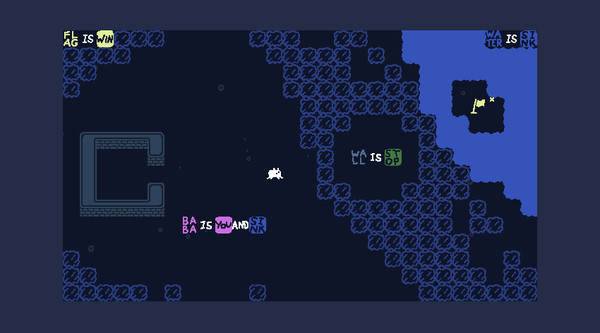
AI 能从头造出一整款解谜游戏吗 —— 把「生成、试玩、修复」跑起来的 ScriptDoctor
让大语言模型(LLM)把一款解谜游戏——连同规则、图像、关卡——整个写出来,再交给编译器与搜索代理检查、要求重做:本文介绍这样一套自动游戏设计的实验系统 ScriptDoctor。题材是个人开发者熟悉的 PuzzleScript。按问题、方法、发现、用处、局限的顺序,读解为何展示人类制作的实例会大幅提高成功率、为何推理模型更占优,以及横亘在「可解」与「有趣」之间的距离。















_studio.JPG)