ESSAY · 2026-08-05
The Verb of Laying Track — A Design Grammar for Routing Puzzles (from Trainyard to Railbound)
What a puzzle tests when you submit a whole plan instead of moving one step at a time
Introduction
Trainyard has a button whose only job is to make the trains run. Once you finish drawing track on the grid and press it, there is nothing left for you to do: the trains follow your drawing, and the game hands back success or failure. Where the Sokoban lineage converses with the board one move at a time, routing puzzles make you submit the whole solution up front. That separation of planning from execution is, I think, the heart of the track-laying verb. In The Verb of Rolling I traced the marks a single move leaves; this time, the very concept of a move disappears.
This essay lines up path-laying puzzles as a design argument, from Pipe Mania in 1989 through Trainyard in 2010, Cosmic Express in 2017, and Railbound in 2022. How does laying differ from pushing or rolling? How does a single line encode order and timing? And where is the border between a track that is judged right or wrong and a road that is merely graded? Read it as part of the Single-Verb Design series, an attempt to take the grammar of routing apart.
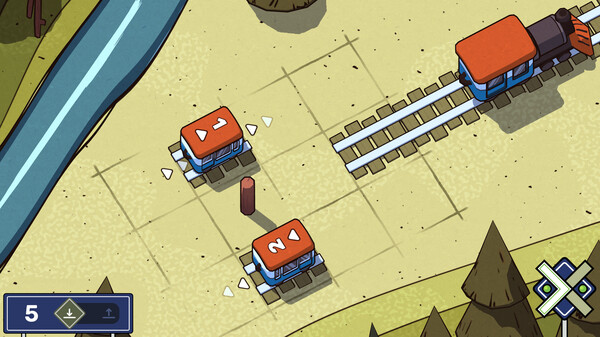 Railbound (from the official Steam screenshots)
Laying First, Running Second — Separating Plan from Execution
Trainyard, released in 2010 by solo developer Matt Rix, has you trace track onto a small iOS grid to deliver colored trains to matching stations. A color algebra sits on top—red and blue trains merging where they meet become purple—so the geometry of your track entangles with the timing of merges. The game languished at first, then climbed to #2 on the entire App Store in October 2010. What matters here is that the player's work is finished before any train moves. Running is no longer an act of control; it is playback, a checking of the answer.
In a move-by-move puzzle, the board answers every move: push a box and you immediately see where it stops. Routing puzzles sever that conversation. While you draw, no train moves an inch. You must run the trains in your head, verifying merge order and crossing timing purely by imagination—the unit of reading is lifted from one move to the whole solution. In exchange, trying is cheap: track can be erased and redrawn endlessly, and failure never damages the board. To the question I raised in The Ethics of Undo—whether to permit trial—routing puzzles answer with generosity built into their very structure.
The ancestor of the form is Pipe Mania, made for the Amiga in 1989 by the UK's The Assembly Line and sold in the US as Pipe Dream by Lucasfilm Games. You place randomly dealt pipe pieces on a grid before the oozing "flooz" overflows. The laying verb is already here, but time pressure and random supply turn reading into reflex. For a thinking routing puzzle to exist, someone had to stop the clock and drive luck out of the parts supply, as Trainyard did. The turning point of this lineage was not the verb itself, but the moment it became a static plan.
Burning Order into a Single Line — Cosmic Express and the Seat Constraint
Connecting dots with lines is an old pleasure. Numberlink (1897) had newspaper readers joining digits without crossings, and its direct descendants—Flow Free (Big Duck Games, 2012) and LinkedIn's Zip (2025)—still have crowds drawing lines daily. LYNE, released by Thomas Bowker in 2014, carved the constraint of one stroke passing through every shape into more than 600 levels. What these share is a discovery: a line can generate difficulty from purely topological constraints—touch everything, cross nothing.
What burned order into that constraint was Cosmic Express (Alan Hazelden, Benjamin Davis, and Tyu, 2017). You lay a single track from a dome's entrance to its exit, picking up aliens and dropping them at the right homes along the way. Seats are limited and the track cannot cross itself—so deciding the shape of the line is deciding the order of pickups and drop-offs. Its prototype was Train Braining, a small game Hazelden made aboard a cross-country train during Train Jam 2015. A train puzzle built on a train carried in the invention of encoding order into a single line.
The difficulty of Cosmic Express comes not from board size but from the combinatorial explosion in one line's freedom. And the ruleset is subtractive: the only verb is drawing track. What the game demands is observational resolution—reading, from the static layout alone, which pickup order will not break the seating. The aliens' homes, the dome's doors, the blocked tiles: everything already constrains the order of a line that has not yet been drawn. You read before you draw. Here, the reading of routing puzzles becomes continuous with observation games.
Junctions and Timing — How Railbound Turns Timetables into Geometry
Railbound, released in 2022 by Poland's Afterburn, brought numbers into this grammar. Numbered cars must be guided to the engine with a limited stock of track pieces, and they must couple in numerical order. Across more than 240 levels the vocabulary grows piece by piece—junctions, crossing barriers, tunnels—while the skeleton of lay-first-run-second never bends. It won a 2023 Apple Design Award for interaction, but what I value more than the trophy is the hardness of the design running underneath its soft picture-book journey of dogs.
The core of Railbound is that it makes you translate time into shape. When two cars head for the same junction, which arrives first is decided entirely by track length and switch direction. You hold one car back with a barrier, split routes with a switch, and fold the timetable of numerical order into static geometry. Since you cannot intervene once the trains run, all scheduling must be finished at laying time. Move-by-move puzzles demand spatial reading; the summit of routing puzzles, I think, is making players control time through the shape of space.
Its vocabulary grows carefully, too. Railbound introduces new pieces gradually, chapter by chapter, sequenced so that the reading learned in one level becomes the premise of the next—the one-thing-at-a-time principle from Carving the Learning Curve holds here as well. What impresses me most is how the limited count of track pieces works as a de facto hint: with only three pieces in hand, the shape of the solution narrows by itself. A constraint that creates difficulty while illuminating the search space—that duality is a virtue peculiar to laying-type design.
Graded Roads vs. Solved Tracks — Freeways and the Edge of Determinism
Everything so far had a clear pass or fail. But the laying verb extends into the world of grading. Freeways, released in 2017 by Justin Smith (Captain Games), has you hand-draw freeway interchanges with a finger and grades you on the traffic efficiency of what you drew. There is no correct answer—only the throughput number your lines managed. The same verb of laying a road splits here: Trainyard's track is judged true or false, while Freeways' roads are evaluated by degree. Go as far as Mini Metro and laying is no longer a puzzle but something closer to management.
Is graded laying still a thinking puzzle? My answer is only half a no. As I wrote in Driving Luck Out of the Design, the reliability of thinking puzzles rests on determinism—if your reading holds, you will solve it. Graded forms structurally lack that experience of reading a level to completion; what remains is the habit of trial and adjustment. But calling that a degradation is premature. The pleasure of Freeways is that your drawn lines stay on screen as yours, begging comparison with other people's. In pass/fail puzzles solutions converge; on graded roads, a signature remains.
In truth, even pass/fail routing puzzles leave room for personality. Two players who clear the same level often have tracks that bend in entirely different ways. As long as the verb is drawing, the solution remains on the board as a picture. Here lies a quiet difference from pushing puzzles: a Sokoban solution is a list of moves, but a routing solution is a diagram. That is why they are shared so readily, and why they are beautiful to look at. A thinking puzzle whose solution stands as an artifact worth contemplating—laying-type design may hold the shortest distance between solving and making of any puzzle form.
Closing
Let me gather the grammar of the laying verb. First, the separation of plan from execution: time stops while you draw, and the run is playback of an answer. Second, encoding into geometry: Cosmic Express burned order into a single line; Railbound folded a timetable into switches and barriers. Third, the edge of determinism: lean toward Pipe Mania's time pressure or Freeways' grading, and the experience of reading a level to completion thins into reflex or habit. Designing a laying puzzle is the work of deciding where to stand on these three axes.
If I were to build a routing puzzle next, I would start by choosing exactly one thing for the line to encode—order, timing, or capacity. Greedily load everything onto one line, and the reading clouds before it deepens. And I would keep caring, to the end, about the fact that the solution stays on screen as a diagram: that moment after clearing when you look at your own track and feel a small pride—laying-type design exists for those few seconds. I will leave the question with you as well. If you let players draw just one line across your board, what would you have that line carry?
Reactions (no login)
Anonymous • one of each per visitor per day
Learn — Curriculum
LearnPartie 3 Verbs — The Grammar of MechanicsChapitre 7 Push, Roll, Fall4 / 7
関連シリーズ