DESIGNER-STUDY · 2026-09-07
Inside Martin Gardner's Philosophy — Turning What He Didn't Know Into Care for the Reader
Scientific American's "Mathematical Games" / hexaflexagons / the Game of Life
He insisted he was not a mathematician, and handed out puzzles for 25 years
"I'm strictly a journalist. I just write about what other people are doing in the field" (Cambridge University Press blog, "The Martin Gardner Interview," 2008 ↗). Martin Gardner never placed himself on the mathematicians' side of the table, and he said so again and again across his interviews.
For 25 years he wrote a puzzle column in Scientific American. Hexaflexagons, pentominoes, the Soma cube, the Game of Life. A great many puzzles we now take for granted reached the world through that column.
And yet he held no degree in mathematics. He majored in philosophy, and took not one mathematics course. What I read here is the person, not the work.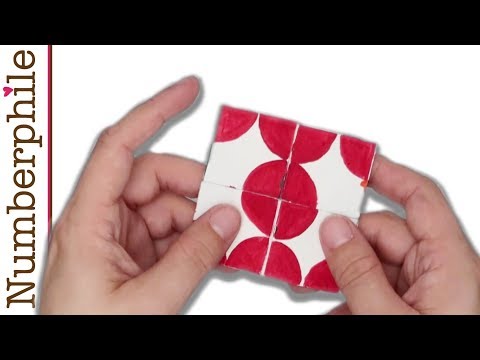 From a video about hexaflexagons (YouTube channel Numberphile, "The Forgotten Flexagon")
The conclusion first. His philosophy is not "write it simply." It is "use the fact that I don't understand it as the difficulty setting itself."
A philosophy BA, a magazine writer, and then January 1957
He was born on October 21, 1914, in Tulsa, Oklahoma. He graduated from the University of Chicago in 1936 with a degree in philosophy, served in the Navy during the Second World War, then moved to New York and became a magazine writer (MacTutor History of Mathematics biography ↗).
On his career he said: "The jobs I've had have been more or less accidental. I knew somebody who said there was an opening" (Cambridge blog part 2, 2008). His schooling stopped at the bachelor's level: "I didn't get any degree higher than bachelor's" (Notices of the AMS, 2005).
The turn came from magic. The material behind the article that seeded the column came from fellow magicians. He found hexaflexagons "from my magic contacts, believe it or not" (Notices of the AMS, 2005).
That became the hexaflexagon article. A hexaflexagon is a shape folded from a strip of paper; flex it and a different face appears. He says he travelled to Princeton to interview John Tukey, one of its co-inventors. The article ran in the December 1956 issue.
One question from the editor Gerard Piel created the column. "Is there enough similar material to this to make a regular feature?" (Notices of the AMS, 2005). In January 1957, "Mathematical Games" began. It ran until 1981.
"I'm strictly a journalist" — refusing the expert's chair
Read several interviews side by side and the argument narrows to one thing: never sit in the expert's chair. He said the same in 1998. "Although my interests are broad, they seldom get beyond elementary levels" (Skeptical Inquirer, "A Mind at Play," March 1998 ↗).
So what did he count as his strength? The answer is oddly concrete. "I consider that that was an advantage for the type of column I was doing for Scientific American, because I had to understand what I was writing about, and that enabled me to write in such a way that an average reader could understand" (Notices of the AMS, June 2005 interview ↗).
His autobiography goes further: "the biggest secret of my success as a columnist was that I didn't know much about math" (Undiluted Hocus-Pocus, 2013 / quoted by Gathering 4 Gardner ↗).
He also kept saying that writing was how he learned. "There is no better way to learn anything than to write about it!" (Skeptical Inquirer, 1998). For 25 years, it seems, he insisted on starting from where his readers stood.
Topology and magic keep coming back
His choice of material leans in a clear direction. One lean is topology — the study of properties that survive bending and stretching. "Topology fascinates me, because you are dealing with such basic properties" (Notices of the AMS, 2005).
The other is magic. "It's my major hobby. I've enjoyed knowing a lot of famous magicians" (Cambridge blog, 2008). And in his head the two are joined: "I particularly like magic tricks that are based on violating topological laws" (Notices of the AMS, 2005).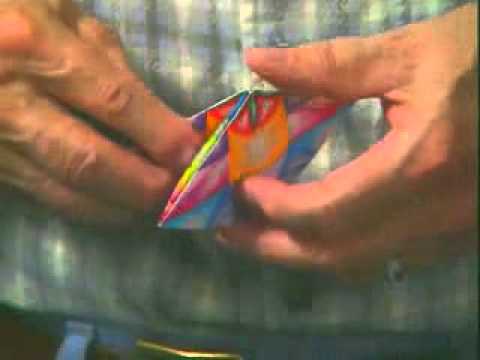 "Martin Gardner and Flexagons" (YouTube channel Jill Britton)
"Mathemagical mathematics combines the beauty of mathematical structure with the entertainment value of a trick" (autobiography / Gathering 4 Gardner). The hexaflexagon is exactly that. It is only folded paper, yet flexing it swaps the faces.
His working method was just as stubborn. "I subscribed to seven or eight math journals that had recreational material, and I would clip articles and file them in appropriate folders." And: "For every column I did there may be four or five folders containing research and notes that I took" (both Notices of the AMS, 2005).
No graduate degree, no specialty, and a career he called accidental
The setbacks he spoke about publicly are not dramatic. They are about what he never became. He barely attended graduate school. "I took a seminar from him under the GI bill after I got out of the Navy. It was not when I was an undergraduate. That was the only graduate course I ever took" (Notices of the AMS, 2005).
He never became a mathematician, and he said what he made of that. "Had I not developed a strong interest in philosophy when I was an undergraduate at the University of Chicago, I might have majored in mathematics, become a professional, and perhaps made some contributions to the field" (his words as quoted in the MacTutor biography ↗).
There is one area where he used the word regret outright: debunking pseudoscience. "In a way, I regret spending so much time debunking bad science. A lot of it is a waste of time" (Skeptical Inquirer, 1998).
That is not a light remark. His name is as widely attached to skepticism as to recreational mathematics — and he called much of that work a waste of his time.
Was not knowing a flaw or a tool?
Line up his statements and the same fact gets opposite verdicts. In 2005 he said: "My knowledge of math is at a very low level. I go up to calculus, and beyond that I don't understand any of the papers that are being written" (Notices of the AMS, 2005).
In the autobiography, that same ignorance had become "the biggest secret of my success." One man, one fact, described both as a defect and as an asset. I read that not as a slip but as a question he spent a life negotiating.
He gave his own example: the Game of Life. "One of my most popular columns was based on Conway's Game of Life." And then: "If I had known more about mathematics, I might not have thought that. But I approached it as a sort of a half-layman" (Notices of the AMS, 2005).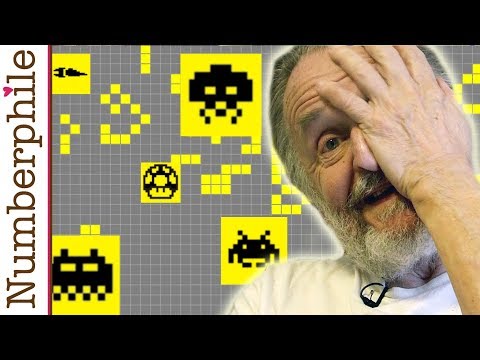 From a video in which the Game of Life's inventor John Conway speaks for himself (YouTube channel Numberphile, "Inventing Game of Life")
The other dilemma is faith against skepticism. One of the movement's best-known writers described himself this way: "I'm what in academic circles is called a 'philosophical theist'" (Cambridge blog part 2, 2008). The man who wrote that "bad science contributes to the steady dumbing down of our nation" (Skeptical Inquirer, 1998) went on believing in God. He chose to explain that pairing rather than hide it.
Carnap, magicians, and Lewis Carroll
The influences he acknowledged are clear. First, the philosopher Rudolf Carnap. "Carnap was a big influence on me. He convinced me that questions about metaphysics are meaningless since they cannot be answered empirically or by reason" (Cambridge blog, 2008). In 1998 he repeated it: "Carnap had a major influence on me."
Second, magicians. Magic was his hobby and also his intake pipe for material. The hexaflexagon that started the column reached him through magic friends.
Third, Lewis Carroll. He said his Annotated Alice "has sold over a million copies" (Cambridge blog, 2008). His reading began with his mother: "My mother read 'The Wizard of Oz' to me when I was a little boy, and I looked over her shoulder as she read it. I learned how to read that way" (his words as quoted in the MacTutor biography).
And one more influence is easy to forget: his readers and correspondents. "I was getting material from top mathematicians who were interested in recreational math" (Notices of the AMS, 2005). The column was not written alone; much of the job was choosing among what arrived.
Kizuki's reading — how I read him
From here on this is my reading. I read Gardner not as a man who made puzzles but as a man who designed difficulty.
The hardest part of puzzle design is not the puzzle. It is estimating where the solver will get stuck. Experts fail here constantly: once you understand something, you can no longer see what not understanding looks like. In Gardner's case, the estimating instrument was himself. He stopped at calculus, so he could see exactly what a reader who stops at calculus sees.
So when he said that not knowing much math was the secret of his success, I read it as a description of method, not modesty. He never tried to erase his own ignorance. He spent it, as a measuring device for standing on the reader's side. Keeping that instrument intact for 25 years may have been his single greatest skill.
Where to start with him
For a first book I would suggest The Annotated Alice. It is not a puzzle book, but his core habit — adding one line wherever a reader might stall — comes through most plainly in the form of annotation.
If you would rather use your hands, fold a hexaflexagon. Paper and scissors are enough to reproduce the column's first step with your own fingers.
On this site, one good route is through the puzzles his column pushed out into the world: pentominoes (1965), the Soma cube (1933), and the two puzzle makers he brought back into view, Henry Dudeney and Sam Loyd.
For neighbouring people, try Scott Kim, who called Gardner a hero of his, and Ernő Rubik, who kept insisting his cube was a discovery rather than an invention.
Sources
Primary sources used for this piece:
・Cambridge University Press blog, "The Martin Gardner Interview Part 2" (25 September 2008) ↗
・Skeptical Inquirer, "A Mind at Play: An Interview with Martin Gardner" (March 1998; interviewer: Kendrick Frazier) ↗ / full reprint: Medium version ↗
・Gathering 4 Gardner, "Who Was Martin Gardner?" (includes quotations from his autobiography) ↗
・Undiluted Hocus-Pocus: The Autobiography of Martin Gardner (Princeton University Press, 2013) ↗
Videos used as images in the text:
・Numberphile, "The Forgotten Flexagon" (YouTube) ↗
・Jill Britton, "Martin Gardner and Flexagons" (YouTube) ↗
・Numberphile, "Inventing Game of Life (John Conway)" (YouTube) ↗
Reactions (no login)
Anonymous • one of each per visitor per day
Learn — Curriculum
LearnPartie 8 Designers — The Philosophies Behind the WorkChapitre 19 Those of Subtraction and Touch6 / 11
関連シリーズ
The Designer's Philosophy第55回 / 全63回