TAG
#sokoban
1 篇评论 · 27 篇随笔
相关随笔
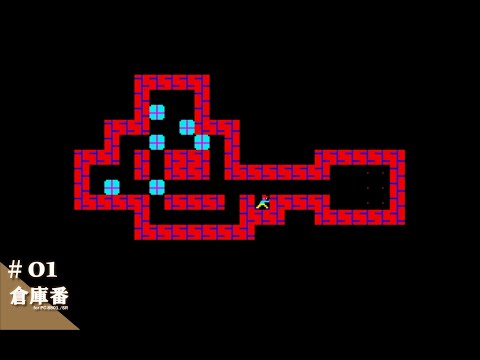
Sokoban, Level 1 — A one-wide corridor carries one box at a time
Level 1 of the “Original” Sokoban set (1982), dissected with board diagrams. Push but never pull, corners kill, side by side freezes, a one-wide corridor takes one box at a time. The traps in the very first push and the full 230-move solution of a level that teaches four rules without a word of text.
Baba Is You: The Board Game — In a Game Where Everything Is Rewritable, One Word Got Nailed Down
A two-player board game of Baba Is You launched on Kickstarter on 15 September 2026. The original was already a game about shoving word blocks around a floor, so moving it to cardboard needs almost no translation: the pushing and the grid movement both survive. But the moment it becomes a duel, the most radical word in the original stops being rewritable. That word is YOU. This is a look at what it means to drive one nail into a game that advertises itself as fully rewritable — written for people who design digital puzzles.
Soundtrack: Bonfire Peaks — the more you carry, the heavier it sounds; burn it, and it lifts
Bonfire Peaks is a Sokoban-style puzzle game where Corey Martin handled design, programming, and music himself. You carry your belongings up a cliff and burn them in a bonfire at the summit. Doremi reads the score he called "equal parts warm, pretty and unsettling" alongside the game's path from a 2018 jam about sacrifice to a story about nostalgia.
「从未教过它可解,却诞生了可解的谜题」——不靠求解器生成 Sokoban 的扩散模型
今天只有一篇。读了 2026 年 8 月 16 日发布在 arXiv 上的预印本《Solvable Sokoban Without a Solver via Diffusion》(Sina Baghal)。判断一个推箱子(Sokoban)盘面是否可解,这个问题本身是 PSPACE 完全的,以往的自动生成惯例是花费高昂代价运行求解器(实际尝试求解的程序)来验证。这篇论文报告的结果是:一个基于 Transformer 的离散扩散模型,在完全不给予「是否可解」标签、也不接触任何求解器的情况下,只学习「填补被遮盖的格子」这一件事,却让生成盘面中的 77.4% 直接可解,剩余部分中的 94.5% 也只需去掉一面墙就能变得可解。论文从生成顺序的自由度这一角度,解释了「可解」这一全局性质如何从局部的训练目标中自然溢出。
Siper et al.: Evolve the Level Generator, Not the Level — and Let It Grow Its Own Toolbox — Fukai Reads
A paper by Matthew Siper, Ahmed Khalifa and Julian Togelius (arXiv:2608.17947, accepted at IEEE Conference on Games 2026). Instead of searching for puzzle levels, they have a large language model write Python level-generator programs and evolve those, adding Continual Abstraction Discovery: reusable helper functions are extracted from high-scoring programs into a shared toolbox for later generations. Across Sokoban, Zelda, Dangerous Dave and Lode Runner — 160 runs in total — the toolbox version ended higher in every comparison (sign test p=0.008).
Eggerland (1985) — The Original One-Room Puzzle Where You Push Your Enemies as Eggs
In 1985, a modest puzzle game appeared for the MSX home computer: Eggerland Mystery. Shoot an enemy to turn it into a pushable egg, then collect hearts to open the treasure box — a design built from just a handful of verbs, contained entirely within one room. HAL Laboratory refined that grammar across a run of Famicom Disk System titles, and in 1989 it crossed the ocean as Adventures of Lolo. Sitting in the producer's chair for those two years was a young Satoru Iwata, years before he became Nintendo's president.
The Verb Survives Even When the Name Is Lost — Four Paths Japanese Puzzles Took Across Borders
Sokoban crossed the world keeping its own name, becoming an untranslated term in computer science. Panel de Pon lost its name but its chain-matching grammar survived. Kwirk changed its potato hero into a tomato. Professor Layton reversed the flow, importing a Western brainteaser tradition. Four cases on why a game's grammar and its name travel separately.
Puzzle Boy / Kwirk (1989) — The Day Atlus Walked a Potato Under Its Own Name
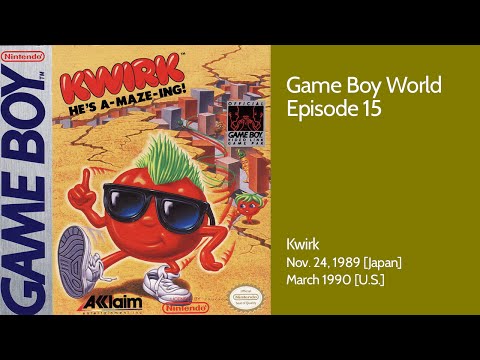
On November 24, 1989, Atlus released Puzzle Boy for the Game Boy, sold overseas as Kwirk. For a studio that had spent years working as an uncredited contractor for other publishers, this was the first game to carry its own name. A maze puzzle built from just three verbs — turn, push, fill — it quietly draws a line all the way to Catherine, the block-stacking puzzle the same company released in an entirely different form 22 years later.
Sokobond (2013) — A Rule Made Only of Bond Counts, Thirty-One Years After the Warehouse
On August 27, 2013, Alan Hazelden and Harry Lee released a small puzzle game called Sokobond. Its skeleton is 1982's Sokoban, unchanged, with exactly one constraint added: each element has a fixed number of bonds it can form. That modest mutation — an IndieCade 2013 finalist, an IGF Excellence in Audio honorable mention — turned Hazelden into a full-time puzzle designer. This piece traces how the push-rule carried through to A Monster's Expedition (2020), a decade later.
Mirror Isles / Skipping Stones to Lonely Homes (2014-2015) — How Two Free Jam Games Became Two Different Escape Islands, a Decade Later
In 2014 and 2015, London puzzle designer Alan Hazelden wrote two free PuzzleScript jam games, Mirror Isles and Skipping Stones to Lonely Homes. By his own account on his website, the former is the spiritual ancestor of his 2020 commercial release A Monster's Expedition, and both games are also credited as one inspiration and starting point for Jonathan Blow's new game Order of the Sinking Star, whose demo appeared in 2026. This piece traces, using only the developer's own words, how two weeks-long free experiments fed into two very different commercial puzzle games over more than a decade.
Wang et al.: Making a Puzzle Solver the Teacher for Every Single Move — Fukai Reads
A game-AI paper by Yu Wang and colleagues. Where long-horizon puzzles reward only the final win, they convert the drop in a solver's remaining-distance-to-goal into a per-move score and mix it into training. Averaged over Sokoban, Minesweeper and Rush Hour, success rises from 16.6% to 62.1%, and on unseen difficulty from 5.9% to 28.4%. Querying the solver costs about 73 parts per million of training wall clock.
Skipping Stones to Lonely Homes (2015) — Throwing Stones Across Islands, the Free PuzzleScript Game That Fathered Two Descendants
On 31 August 2015, London-based puzzle designer Alan Hazelden quietly published a free browser game on his own site: Skipping Stones to Lonely Homes. A Sokoban-lineage puzzle built on indirect action — throwing stones whose ripples move distant lilypads — it is, by Hazelden's own account, the prototype behind the 'spiritual successor' A Monster's Expedition (2020), and one of the starting points for Jonathan Blow's decade-in-the-making Order of the Sinking Star (2026). This piece traces how one free hobbyist game fed into two major descendants a decade later.
From the same skeleton to a different puzzle: the Thinky Collective's “inherit just one thing” design experiment
One piece today. I read, in the original English, a Thinky Games article (by Corey Hardt, published July 24, 2026) from the edited puzzle-focused outlet. It covers how the Thinky Collective — a loose community of puzzle gamedevs — built the browser game The Snake That Eats Puzzle Game Mechanics. Normally they pass a single large PuzzleScript project around, each adding levels, art, or refinements. This time the method changed: each dev received just one piece of the previous person's game and had to make a miniature, single-level game from that shared element. The result is that adjacent games might share sprites while their mechanics have swapped, or keep the same level shape while a new look and context turn the puzzle into something else entirely. A constraint produced divergence, and a dozen-plus one-screen games were strung together. As an aspiring designer, I carried this home as a design template I want to try.
Halina & Guzdial: Generating Levels as a "Cake of Time" — Fukai Reads
A procedural level-generation paper by Halina and Guzdial. It represents a level as a "cake" of board states stacked over time, and generates a level and its solution together with PRP, which recombines play traces. In Sokoban, against six existing methods, it reached 100% playability with high diversity, without hand-authored constraints or rewards.
PuzzleScript(2013)——一行规则,量产了全世界的「推箱子游戏」
2013年10月,Stephen Lavelle(increpare)免费公开了浏览器解谜引擎 PuzzleScript。这个只需一行规则就能做出仓库番类谜题的工具,经由 Alan Hazelden 的早期作品,孕育出《A Good Snowman Is Hard to Build》,又经过 Hempuli 本人所说的“推箱子谜题复兴”,一路连到了《Baba Is You》的土壤。本文核实这条系谱。
同一道命题诞生两款不同的游戏——Alan Hazelden 谈「收敛的构想与分岔的设计」
今天只有一篇。我读了专注于解谜的编辑媒体 Thinky Games 每月连载专栏「Thinky Third Thursday」的2026年7月号(作者是 Draknek & Friends 主理人 Alan Hazelden,2026年7月17日发布,英文原文)。我把重心放在 Alan 本人在该期中写下的一段话上。从 Dom Camus 主办的 Thinky Puzzle Game Jam 6(题目为「Locked Room」,投稿超过80款)中,他把自己团队的作品《All the Gold in Fort Locks》与 ELAiNE 的《Every Door a Portal》并列介绍。两款作品几乎共享同一个构想——「用哪把钥匙开门,门后的现实就会被改写」——却因钥匙的处理方式(在盘面上推动,还是放进背包携带)以及关卡结构(单一相互连通的挑战,还是11个独立关卡)这几点判断的不同,而变成了截然相反的体验。Alan 将其评价为「一个绝佳的例子,说明相似的游戏构想能够多快地分岔成截然不同的体验」。构想可以共享,但设计判断才是分出体验的关键。作为一名有志于设计的人,我认为这段话是今天最值得带走的收获。
好谜题"想被解开"——Tom Hermans 以 Sokoban 讲述的三层:呈现、简洁、抱负
今天一篇。我以英文原文通读了解谜开发者 Tom Hermans(Auroriax)发表在 Game Developer(旧 Gamasutra)上的特稿博客《How to make a good puzzle - An explorable explanation(如何做出好谜题——可玩的解说)》。虽是 2018 年的文章,却是经久的入门经典:借助可实际游玩的 Sokoban 关卡,从呈现(Presentation)、简洁(Elegancy)、抱负(Aspiration)三层讲述何为好谜题。好谜题应当"想被解开";用最小的空间与步数搭建;理解可能性空间;每一关都教玩家新东西;并以独创的核心机制与神秘世界给予动机。作为被编辑媒体收录的实务者一手设计论,符合本汇总的可信度门槛。稍旧,故标注日期处理。
让逻辑谜题更快破解的思路 — Sokoban-like 系的诀窍
自1982年今林宏行发布《仓库番》以来,这种只是把货物推到指定位置的Sokoban-like谜题已经被玩了40多年。规则如此简单,为何还是会卡手?本文像挖掘时代地层一样,整理出卡关时应重新审视的4个视角(死锁的形状、逆向推算、暂存、推动顺序)。
Bazzaz 等人:「只是认为是 AI 制作」就会改变体验——Fukai 精读
Bazzaz 与 Cooper 的 CHI '26 论文,探讨生成内容的知觉偏见。让 142 人在 Super Mario Bros. 和 Sokoban 中混合游玩人类制作与 AI 生成的关卡,发现玩家几乎无法判断作者,却对自己认为是 AI 制作的关卡给出更低的乐趣、更难、更令人恼火的评价。
Patrick Traynor 的设计哲学——将设计视为发现而非发明
通过 Patrick Traynor 本人的访谈与 GDC 2024 演讲,考察这位独自完成《Patrick's Parabox》的制作者。他将递归称为「宇宙角落里的真实」,将自己定位为发现者而非发明者;本文聚焦其设计思想、对「可接触性」的执着、难度曲线与规则制定上的失败与突破,以及发现者的伦理。
Void Stranger 原声带——在单色迷宫中回响的、贫乏音源的交响
单色 Sokoban 迷宫 Void Stranger 的音乐,仅凭普通 MIDI 音源与芯片波形,使庄严与不安共存。作曲者 Eero Lahtinen 将「解不开时反复听同一首曲子也不会厌倦」作为设计的主轴。Doremi 从创作视角解读在反复中不磨损的音效制作,以及贴合思考节奏的持续音。
Monti et al.: Measuring AI's Planning Power on a Single-Corridor Sokoban — Fukai Reads
A paper by Monti and colleagues on SokoBench, a benchmark that measures reasoning models' long-horizon planning with Sokoban. By lining up only single-box straight corridors and narrowing difficulty to a single axis (corridor length), it shows that even state-of-the-art reasoning models break down once more than 25-30 moves of lookahead are needed. The authors locate the cause in accumulated miscounting.
「能解」与「有趣」分道之处——PuzzleJAX 让机器去解 500 多款 PuzzleScript 游戏(arXiv,2025年8月)
今日一篇:论文「PuzzleJAX: A Benchmark for Reasoning and Learning」(arXiv 预印本,2025年8月),作者为 NYU、马耳他大学、金山大学(南非)与微软的研究者(Sam Earle、Graham Todd、Ahmed Khalifa、Julian Togelius 等)。他们将 Stephen Lavelle(increpare)于2013年发布的解谜制作语言 PuzzleScript 在 GPU 上重新实现,把全球作者所写的 500 多款游戏交给树搜索、强化学习与大语言模型去解。以设计者视角阅读,核心只有一点:「机器能否解开」与「对人是否有趣」是两回事。
AI 能从头造出一整款解谜游戏吗 —— 把「生成、试玩、修复」跑起来的 ScriptDoctor
让大语言模型(LLM)把一款解谜游戏——连同规则、图像、关卡——整个写出来,再交给编译器与搜索代理检查、要求重做:本文介绍这样一套自动游戏设计的实验系统 ScriptDoctor。题材是个人开发者熟悉的 PuzzleScript。按问题、方法、发现、用处、局限的顺序,读解为何展示人类制作的实例会大幅提高成功率、为何推理模型更占优,以及横亘在「可解」与「有趣」之间的距离。
SSR 证明的"最少规则、最大深度",以及视点成为解法之时
今天两篇。Thinky Games 2026年4月21日发布的发行10周年特集——被谜题开发者们誉为"完美设计"的 Stephen's Sausage Roll 催生"sausage-like"这一新类型词的极限简约主义。以及 Thinky Third Thursday 2026年4月号(Alan Hazelden,4月16日)介绍的《A Little Perspective》——"视角转换"这一点让不可能变为可能的设计论,以及沿同一轴线构建中的新作《He Who Watches》。
Tsumiki 设计讨论摘要 — 2026年6月5日
今日一篇。2026 年 6 月 1 日,Thinky Games 在骄傲月企划中刊出了对《Blobun》游戏导演 Ashe 的访谈。机制始于一个角色逆转的问题:如果玩家自己就是方块呢?结构原则被直接陈述:每个世界引入 2-3 个谜题元素,分别深化,再相互组合,最终世界 Victory Road 是考验所有元素的综合终章。团队还制作了免费 PICO-8 简化版,验证核心机制脱离了高完成度画面后仍然成立。
仓库番(1982) — 元谜题 44 年前的原型
1982 年,Thinking Rabbit 的今林宏行发布了仓库番。仅靠「走」与「推」两个动词成立的这部作品,为何会成为 44 年后 Baba Is You 与 Patrick's Parabox 的祖先——从时代脉络重读。