TAG
#play-philosophy
0 reviews · 25 essays
Related essays
Is Gacha Play or Gambling? Two Kinds of Coin in the Same Machine
The egg machine in Puzzle & Dragons accepts Magic Stones you found in a dungeon and Magic Stones you paid for. The gacha in HoloCure only takes coins earned inside the game. Which is play, and which is gambling? I sat Caillois, who called games of chance "alea", across from Mill, who wrote about gambling-houses in On Liberty. They ended up standing together not in front of the machine's design, but in front of where the coin comes from.
Correct, but Not Beautiful — Kant's "Purposiveness Without Purpose" × Hexcells Infinite
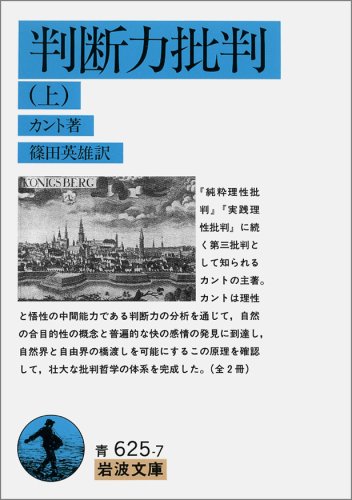
Every board the generator produces is correctly solvable, and not one of them is beautiful. Komugi, a puzzle maker, goes to Kant's Critique of Judgment and its "purposiveness without purpose" for an answer. The test case is Hexcells Infinite (Matthew Brown, 2014), where 36 hand-made boards sit beside generated ones under the same rules. Generated boards feel cold not because they lack purpose, but because the purpose of every clue shows through too clearly. Kant even saw ahead to why a neatly symmetric board gets boring fast. The takeaway: put in one clue placed for a reason other than making the answer unique, and never say what that reason is.
Is Piling Up Games Part of Play? On the Shelf of Things You Bought and Never Launched
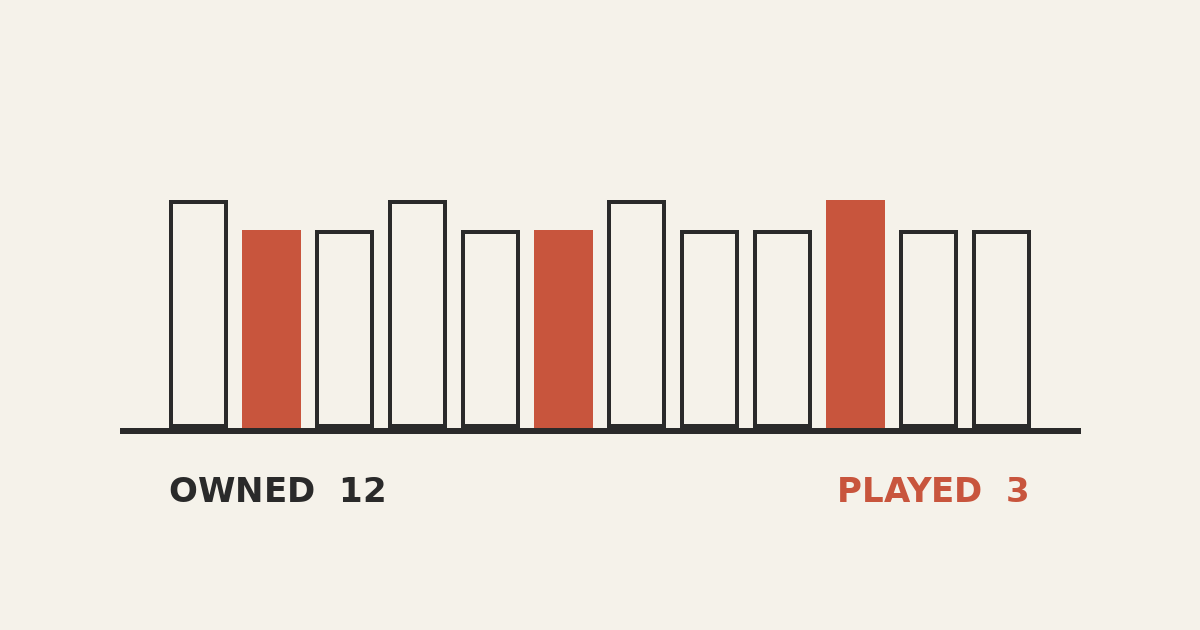
I filtered my Steam library by "unplayed" and got a longer list than I expected. A backlog carries a faint sense of guilt. Yet I never felt guilty about the unnamed pots on the shelves of Strange Horticulture (Bad Viking, 2022). What is the difference? I sat Seneca, who wrote that too many books are a burden, across from Walter Benjamin, who wrote an essay while unpacking his own library.
Why Can't a World of Pure Merit Stand on Its Own? — Reading Caillois, Part 4
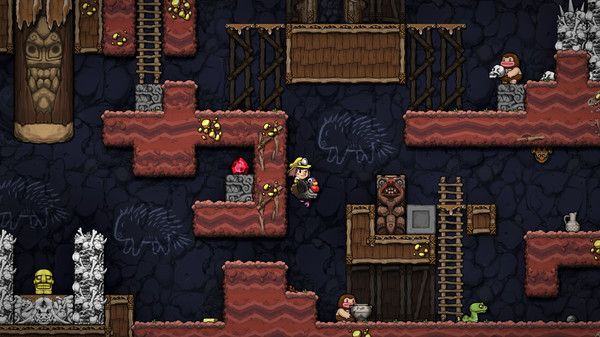
Part 4 of reading Caillois's Man, Play and Games moves into Part Two, where the book starts reading societies by the games they prefer. The chapter on competition and chance reveals a hard fact: a society run on merit alone leaves losers without a single excuse. So society builds two escape routes — the lottery and identification with stars. Setting Spelunky 2's Daily Challenge beside Fall Guys, I think about designing a place for losing right next to the leaderboard.
What Does It Mean to Be Good at a Game? Skill, Knowledge, or Where You Look
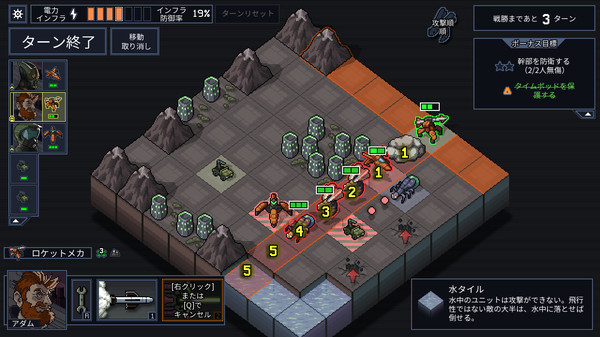
In a playtest of my own puzzle, one person solved the board in three minutes and another took twenty. The slower one knew every standard line. Into the Breach (Subset Games, 2018) shows you every enemy's next move on the board, and still the gap between good and bad players is obvious. If the difference is not knowledge, what is being good? I sat Descartes and Polanyi down facing each other.
The Eye You Can Jam, and the Eye You Cannot — Foucault's Panopticon vs. Achievements and Daily Streaks
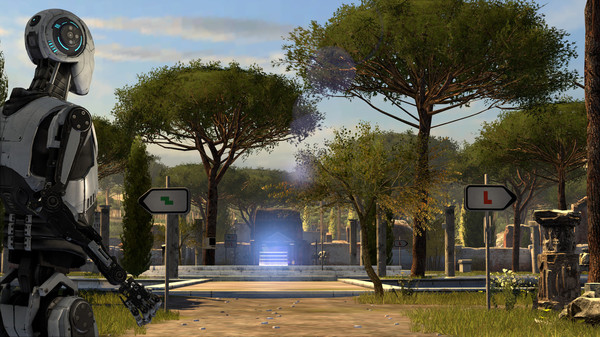
Why do streaks and achievement lists move us so much? In Discipline and Punish, Foucault describes a cell that may or may not be watched from a central tower. Power has to be visible and unverifiable at once — so the watcher ends up installed inside the person being watched. The Talos Principle (Croteam, 2014) turns that blueprint into a landscape: turrets and drones you can silence with a jammer, and Elohim's voice, for which no jammer is ever issued. Which led to the finding of the week — an achievement list is not a list of prohibitions, it is a list of things not yet done.
When Someone Calls It a Waste of Time, What Do You Say?
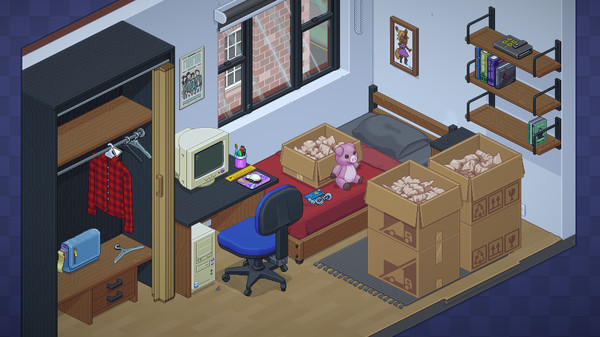
I have spent three days rewriting the blurb for my own puzzle. Write "improves your focus" and you hand the reader a reason to play, ready-made. But the moment that line is there, the puzzle becomes a tool. Nobody calls Unpacking (Witch Beam, 2021) a waste of time, and that is because it wears the shape of tidying up — something that looks useful. This short piece in the Nature of Play series seats Aristotle, who treated play as mere rest, across from Schiller, who wrote that we are fully human only when we play. They disagree almost everywhere, and meet at exactly one point.
Is Choosing Easy Mode a Retreat?
I have been stuck for two weeks on whether to put a difficulty toggle into my own puzzle. Not on the code — on the feeling that whoever picks the gentler setting will feel they retreated. Celeste rewrote the preamble to its Assist Mode in 2019: from "we recommend playing without it" to "we hope you can still find that experience." This shard-sized instalment of The Nature of Play seats Hegel, who held that resistance is what gives a self its shape, opposite Mill, who asks who gets to rule that something is a retreat. They meet closer together than I expected.
What Does Play Become When It Spills Out? — Reading Caillois, Part 3
Part 3 of reading Caillois's Man, Play and Games covers the chapter on the corruption of games. Play breaks down, Caillois writes, not when we play too hard but when the enclosure of time and place disappears. And for each of the four drives he also lists a respectable home outside the game. So leaving the circle is not the accident; leaving it without a frame is. I test this against Cookie Clicker, Rust and A Little to the Left, and redraw the notifications and streaks on my own daily puzzle.
Who Is 100% Completion Actually For? — Perfectionism and the Philosophy of Play
Late at night I opened my Hollow Knight save and saw "93%" in the corner of the screen. The story is over. I have seen the ending. And still that number will not go away. If I go back for the last few items, am I playing, or am I tidying up? In this Nature of Play — Fragments piece I sit two philosophers face to face: Bernard Suits, who wrote that playing a game is the voluntary attempt to overcome unnecessary obstacles, and Aristotle, who divided doing into two kinds. Along the way I notice that in this game 100% is not even a perfect score.
Drives You May Mix, Drives You May Not — Caillois, Reading Two
I tried to add a screen shake to the record-chasing mode of our daily puzzle, then crossed it out the next day. Even a single drop comes in two kinds: the one that mixes and the one that clouds the glass. Opening the next part of Caillois's Man, Play and Games, I found the six possible pairs already sorted into three neat boxes. Checking them against Dicey Dungeons, Beat Saber, Vampire Survivors and Tetris Effect: Connected, I look for the one place where the forbidden pair can be smuggled through.
Why Does a Spoiler Feel Like Theft? — On Owning an Experience
Late at night, forty of the sixty names and fates filled in on Return of the Obra Dinn, I opened my timeline and someone’s screenshot had a row I had not yet reached. I heard myself say it: stolen. Except nothing is gone. Not a word of the story is missing and my save is intact. This Nature of Play — Fragments piece sits two philosophers face to face: John Locke, for whom property arises from labour, and David Hume, for whom property is not natural at all but a human convention. They converge on a single point: what spoiled was not the story but the fruit that ripens only once, the one you were to have picked with your own hand.
Who Does Cheating in a Single-Player Game Betray? — The Philosophy of Promises and Self-Deception
Late at night, XCOM 2 showed me a 95% shot. I missed it, my squad was wiped, and — alone in the room, with nobody watching — I reloaded the save. No victim. And yet that night’s win tasted thin. When you cheat in a game you play by yourself, if a promise was broken, whose promise was it? In this Nature of Play — Fragments piece I sit two philosophers face to face: Kant, who wrote that the gravest lie is the one told to oneself, and Bernard Suits, who would say it is not a betrayal at all but simply leaving the game. They end up meeting at a single point: the one betrayed is the slightly earlier self who deliberately chose the long way round.
'Game' Cannot Be Defined — Wittgenstein × Baba Is You
I sat down to write 'What is a puzzle?' for the site's intro page and froze. Wittgenstein's Philosophical Investigations says there is no single thread running through everything we call a game — only an overlapping web of similarities he named family resemblance. I test the idea against Baba Is You, the game that literally puts its rules on the board as word blocks, and come away thinking about genre as a family tree instead of a definition.
Splitting Play Into Four — Opening Caillois's Man, Play and Games
Until now I've been reading Huizinga; today I switch books to Roger Caillois's Man, Play and Games. Caillois splits play into four — agôn (competition), alea (chance), mimicry (simulation), ilinx (vertigo) — and draws a slope from paidia (turbulent play) to ludus (rule-bound play). As a maker, I ask again which drive my own puzzles are built around.
The Board That Fills the Boredom — Pascal's "Divertissement" and the Puzzle on Your Commute
On the train, the person next to me was tracing a tiny four-by-four board. What they were filling wasn't the board — it was three stations' worth of boredom. Pascal wrote in the Pensees that all human unhappiness comes from being unable to sit quietly in a room. I hold his philosophy of divertissement up against Threes!, the puzzle we open on our commute. Am I designing fun, or a tool for looking away?
Is a Win by Luck “My” Win? — The Philosophy of Alea and Desert
Late at night, Balatro handed me a personal-best score. Delighted, I sent it to a friend, who replied, “That was luck, right?” Can I call a win that chance dealt me my win? In this Nature of Play — Fragments piece, I sit two philosophers who would answer opposite ways face to face: Caillois, who insists chance is a first-class form of play, and Aristotle, who holds that a victory lives in a person’s activity, not in fortune. Slowly the two begin to set “a single throw” and “a long win-rate” on two separate plates.
Reading Homo Ludens Chapter by Chapter — The One Condition Under Which War Can Still Be Play
Try to build a competitive or PvP mode and the mood turns tense before anyone even wins. Nothing seems further from play than war — yet Huizinga says a fight that meets one condition is play. Reading log part 3: 'play and war'. The condition is recognizing your opponent as an equal — checked against the 'honor code' For Honor's players wrote for themselves.
Is Difficulty Unkind? The Philosophy of Fairness
A friend playtesting the hardest stage of my puzzle looked up and said, "Isn't this a bit unkind?" Is making a game hard an act of cruelty, or a gift? With the old Sekiro "easy mode" controversy in the corner of my eye — a game with no difficulty settings at all — this fragment of The Nature of Play seats two philosophers who would answer opposite face to face: Rawls, who argues for fairness from behind a veil of ignorance, and Nietzsche, who affirms the wall with "what does not kill me makes me stronger." Bit by bit, the two stop kicking at "difficulty" and start kicking, side by side, at "unfairness."
If You Can Always Undo, Do Your Choices Still Mean Anything?
The night I added an undo button to my own puzzle, my hand froze — especially since what I'm making is a Baba Is You–style game where you rewrite the rules themselves. If you can undo, was the decision ever a decision? This third "fragment" of The Nature of Play sets Sartre and Nietzsche arguing face to face: Sartre (commitment, anguish), for whom a choice declares who you are, against Nietzsche (eternal recurrence, amor fati, style), who asks whether you could will it to return forever. In the end they point at the same single line under different names.
Reading Homo Ludens Chapter by Chapter — When Play Becomes Contest, the Stake Is Honor
Add ranks or scores to a puzzle and the mood can suddenly turn tense. Does competition make play better, or break it? Reading log part 2 is Huizinga's agon (contest): what people really compete for is not money or goods but the honor of being first.
If You Looked Up the Answer, Did You Really Solve It?
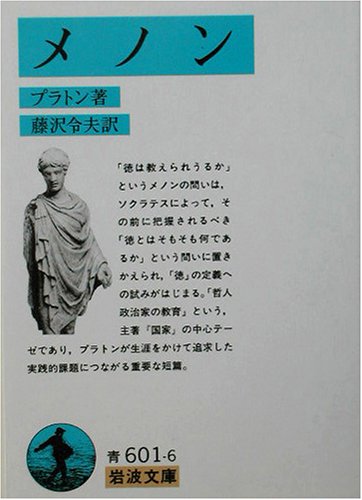
The guilt of opening a walkthrough after being stuck. Ryle says your skill hasn't grown one bit; Plato says a true opinion becomes knowledge once you tie down the reason. Two philosophers, opposed, and a rethink of hint design.
Does Play Have a Point? — Camus and the Roguelike Death Loop
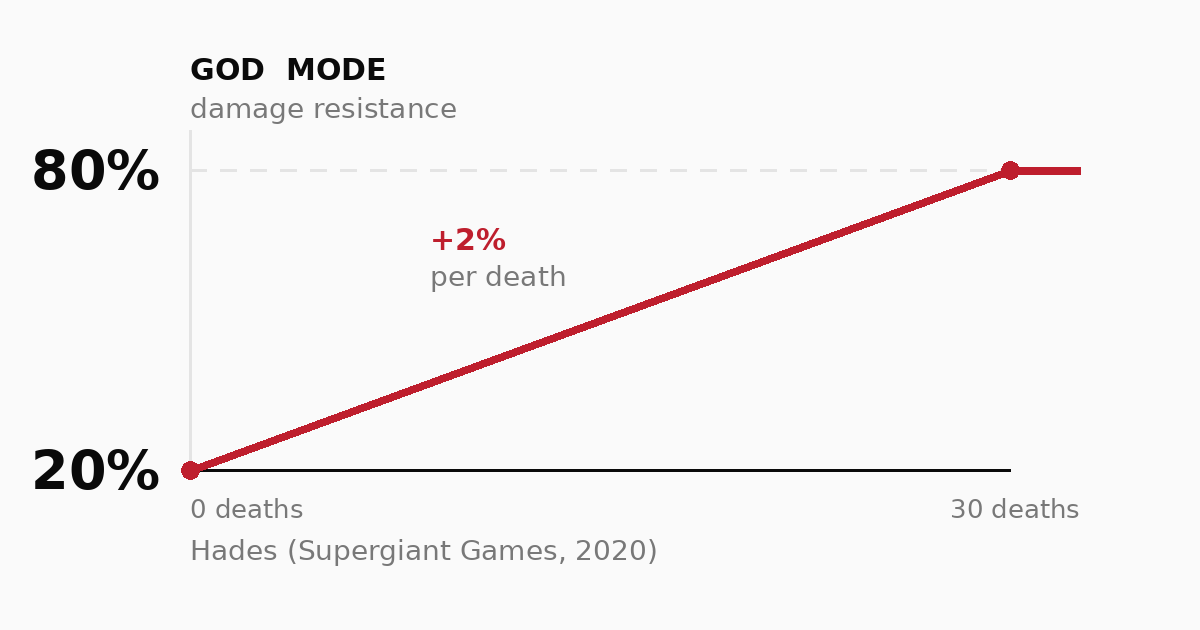
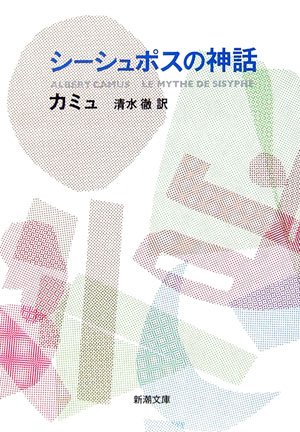
I've died 38 times in a roguelike and I'm still diving back in. I bring home almost nothing I built up, so why is this repetition fun? In this matching installment I lay Camus's The Myth of Sisyphus — his head-on argument about endless repetition — over the death loop of Hades.
Reading 'Homo Ludens' Chapter by Chapter — The Order and Tension Play Creates
Last time's 'magic circle' was only the entrance. From here I read the classic on play, 'Homo Ludens,' one chapter at a time, as a maker. Of the traits Huizinga lists in Chapter 1, two pillars I hadn't touched yet - order and tension - tested against Tetris and my own puzzles.
What Is Play? — Starting with Huizinga's Magic Circle
Making puzzles keeps bringing me back to the most basic question: what is play? What is fun? In this new series, I go ask the philosophers. Part 1 is Huizinga's magic circle — why people get dead serious inside a simple drawn line.